
太阳中微子偏差

Search documents
【人民日报】捕捉“幽灵粒子”的中国突破
Ren Min Ri Bao· 2025-12-01 03:29
Core Insights - The Jiangmen Neutrino Experiment (JUNO) has successfully completed its construction and released its first physical results, marking a significant advancement in neutrino research in China [4][9] - The experiment aims to explore the properties of neutrinos, particularly their mass ordering, which is crucial for understanding the universe's evolution and the mystery of matter-antimatter asymmetry [5][6] Summary by Sections Experiment Overview - JUNO is a next-generation neutrino experiment designed to investigate "ghost particles" known as neutrinos, which play a vital role in explaining cosmic evolution [4] - The experiment's first results include measurements of the solar neutrino oscillation parameters, achieving a precision increase of 1.5 to 1.8 times compared to previous experiments [4] Scientific Significance - Neutrinos constitute about one-fourth of the 12 fundamental particles that make up the material world, yet they are among the least understood due to their weak interaction with matter [5] - The study of neutrino oscillation and CP violation may provide insights into why there is more matter than antimatter in the universe, addressing a significant mystery in cosmology [5][6] Historical Context - The success of JUNO builds on years of research, particularly the Daya Bay Neutrino Experiment, which laid the groundwork for current neutrino studies in China [7][8] - The Daya Bay experiment, which began in 2006, was pivotal in measuring the mixing parameter θ13 and demonstrated the feasibility of further neutrino research [8] Technical Aspects - JUNO's detector is located 700 meters underground in Jiangmen, Guangdong, featuring a 35.4-meter diameter acrylic sphere filled with 20,000 tons of liquid scintillator, making it 20 times larger than similar international facilities [9][10] - The experiment has overcome significant technical challenges, including the development of a high-purity liquid scintillator and advanced photomultiplier tubes for detecting faint neutrino signals [9][10] Future Prospects - The JUNO facility is designed for a lifespan of 30 years, with plans to expand its research scope beyond mass ordering to include studies of solar and terrestrial neutrinos [10] - The project involves over 700 researchers from 17 countries and is expected to yield significant scientific breakthroughs and train the next generation of physicists [10]

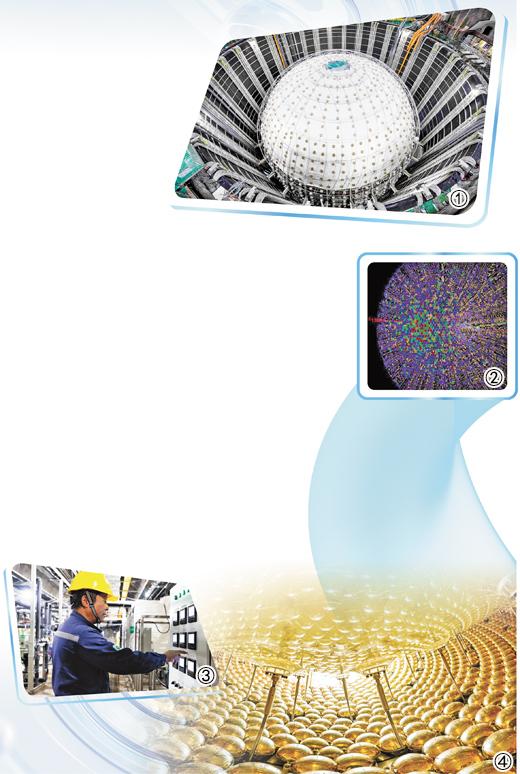
捕捉“幽灵粒子”的中国突破(院士讲科普)
Ren Min Ri Bao· 2025-11-28 22:00
Core Insights - The Jiangmen Underground Neutrino Observatory (JUNO) has successfully completed its construction and released its first scientific results, marking a significant advancement in neutrino research [3][4][6] - The experiment aims to explore the properties of neutrinos, particularly their mass hierarchy, which is crucial for understanding the universe's evolution and the mystery of matter-antimatter asymmetry [4][5][8] Summary by Sections Experiment Overview - JUNO is a next-generation neutrino experiment designed to study "ghost particles" known as neutrinos, which are fundamental to understanding cosmic evolution [3][4] - The facility is located 700 meters underground in Jiangmen, Guangdong, and features a large detector with a diameter of 35.4 meters, containing 20,000 tons of liquid scintillator, making it 20 times larger than similar international facilities [8][9] Scientific Achievements - The first physical results from JUNO, reported after analyzing 59 days of effective data, have improved the measurement precision of the solar neutrino oscillation parameters by 1.5 to 1.8 times compared to previous experiments [3][6] - The experiment confirmed the "solar neutrino anomaly," suggesting the existence of new physics beyond current understanding [3][4] Historical Context - The success of JUNO builds on the foundation laid by the Daya Bay Neutrino Experiment, which was pivotal in measuring the mixing parameter θ13 and achieving the highest precision in neutrino measurements before JUNO [6][7] - The Daya Bay experiment, initiated in 2006, led to significant breakthroughs in neutrino oscillation studies, paving the way for the current JUNO project [6][7] Future Prospects - JUNO's design life is projected to be 30 years, with expectations to expand its research scope beyond mass hierarchy to include solar and terrestrial neutrinos, and potentially detect neutrinos from supernovae [9] - The project involves over 700 researchers from 17 countries and aims to produce significant scientific breakthroughs and train the next generation of physicists [9]
十年磨一剑!江门中微子大科学装置用“中国精度”重新审视宇宙法则
Yang Shi Wang· 2025-11-19 07:20
Core Insights - The Jiangmen Neutrino Experiment has released its first major scientific results, confirming the existence of the "solar neutrino anomaly" with improved measurement precision of 1.5 to 1.8 times compared to previous international experiments [1][8] - The experiment, located 700 meters underground, aims to unravel the mysteries of neutrinos, which are fundamental particles that can easily pass through matter, including the Earth [3][4] Group 1: Experiment Overview - The Jiangmen Neutrino Experiment is a significant scientific facility that has been operational for only two months and has already made a notable breakthrough [3] - The experiment utilizes a 20,000-ton liquid scintillator and 45,000 high-precision detectors to accurately record neutrino identity changes from a nuclear power plant located 53 kilometers away [6] Group 2: Scientific Significance - The successful identification of neutrino transformation parameters provides a new tool for understanding solar neutrinos, potentially leading to insights about the internal structure of the Sun and the existence of unknown particles [8][10] - The findings suggest that there may be inconsistencies in the understanding of neutrino behavior from solar and nuclear sources, indicating either gaps in knowledge about the Sun or deeper secrets of neutrinos themselves [4][8]
中国江门中微子实验发布首个成果 高精度证实暗示新物理的偏差
Zhong Guo Xin Wen Wang· 2025-11-19 06:43
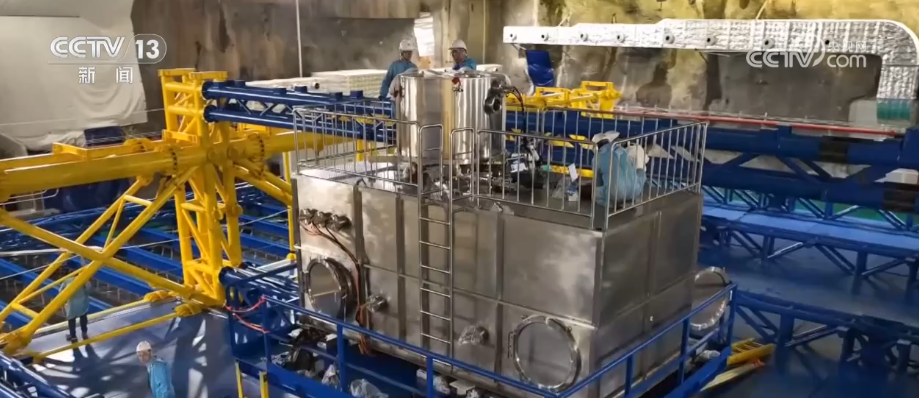
Core Insights - The Jiangmen Neutrino Experiment has successfully constructed its facility and released its first physical results, confirming the "solar neutrino anomaly" with high precision, suggesting potential new physics beyond the standard model [1][3]. Group 1: Experiment Overview - The Jiangmen Neutrino Experiment, located 700 meters underground, has captured over 2,300 neutrinos from August 26 to November 2, 2025, achieving a measurement precision of the "solar neutrino oscillation parameters" that is 1.5 to 1.8 times better than previous experiments [3][5]. - The experiment aims to resolve the inconsistency in the measurement of mass-squared differences between solar and reactor neutrinos, known as the "solar neutrino anomaly," which indicates the possibility of new physics [3][5]. Group 2: Technical Achievements - After over a decade of design and construction, the Jiangmen Neutrino Experiment has become the world's first next-generation large-scale, high-precision neutrino experiment, with key performance indicators meeting or exceeding design expectations [5][6]. - The core detector, a liquid scintillator with an effective mass of 20,000 tons, is housed in a 44-meter deep water pool, featuring a 41.1-meter diameter stainless steel support structure and various critical components, including 20-inch and 3-inch photomultiplier tubes [6]. Group 3: Historical Context - The concept for the Jiangmen Neutrino Experiment was proposed by the Institute of High Energy Physics in 2008, receiving support from the Chinese Academy of Sciences and the Guangdong provincial government in 2013, with international collaboration beginning in 2014 [5][6]. - The construction of the underground laboratory was completed in December 2021, with detector installation starting thereafter, and the experiment is set to officially begin data collection in August 2025 [5].
【中国新闻网】中国江门中微子实验发布首个成果 高精度证实暗示新物理的偏差
Zhong Guo Xin Wen Wang· 2025-11-19 06:03
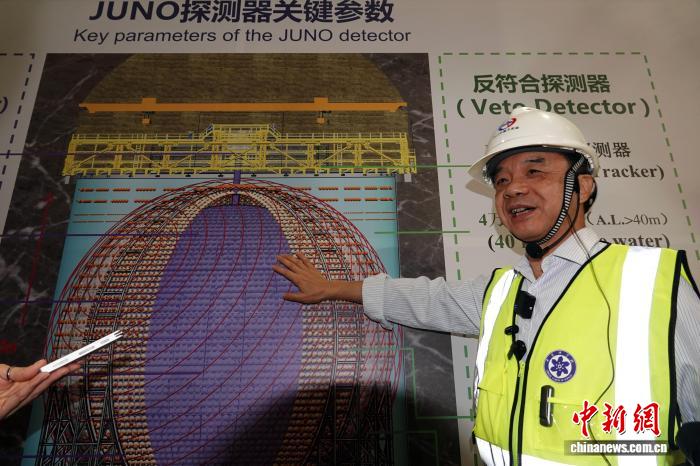
Core Insights - The Jiangmen Neutrino Experiment (JUNO) has successfully constructed its experimental facility and announced its first physical results, confirming the "solar neutrino anomaly" with the highest precision to date, suggesting potential new physics beyond the standard model [2][3] Group 1: Experimental Achievements - The experiment, located 700 meters underground, captured over 2,300 neutrinos between August 26 and November 2, 2025, achieving a measurement precision of the solar neutrino oscillation parameters that is 1.5 to 1.8 times better than previous experiments [2] - The experiment's detector performance indicators have met or exceeded design expectations, indicating readiness for cutting-edge neutrino physics research [3] Group 2: Historical Context and Development - The concept for the Jiangmen Neutrino Experiment was proposed by the Institute of High Energy Physics in 2008, receiving support from the Chinese Academy of Sciences and the Guangdong provincial government in 2013 [3] - The construction of the underground laboratory began in 2015, with the completion of the laboratory and installation of the detector achieved by December 2021, and the detector construction expected to be completed by December 2024 [3] Group 3: Technical Specifications - The core detector consists of a 20,000-ton liquid scintillator, housed in a 41.1-meter diameter stainless steel shell, with a central water pool 44 meters deep [3][5] - The detection system includes 20,000 20-inch photomultiplier tubes and 25,000 3-inch photomultiplier tubes, contributing to its high sensitivity [5]
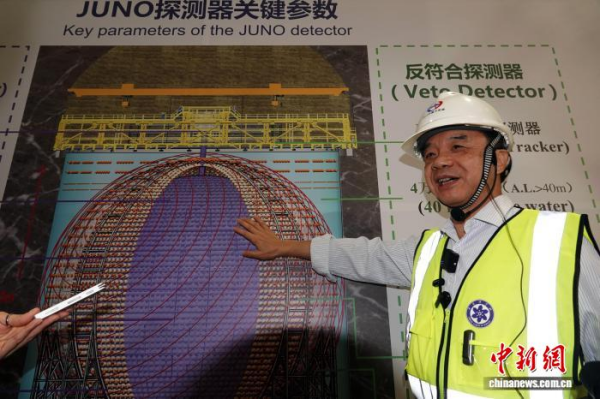
“幽灵粒子”探测精度世界第一!江门中微子实验重大成果发布
Nan Fang Du Shi Bao· 2025-11-19 04:40
Core Insights - The Jiangmen Underground Neutrino Observatory (JUNO) has successfully completed its construction and announced its first scientific results, measuring solar neutrino oscillation parameters with an accuracy improved by 1.5 to 1.8 times compared to previous experiments [1][4][6]. Group 1: Project Overview - JUNO is the first large-scale, high-precision neutrino experiment of its kind, designed to detect elusive neutrinos, often referred to as "ghost particles" [1][3]. - The project is a significant international collaboration involving over 700 researchers from 75 institutions across 17 countries and regions [8][11]. - The observatory is set to officially begin data collection on August 26, 2025, after a series of construction and installation phases that began in 2008 [11]. Group 2: Scientific Achievements - The first physical results from JUNO were derived from data collected over 59 days, confirming the solar neutrino oscillation parameters and addressing the previously noted "solar neutrino anomaly" [6][9]. - The experiment's design allows for simultaneous measurement of both solar and reactor neutrinos, which could provide insights into new physics beyond the current particle physics framework [6][11]. - The core detector, with an effective mass of 20,000 tons, is designed to achieve unprecedented sensitivity in neutrino detection, focusing on neutrino mass ordering and oscillation parameters [11]. Group 3: Future Prospects - JUNO is expected to produce significant scientific results over the next few decades and contribute to the training of a new generation of physicists [11]. - The facility has a design lifespan of 30 years and can be upgraded to become the world's most sensitive experiment for neutrinoless double beta decay, potentially probing the absolute mass of neutrinos [11].
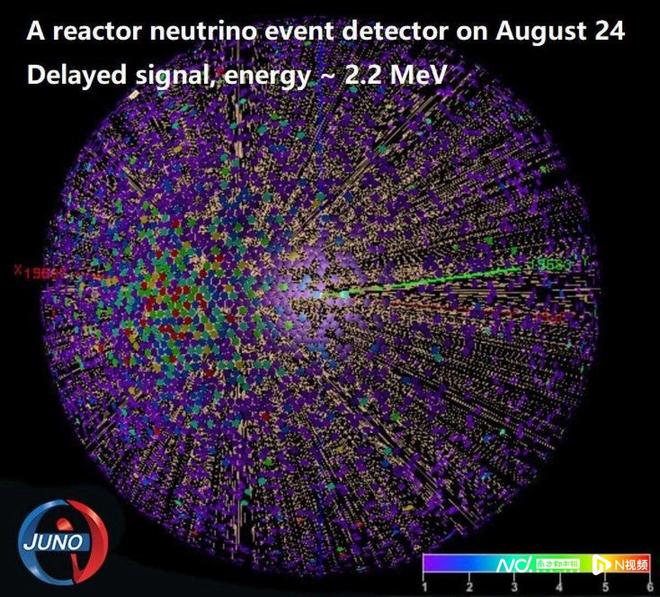
建成仅两个多月,江门中微子实验发布首个物理成果
Xin Jing Bao· 2025-11-19 04:08
Core Insights - The Jiangmen Underground Neutrino Observatory (JUNO) has successfully completed its construction and released its first physical results, marking a significant milestone in neutrino research [1][2]. Group 1: Neutrino Research Significance - Neutrinos are one of the three types of fundamental particles that make up the material world, and they are produced in vast quantities by processes such as nuclear reactions in stars and radioactive decay [2]. - The JUNO experiment aims to address a major question in particle physics: the ordering of neutrino masses, which is crucial for understanding the fundamental properties of these particles [2][3]. Group 2: Experimental Achievements - The JUNO collaboration reported a measurement of the solar neutrino oscillation parameters with unprecedented precision, improving upon previous experiments by 1.5 to 1.8 times [3]. - The experiment confirmed a previously observed discrepancy known as the "solar neutrino anomaly," which suggests the possibility of new physics beyond the standard model [3]. Group 3: Future Prospects - The JUNO facility is expected to produce significant physical results over the coming decades and contribute to the training of a new generation of physicists [4]. - With a design lifespan of 30 years, JUNO can be upgraded to become the world's most sensitive experiment for detecting neutrinoless double beta decay, which could provide insights into whether neutrinos are their own antiparticles and help measure their absolute mass [3].
论文“收割机”?地下700米的大国重器建设成功
仪器信息网· 2025-11-19 03:55
Core Insights - The Jiangmen Underground Neutrino Observatory (JUNO) has successfully completed its construction and released its first physical results after 59 days of operation, achieving a measurement precision of 1.5 to 1.8 times better than previous best results for two key solar neutrino oscillation parameters [1][3] Group 1: Experimental Achievements - The JUNO experiment confirmed the "solar neutrino anomaly" by measuring the oscillation parameters through reactor neutrinos, which had previously shown inconsistencies with solar neutrino measurements [3] - The experiment is the first of its kind to be built as a next-generation large-scale, high-precision neutrino facility, with key performance indicators meeting or exceeding design expectations [3][4] Group 2: Technical Specifications - The core detector of JUNO consists of a liquid scintillator with an effective mass of 20,000 tons, located in a water pool 44 meters underground, supported by a stainless steel structure with a diameter of 41.1 meters [4] - The detector includes 20,000 20-inch photomultiplier tubes and 25,000 3-inch photomultiplier tubes, along with advanced electronic systems and low-background materials [4]

中国江门中微子实验取得重大成果:证实太阳中微子偏差的存在,为探索未知物理世界打开新窗口
Ge Long Hui· 2025-11-19 03:29
Core Viewpoint - The Jiangmen Neutrino Experiment, a major scientific facility operated by the Institute of High Energy Physics of the Chinese Academy of Sciences, has officially commenced operations and achieved its first significant research result: the confirmation of the existence of solar neutrino oscillation deviations [1] Summary by Categories Scientific Achievements - The experiment confirmed the existence of solar neutrino deviations by analyzing data from 59 days of reactor neutrino observations [1] - Two oscillation parameters were measured, enhancing the precision of the measurements [1] Research Objectives - The primary scientific goal of the experiment is to address the neutrino mass ordering problem, which could open new avenues for exploring unknown aspects of the physical world [1]
中国江门中微子实验取得重大成果
Xin Lang Cai Jing· 2025-11-19 03:07
Core Insights - The Jiangmen Neutrino Experiment, a major scientific facility operated by the Institute of High Energy Physics of the Chinese Academy of Sciences, has officially commenced operations and achieved its first significant research result: the confirmation of the existence of solar neutrino oscillation anomalies [1] Summary by Categories - **Scientific Achievement** - The experiment confirmed the existence of solar neutrino anomalies by analyzing data from 59 days of reactor neutrino observations [1] - Two oscillation parameters were measured, enhancing the precision of the findings [1] - **Research Objectives** - The primary scientific goal of the experiment is to address the neutrino mass ordering problem [1] - This research aims to open new avenues for exploring the unknown aspects of the physical world [1]