中端手机市场

Search documents
中端手机春节“生死战”:集体涨价,进退两难
凤凰网财经· 2026-02-06 11:38
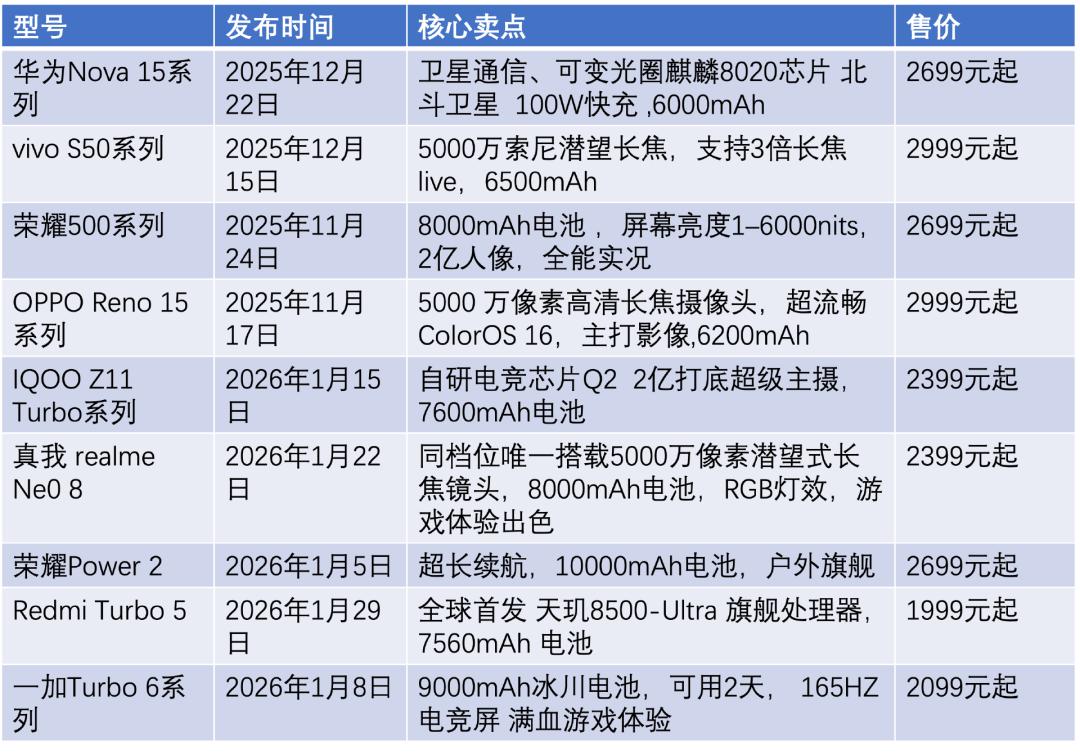
Core Viewpoint - The mid-range smartphone market is facing significant challenges due to rising memory prices, leading to increased prices or reduced specifications, which undermines the value proposition of mid-range devices [2][3][19]. Group 1: Market Trends - The mid-range smartphone segment has seen its market share decline from 35% in 2021 to an expected 23% by 2027, while the entry-level market remains stable at 41%-45% [13]. - In January 2026, Android manufacturers launched five mid-range models, indicating a crowded market with intense competition [4]. - The mid-range segment, which once accounted for over half of the smartphone market, now serves around 500 million users in China, with a significant portion of sales concentrated in the 2000-4000 yuan price range [6][12]. Group 2: Product Features and Consumer Preferences - Recent mid-range models emphasize battery life, with many devices featuring batteries over 6000mAh, catering to the increasing reliance on smartphones [7][11]. - Manufacturers are shifting focus from parameter-heavy designs to user experience, with features tailored to specific use cases, such as gaming or photography [11][19]. - The best-selling model recently is the OPPO Reno 15, with sales reaching 1.1875 million units shortly after launch, followed by the Honor 500 series [11]. Group 3: Pricing and Profitability - Rising memory chip prices have significantly impacted mid-range device costs, with LPDDR4X prices increasing by nearly 80% and LPDDR5X prices more than doubling [19][21]. - Many manufacturers have opted to raise prices by 200-600 yuan for new models to maintain profit margins, with the average profit for a 3000 yuan device dropping to just 30 yuan [18][21]. - The introduction of government subsidies has not led to substantial sales increases in the mid-range segment, with growth primarily occurring in high-end and low-end markets [15][24]. Group 4: Future Outlook - The mid-range smartphone market is at a critical juncture, with predictions of a 3%-4% decline in overall smartphone shipments in 2026 [24]. - Companies are exploring strategies to simplify product offerings and enhance competitiveness, such as introducing "super standard versions" to streamline configurations [24][25]. - The ongoing price increases and market saturation may lead to further challenges for mid-range devices, potentially marking 2026 as one of the toughest years for this segment [25].


中端手机春节“生死战”:集体涨价,进退两难
3 6 Ke· 2026-02-06 08:23
Core Viewpoint - The mid-range smartphone market is facing significant challenges due to rising memory prices, leading to increased prices or reduced specifications across brands, which undermines the value proposition of mid-range devices [1][11][12]. Group 1: Market Dynamics - The mid-range smartphone segment has seen its market share decline from 35% in 2021 to an expected 23% by 2027, while the entry-level market remains stable at 41%-45% [8]. - In January 2026 alone, Android manufacturers launched five mid-range models, indicating a crowded market despite declining demand [1][8]. - The mid-range segment, which once accounted for over half of the smartphone market, now serves around 500 million users in China, with a significant portion of sales concentrated in the 2000-4000 yuan price range [2][8]. Group 2: Product Features and Consumer Preferences - Recent mid-range models emphasize battery life, with all nine newly released models featuring batteries over 6000mAh, catering to the increasing reliance on smartphones [2][3]. - The focus has shifted from parameter competition to user experience, with brands prioritizing features like battery life and specific use-case enhancements [6][7]. - Notable models include the Honor Power 2 with a 10000mAh battery and the OnePlus Turbo 6 with a 9000mAh battery, highlighting the trend towards high-capacity batteries [4][5]. Group 3: Pricing Strategies and Profit Margins - Rising memory chip prices have led to increased costs for mid-range devices, with LPDDR4X prices rising nearly 80% and LPDDR5X prices more than doubling [11][12]. - Many manufacturers have opted to raise prices by 200-600 yuan for new models to maintain profit margins, with some models seeing price increases despite unchanged specifications [13][15]. - The profit margins for mid-range devices have significantly decreased, with some retailers reporting profits as low as 30 yuan for devices priced around 3000 yuan [10]. Group 4: Future Outlook - The smartphone market is expected to shift from growth to decline, with overall shipments projected to decrease by 3%-4% in 2026 [15]. - Companies are adjusting their strategies by reducing production orders and focusing on fewer, more standardized models to maintain competitiveness [15][16]. - The mid-range smartphone market is at a critical juncture, facing pressures from both rising component costs and changing consumer preferences [16].