主动管理ETF

Search documents
开年两个“万亿”,ETF“非对称”优势如何突围?
券商中国· 2026-01-19 02:31
Core Viewpoint - The article highlights the significant growth and evolution of ETFs in China, with two major records achieved in early 2026, indicating a robust and competitive market landscape. The focus is on the "Matthew Effect," where leading players like Huaxia and E Fund continue to dominate, while smaller firms carve out niches through differentiated strategies [1][2]. Group 1: ETF Market Overview - As of January 16, the total size of all listed ETFs reached 6.07 trillion yuan, managed by 58 fund companies. Huaxia Fund's ETF surpassed 1 trillion yuan on January 12, later adjusting to 964.82 billion yuan due to market fluctuations [2]. - The top five fund companies account for 53.21% of the total ETF market size, with E Fund and Huatai-PB following Huaxia in scale [2][3]. Group 2: Competitive Dynamics - The article discusses the "liquidity moat" and "institutional allocation preference" as key factors contributing to the scale disparity among ETF managers. Larger ETFs tend to attract more institutional investments due to better liquidity, reinforcing the dominance of leading firms [3][5]. - The analysis indicates that the competition among ETF managers is shifting from simple scale to a more complex ecosystem approach, focusing on product differentiation and comprehensive solutions for investors [8][9]. Group 3: Product Differentiation and Strategy - Smaller fund companies are encouraged to focus on niche markets and innovative strategies to compete effectively against larger firms. The article emphasizes the importance of creating unique products that meet specific investor needs [6][10]. - The future of ETFs is seen as moving towards "solution-oriented competition," where the emphasis is on providing complete investment solutions rather than just tracking indices [8][9]. Group 4: Future Trends and Innovations - The article notes that the global market for actively managed ETFs is expected to grow significantly, with a projected size of 1.84 trillion USD by the end of 2025, indicating a shift in investor preferences towards active management strategies [10]. - Companies like Pengyang Fund are exploring new product categories, such as long-term bond ETFs, to enhance their offerings and meet evolving market demands [6][10].


历史性突破!香港市场单只ETF,首次突破100亿份
Zhong Guo Ji Jin Bao· 2025-08-17 13:59
Group 1 - The Hong Kong market has achieved a historic milestone with the first ETF surpassing 10 billion shares, specifically the Southern Eastern's Hang Seng Tech Index ETF, which reached 10.219 billion shares [2] - The overall Hong Kong ETF market has developed a comprehensive ecosystem, with various leveraged and inverse ETFs gaining popularity among investors [3] - The growth of Hong Kong ETFs has been significantly driven by "northbound" capital inflows from mainland investors, making ETFs a favored tool for investment in the Hong Kong market [4] Group 2 - As of August 15, multiple ETFs and leveraged products in Hong Kong have exceeded 1 billion shares, including the Tracker Fund of Hong Kong with 6.138 billion shares and the Southern Eastern Hang Seng Tech Index Daily Inverse (-2x) product with 3.541 billion shares [4] - The Hong Kong ETF market is characterized by a diverse range of products, including leveraged, inverse, and actively managed ETFs, which have shown strong growth in recent years [4] - The introduction of high-yield U.S. stock-themed actively managed ETFs, such as the Hang Seng Morgan U.S. High Income Active ETF, reflects the demand for defensive investments amid economic uncertainties [5] Group 3 - The bullish performance of the Hong Kong stock market is expected to continue, providing direct support for ETF development, with predictions of further capital inflows from both mainland and overseas investors [6] - Notable sectors in the Hong Kong market include semiconductors and new consumption concepts, which have performed well this year, suggesting potential investment opportunities in related ETFs [6] - The overall sentiment regarding the Hong Kong market remains optimistic, with expectations of sustained growth driven by liquidity and favorable economic conditions [10] Group 4 - The Asia-Pacific region is witnessing rapid growth in the ETF market, with China projected to surpass Japan as the largest ETF market in the region by the end of the year [8][9] - As of August 14, the number of stock ETFs in mainland China reached 1,173, with a total scale of 3.87 trillion yuan, indicating a fast-paced development in the ETF sector [9] - The global ETF market is experiencing strong trends, including the expansion of actively managed ETFs and the introduction of digital asset strategies, which are expected to maintain robust growth [11]

通过ETF抄底美股美债,美国ETF资金流入创纪录,VOO吸金650亿美元
Hua Er Jie Jian Wen· 2025-05-26 02:59
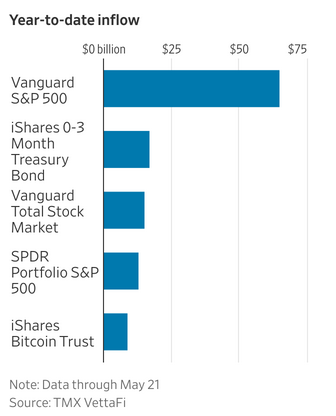
Group 1 - The core viewpoint of the articles highlights a significant influx of funds into ETFs amid market volatility, with U.S. ETFs attracting $437.9 billion so far this year, potentially marking the second consecutive year of record inflows [1][4] - Vanguard's S&P 500 ETF (VOO) has been the largest beneficiary, with a remarkable net inflow of $65 billion this year, making it the largest ETF by assets globally [1][4] - VOO set a record last year with $116 billion in annual inflows and is on track to break this record again before October [4] Group 2 - During periods of market turmoil, investors have shown a strong tendency to buy, with a buy-sell ratio reaching 5 to 1 in early April, indicating a readiness to invest cash when asset prices drop [5] - There is a notable trend of funds shifting from mutual funds to ETFs, with numerous fund management companies applying to the SEC to offer new ETF share classes for existing mutual funds, which could accelerate this transition [5] - The short-term U.S. Treasury ETFs have gained popularity, with BlackRock's 0-3 month Treasury fund attracting nearly $17 billion, reflecting a defensive investment strategy among investors [6][7] Group 3 - Active management ETFs are gaining traction, with 30% of ETF inflows this year directed towards these products, despite them representing less than 10% of total ETF assets [6] - A JPMorgan active management stock fund has entered the top ten, utilizing options strategies to reduce volatility and generate above-average dividend income, appealing particularly to the retirement demographic [6][7] - Fidelity's ETF management noted a consistent inflow into active management products over the past 12 to 24 months, even during extreme market volatility [7]