产业权力转移

Search documents
“友邦惊诧”遭遇中国速度
Guan Cha Zhe Wang· 2025-12-02 06:44
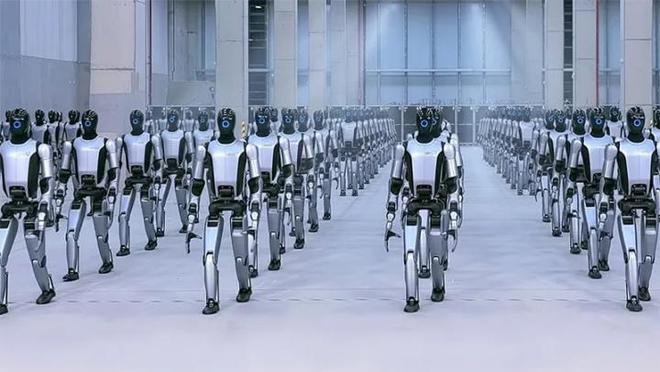
Core Viewpoint - The video released by Chinese robotics company UBTECH showcasing hundreds of Walker S2 humanoid robots has sparked controversy, primarily questioning its authenticity rather than the technology itself, highlighting a gap in technological perception and a potential shift in industry power dynamics [1][3][12] Industry Characteristics - The humanoid robotics industry is a complex system engineering field that integrates multiple technologies, including mechanical structures, motor drives, sensors, AI algorithms, and battery energy, reflecting the comprehensive capabilities of a country's manufacturing base [3][4] - Shenzhen's "Robot Valley" exemplifies a dense industrial ecosystem where hundreds of robotics companies and component suppliers are located within walking distance, significantly reducing design-to-prototype cycles and enabling rapid iteration [4][5] Cost Control and Market Position - Chinese humanoid robotics companies benefit from long-term accumulation in core components like motors, batteries, and sensors, leading to significant cost advantages. For instance, a humanoid robot priced under 10,000 RMB was recently launched, demonstrating high performance despite its low cost [4][5] - The Chinese government supports the robotics industry by providing real-world application scenarios, which helps companies identify viable business models and accelerates technology iteration [5][10] Comparison with Western Counterparts - In contrast to the rapid development of Chinese humanoid robotics, Western companies like Boston Dynamics face challenges in commercialization despite having advanced technologies. The company has changed ownership multiple times due to difficulties in achieving profitability [6][10] - Western robotics firms often struggle with the paradox of being technologically advanced but commercially lagging, as they find it hard to scale their innovations into practical applications [6][7] Market Dynamics and Future Outlook - The humanoid robotics sector is at a pivotal moment, similar to the early smartphone industry, where the ability to mass-produce at low costs will determine success. China holds a favorable position due to its complete supply chain, large domestic market, and supportive policies [10][12] - The diversity of the Chinese humanoid robotics market, with around 200 startups focusing on various applications, contrasts sharply with the Western market dominated by a few giants, fostering faster technological iteration and richer application exploration [8][10] Marketing and Perception - The controversy surrounding the authenticity of UBTECH's video may have been a strategic marketing move to generate global attention, similar to previous instances in the Chinese tech industry [9][12] - The skepticism from Western observers reflects a deeper anxiety about the changing competitive landscape in the robotics industry, as they struggle to reconcile their perceptions with the rapid advancements made by Chinese companies [11][12]

别再盯着稀土矿了!中国30年布下的产业天网,才是美国最怕的武器
Sou Hu Cai Jing· 2025-06-16 18:47
Core Viewpoint - The essence of the rare earth industry competition is not merely about resource availability or technological barriers, but rather the complex ecological system that supports rare earth refining [1][3][12]. Group 1: Resource and Technology - The United States holds approximately 10% of the world's rare earth reserves, with the Mountain Pass mine being a significant resource [1]. - The technological gap in rare earth separation and purification processes between the U.S. and China is minimal [1]. Group 2: Ecological System - The refining process of materials like gallium exemplifies the paradox of industrial miracles and resource consumption, requiring substantial raw materials and energy [3]. - China's industrial network effectively utilizes by-products from rare earth refining, significantly reducing comprehensive costs by over 40% [5]. Group 3: Challenges in the U.S. - The U.S. faces critical challenges in rebuilding its rare earth supply chain due to a lack of integrated industries to manage by-products, leading to increased environmental costs [7]. - Historical precedents, such as the bankruptcy of Molycorp, highlight the vulnerabilities of isolated production models in the face of price fluctuations [9]. Group 4: Capital and Investment - The financial implications of establishing a rare earth industry in the U.S. are daunting, with initial investments in the billions and negative cash flow concerns [11]. - The potential for U.S. projects to become reliant on government subsidies raises questions about their long-term viability [11]. Group 5: Global Industry Dynamics - The rare earth dilemma reflects a deeper shift in global industrial power, with China's three-decade investment in a comprehensive rare earth ecosystem creating a formidable competitive advantage [12]. - The real competition in the industry has shifted from mining and laboratory work to the ability to construct and maintain ecological systems [14].