
亲商政策

Search documents
“资本主义之都”选出了“最反资本主义”的市长
Hua Er Jie Jian Wen· 2025-11-05 03:06
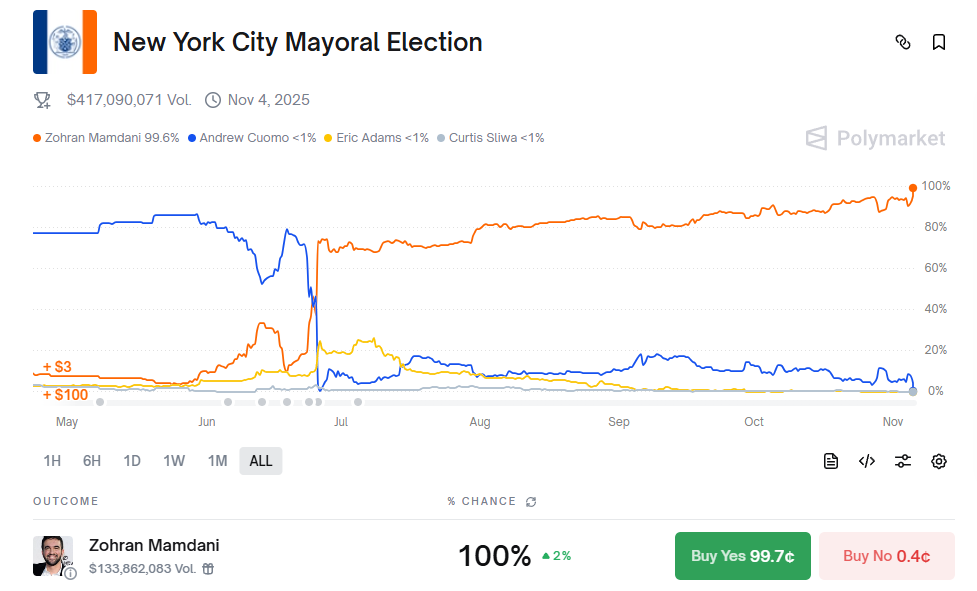
Core Points - The Democratic candidate Zohran Mamdani won the New York City mayoral election, marking a significant defeat for the Republican Party [1][3] - The election saw over 2 million voters, the highest turnout since 1969, with a total betting amount of $417 million on prediction platforms [1][3] Election Dynamics - Mamdani's victory was facilitated by a divided opposition, with former Governor Andrew M. Cuomo running as an independent and attracting support from current Mayor Eric Adams, who withdrew from re-election due to corruption allegations [4] - Republican candidate Curtis Sliwa faced pressure to withdraw but chose to remain in the race, contributing to the fragmentation of anti-Mamdani votes [4] Economic Vision - Mamdani represents a progressive vision, advocating for increased taxes on the wealthy to fund social welfare programs, while Cuomo positions himself as a moderate pro-business candidate [5] - The election outcome is crucial for the future fiscal and regulatory direction of New York City, impacting business operating costs and the investment environment [5][6] Broader Implications - The potential for intervention by former President Trump, who openly supported Cuomo, raises concerns about policy friction and business risks following Mamdani's election [6] - The election results could lead to historical milestones, with Mamdani potentially becoming the youngest and first Muslim mayor, while Cuomo could become the oldest first-term mayor [6] Other State Elections - The Democratic Party also showed strength in other states, with candidates Abigail Spanberger and Mike Sherill winning or predicted to win their respective gubernatorial races in Virginia and New Jersey [7][8]

加拿大六大银行Q3业绩稳健!美银:EPS上修趋势持续 估值仍具吸引力
智通财经网· 2025-09-05 08:17
Core Viewpoint - The six major Canadian banks reported solid Q3 2025 earnings, with an upward trend in EPS despite macroeconomic headwinds, indicating a positive outlook for the sector [1][2]. Group 1: Earnings Performance - The average EPS of the six banks exceeded expectations by 8.1%, with the Royal Bank of Canada leading at 15.7% above expectations [1]. - The strong performance in capital markets and rising net interest margins offset the increase in manageable credit costs [1]. - The average CET1 capital ratio of these banks is 13.3%, suggesting they have excess capital to support growth [1]. Group 2: Future Outlook - The consensus EPS forecast for 2026 was raised by 2.0% following the Q3 earnings release, with a potential upside of 5%-10% for 2026 EPS [1]. - The anticipated USMCA trade agreement could act as a catalyst for increased corporate hiring and investment [2]. - Global buying interest and an improving macro outlook are expected to support bank stock valuations [2]. Group 3: Comparative Analysis - Canadian banks have a 2026 P/E ratio of 12.1, compared to 12.5 for U.S. banks and below 8 for European banks, indicating relatively higher valuations [3]. - The P/B ratio for Canadian banks stands at 1.6, while European banks are at 0.8 and U.S. banks at 1.7 [3]. - The significant weight of bank stocks in the Canadian TSX index (20%-25%) may attract global asset managers to increase their allocation to the Canadian market [3]. Group 4: M&A Potential - There is potential for mergers and acquisitions in the sector, contingent on macroeconomic clarity and the USMCA agreement [3]. - The Royal Bank of Canada is interested in expanding its wealth management business, including in Europe [3]. - The Montreal Bank is focused on enhancing its ROE in the U.S. market while remaining open to acquisitions within its footprint [3].


韩国总统候选人金文洙:将推动亲商政策和核能。
news flash· 2025-05-18 12:32
Core Viewpoint - The presidential candidate Kim Moon-soo of South Korea aims to promote pro-business policies and nuclear energy initiatives [1] Group 1: Pro-Business Policies - Kim Moon-soo emphasizes the importance of creating a favorable business environment to stimulate economic growth [1] - The candidate plans to implement policies that support entrepreneurship and attract foreign investment [1] Group 2: Nuclear Energy - Kim advocates for the expansion of nuclear energy as a key component of South Korea's energy strategy [1] - The candidate believes that nuclear power can help achieve energy independence and reduce reliance on fossil fuels [1]