
人工光合作用

Search documents
【中国新闻网】突破人工光合作用瓶颈 中国团队研发出二氧化碳规模化转化新方案
Zhong Guo Xin Wen Wang· 2026-02-02 03:28
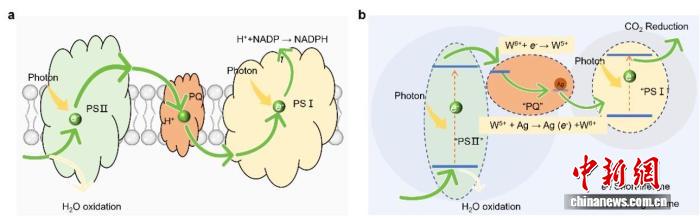
Core Insights - The research team from the Institute of Earth Environment, Chinese Academy of Sciences, has developed a universal strategy for the synergistic conversion of carbon dioxide and water, inspired by photosynthesis, to support clean energy and carbon neutrality goals [1][5]. Group 1: Research and Development - The team has innovatively designed an electronic storage pathway that mimics the physiological mechanism of plants storing light-generated electrons, allowing for precise control over the reaction rates and extent of carbon dioxide and water [4]. - A silver-modified tungsten trioxide material with electronic storage capabilities was successfully constructed, which, when combined with cobalt phthalocyanine, demonstrated nearly a hundredfold increase in carbon dioxide conversion efficiency compared to pure cobalt phthalocyanine [4]. Group 2: Practical Applications - The new approach operates stably under natural light conditions, providing a feasible technical pathway for the large-scale conversion of carbon dioxide into clean energy sources such as carbon monoxide and methane [4]. - The research highlights the potential for creating various structurally adaptable composite catalyst systems based on actual needs, showcasing the universal applicability and practicality of the developed solution [4].

我科学家提出自然光驱动二氧化碳转化通用方案
Huan Qiu Wang Zi Xun· 2026-02-02 01:28
Core Insights - The research team from the Chinese Academy of Sciences has developed a universal strategy to overcome the challenge of synchronously utilizing photogenerated electrons and holes in artificial photosynthesis, which is crucial for the conversion of carbon dioxide resources [1][3] Group 1: Research Breakthrough - The team mimicked the physiological mechanism of plants that temporarily store photogenerated electrons, designing a silver-modified tungsten trioxide material with electron storage capabilities [3] - This innovative material allows for precise control over the electron release process, enabling efficient cooperative conversion of carbon dioxide and water under natural light [3] Group 2: Efficiency and Scalability - Experimental results indicate that when combined with the catalytic active component cobalt phthalocyanine, the carbon dioxide conversion efficiency of the new material is nearly 100 times higher than that of pure catalysts [4] - The proposed strategy demonstrates good universality and scalability, making it adaptable to various composite catalyst systems, thus providing a feasible technological pathway for large-scale solar energy conversion of carbon dioxide into clean energy [4]
突破人工光合作用瓶颈 中国团队研发出二氧化碳规模化转化新方案
Xin Lang Cai Jing· 2026-02-01 03:51
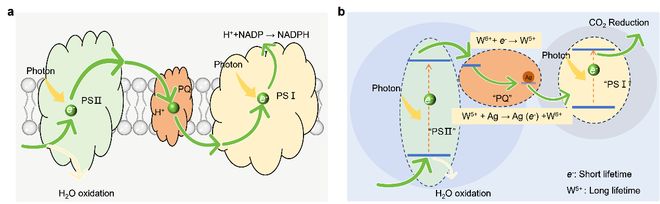
Core Viewpoint - The research team from the Chinese Academy of Sciences has developed a universal strategy for the synergistic conversion of carbon dioxide and water, inspired by photosynthesis, which aims to provide a feasible technological pathway for achieving clean energy and carbon neutrality goals [1][4]. Group 1: Research and Development - The team has successfully constructed a silver-modified tungsten trioxide material with electronic storage capabilities, which, when combined with cobalt phthalocyanine, has demonstrated nearly a hundredfold increase in carbon dioxide conversion efficiency compared to pure cobalt phthalocyanine [5]. - The innovative design allows for the storage of light-generated electrons and their precise release, enabling accurate control over the reaction rates and extent of carbon dioxide and water conversion [3]. Group 2: Practical Applications - The new strategy operates stably under natural light conditions, providing a viable technological pathway for the large-scale conversion of carbon dioxide into clean energy sources such as carbon monoxide and methane [5]. - The approach showcases good universality and applicability, allowing for the construction of various structurally adapted catalytic systems based on actual needs [5].
人工分子能模仿自然光合作用,为太阳能转化为碳中和燃料开辟新路径
Ke Ji Ri Bao· 2025-08-26 04:35
Core Insights - A research team from the University of Basel in Switzerland has made significant advancements in artificial photosynthesis by developing a new type of artificial molecule that mimics the natural photosynthesis mechanism of plants, capable of storing two positive and two negative charges under light conditions [1][2] - This breakthrough offers new possibilities for converting solar energy into carbon-neutral fuels, which is a crucial direction for future clean energy [1] Group 1: Research Findings - The artificial molecule consists of five functional units, each responsible for specific tasks, with one end containing two units that can release electrons, resulting in a positive charge, and the other end having two units that can receive electrons, resulting in a negative charge [1] - The core structure of the molecule absorbs light energy and initiates the electron transfer reaction, which is essential for the process [1] Group 2: Methodology - The team employed a two-step light exposure method to achieve the storage of four charges, where the first flash excites the molecule, triggering electron transfer and generating a pair of positive and negative charges, which then migrate to opposite ends of the molecule [2] - A second flash induces the same reaction, allowing the molecule to ultimately carry two positive and two negative charges, enabling the process to occur under weaker light conditions, closer to natural sunlight intensity [2] Group 3: Implications - The separated charges within the molecule can maintain a relatively stable state for a sufficient duration to participate in subsequent chemical reactions, such as the decomposition of water into hydrogen and oxygen, which is a key step in producing solar fuels [2] - This research enhances the understanding of the electron transfer mechanisms in artificial photosynthesis and lays the groundwork for designing more efficient solar fuel conversion technologies that are closer to natural systems [2]

人工分子能模仿自然光合作用 为太阳能转化为碳中和燃料开辟新路径
Xin Lang Cai Jing· 2025-08-25 23:26
Core Insights - A research team from the University of Basel in Switzerland has made significant advancements in artificial photosynthesis by developing a new type of artificial molecule that mimics the natural photosynthesis mechanism of plants [1] - This new molecule can store two positive and two negative charges simultaneously under light conditions, presenting new possibilities for converting solar energy into carbon-neutral fuels [1] - The related research paper has been published in the latest issue of Nature Chemistry, highlighting the potential impact of this technology on sustainable energy solutions [1] Summary by Categories Research Development - The University of Basel's research team has created an innovative artificial molecule that replicates the natural process of photosynthesis [1] - This advancement allows for the simultaneous storage of two positive and two negative charges when exposed to light [1] Implications for Energy - The development of this artificial molecule opens new avenues for the conversion of solar energy into carbon-neutral fuels, which is crucial for addressing climate change [1] - The findings published in Nature Chemistry emphasize the importance of this research in the context of sustainable energy [1]