人工智能编码

Search documents
GLM-5深夜登场,这是国产开源模型首次逼平Claude Opus 4.5。
数字生命卡兹克· 2026-02-12 01:25
Core Viewpoint - The article emphasizes the significant advancements of the GLM-5 model in the AI coding landscape, positioning it as a competitive alternative to leading models like GPT-5.3-codex and Claude Opus 4.6, particularly in terms of performance and cost-effectiveness [3][72]. Performance and Capabilities - GLM-5 has expanded its parameters from 355 billion to 744 billion, resulting in a substantial increase in intelligence and capabilities, while keeping costs relatively low [7]. - In benchmark tests, GLM-5 scored 75.9 in the BrowseComp benchmark, surpassing GPT-5.2 by 10 points and approaching the top models like GPT-5.2 Pro and Opus 4.6 [12]. - The model shows strong performance in various tasks, including long-term planning and execution, indicating its capability to handle complex tasks effectively [16][64]. Cost and Accessibility - GLM-5 offers a significantly lower price point compared to its competitors, with input and output costs being much cheaper, making it more accessible for users [17][18]. - The subscription model for GLM-5 is priced at two-thirds of the Claude Max package while offering three times the token limit, indicating a strong value proposition [20]. Development and Use Cases - The article discusses practical applications of GLM-5, including the development of a cross-platform content distribution tool, showcasing its ability to handle real-world coding tasks effectively [27][36]. - Another example includes the creation of a card counting plugin for a game, demonstrating GLM-5's capability to engage in complex problem-solving and iterative development [42][64]. Market Position and Future Outlook - The emergence of GLM-5 signifies a narrowing gap between domestic models and leading international counterparts, suggesting a shift in the competitive landscape of AI coding tools [70][72]. - The open-source nature of GLM-5, combined with its affordability, is expected to democratize access to advanced AI coding capabilities, fostering a more vibrant community and accelerating model iterations [73].


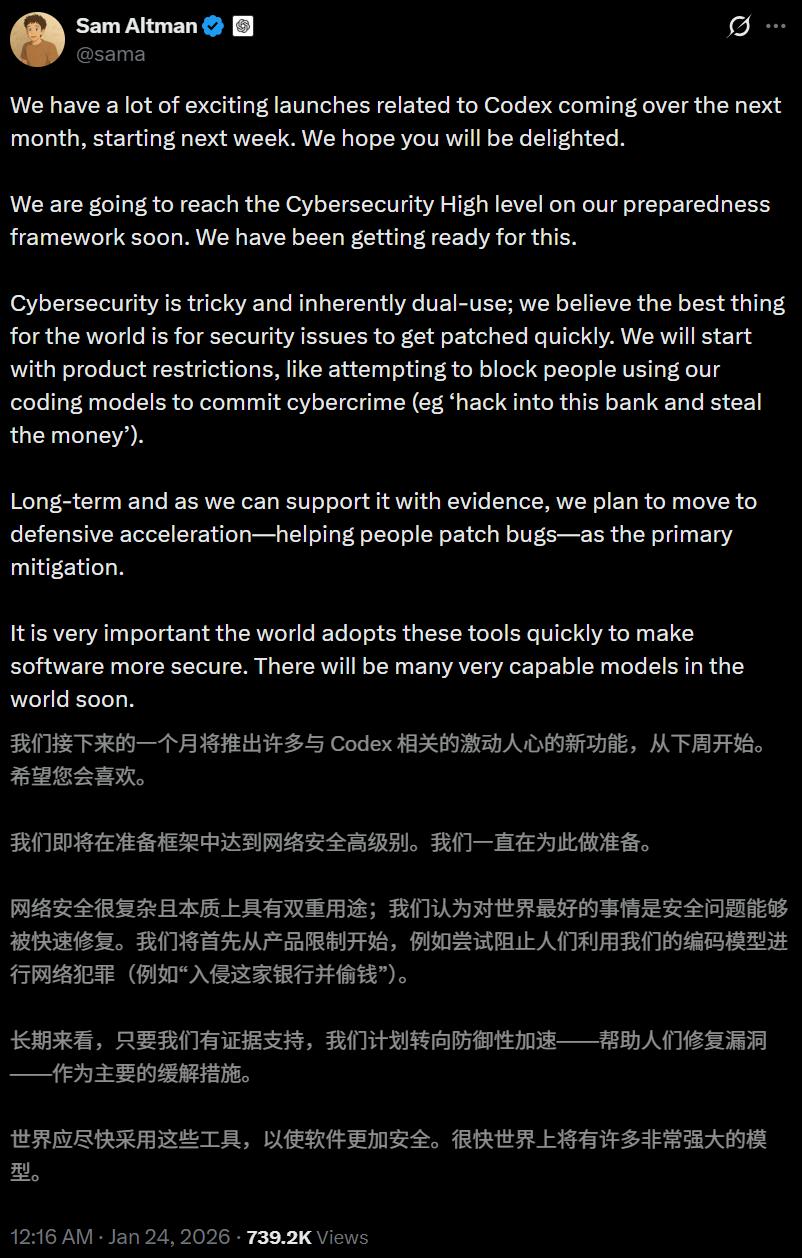
奥特曼被吓坏,Codex全家桶上线倒计时,恐将撕开全网漏洞
3 6 Ke· 2026-01-26 00:21
Group 1 - The core message indicates that OpenAI's upcoming Codex capabilities will significantly enhance its power, posing a high cybersecurity risk level for the first time, potentially leading to an increase in cyberattacks [1][5][6] - OpenAI's models are now capable of identifying previously undiscovered security vulnerabilities within seconds, which raises concerns about their potential misuse for cybercrime [1][4] - The cybersecurity landscape is shifting, where the discovery of vulnerabilities may no longer be solely in human hands, as AI models evolve to autonomously find and exploit these weaknesses [2][3][4] Group 2 - OpenAI plans to implement a strategy of "restricting use first, then assisting defense" to mitigate potential risks associated with Codex [8][10] - The strategy includes limiting certain capabilities of Codex to prevent malicious use and enhancing overall software security through AI [9][12] - The urgency for robust defensive measures is emphasized, as the proliferation of powerful AI models is anticipated, necessitating proactive cybersecurity strategies [11][13] Group 3 - The article discusses the competition between Codex and Claude Code, highlighting that Codex is designed for users who prefer results over the coding process, while Claude Code emphasizes collaboration and interaction [14][20][25] - The future of software development is projected to shift towards non-technical users who prioritize outcomes rather than the intricacies of coding, suggesting a decline in the traditional role of engineers [25][26] - The distinction between AI as a colleague versus a tool is crucial, with Codex catering to those who want to delegate tasks and focus on results, while Claude Code requires ongoing user engagement [25][26]
Suno 的 ARR 1.5 亿美金了,一个刻意保持简单的产品突破 400 万美金 ARR
投资实习所· 2025-10-16 10:08
Core Insights - Music AI Suno has achieved an Annual Recurring Revenue (ARR) of over $150 million, with a remarkable year-on-year growth rate of 400% since its launch just two years ago [1] - The primary revenue source for Suno comes from individual user subscriptions and point purchases, with subscription plans priced at $10/month and $30/month [1][2] User Demographics and Target Market - Suno's target audience is broad, primarily focusing on music enthusiasts and creators, including over 10 million users, which includes both casual creators and Grammy-winning artists [2] - The core user group consists of "ordinary people" who have never created music before, appealing to those without musical skills who wish to generate songs easily through text prompts [2][5] User Needs and Value Proposition - Paid users seek creative freedom and convenience, as Suno allows quick song generation without the need for professional skills or expensive equipment, making it attractive for social media content creators [2][4] - The cost-effectiveness of Suno's subscription model is highlighted, especially when compared to traditional music production costs, making it suitable for individuals and small projects [4] Revenue Opportunities and Business Model - Suno's Pro and Premier subscription plans offer commercial rights, attracting users who wish to monetize their music through platforms like YouTube, Bandcamp, and NFT markets [4] - The potential for users to earn through advertising revenue, direct sales, or custom music services enhances their willingness to pay for subscriptions [4] Competitive Landscape - OpenAI's ARR has reached $13 billion, with 70% derived from ChatGPT subscriptions, while facing significant losses, indicating a need for diverse revenue streams [6] - Competitor Anthropic is also experiencing rapid growth, with an expected ARR of $9 billion this year and potential to exceed $26 billion next year, driven by strong demand in the enterprise market [6] Product Strategy and Market Positioning - A small team has successfully achieved an ARR of $4 million by maintaining product simplicity and focusing on a single offering, demonstrating that simplicity can be a competitive advantage [7]