人工智能转型

Search documents
高通暗示将减少对台积电依赖
半导体芯闻· 2026-03-23 10:24
Core Viewpoint - Qualcomm signals a shift to reduce reliance on TSMC for semiconductor supply, emphasizing a continued partnership with Samsung Foundry [1][3]. Group 1: Partnership and Strategy - Qualcomm's senior vice president Chris Patrick highlights the importance of balancing performance, cost, and available capacity in collaboration with global foundries, particularly Samsung [1][3]. - Qualcomm has exclusively awarded TSMC the contract for its Snapdragon 8 series processors for four consecutive years, but is now looking to diversify its supply chain [3]. - The competition for orders in the 3nm process has seen Samsung struggle against TSMC, but rising costs at TSMC are increasing expectations for Samsung's foundry capabilities [3]. Group 2: Technological Development - Qualcomm's Alex Katouzian emphasizes that factors beyond price, such as technology, battery efficiency, capacity, and yield, are critical in selecting foundries [4]. - Patrick mentions that Qualcomm operates as a "single team" with Samsung, collaborating on future platforms that will take approximately three years to develop [4]. Group 3: Market Trends and Challenges - The shift towards AI is driving significant demand for memory and advanced semiconductor technologies, contributing to rising costs in the industry [5]. - Qualcomm's CMO Don McGuire discusses a paradigm shift in marketing strategies, moving from SEO to Generative Engine Optimization (GEO) to enhance brand visibility in AI environments [5]. - The upcoming 6G era is expected to focus on "AI-native networks" and enhanced uplink capabilities, which are crucial for transmitting large amounts of data generated by AI agents and smart glasses [5].



四年来首次盈利!LG Display公布2025年业绩
WitsView睿智显示· 2026-01-28 06:49
Core Viewpoint - LG Display achieved a significant turnaround in 2025, reporting a total sales of 25.81 trillion KRW (approximately 125.18 billion RMB) and an operating profit of 517 billion KRW (approximately 2.51 billion RMB), marking its first annual profit in four years despite a 3% decline in sales compared to the previous year [1][3]. Group 1: Financial Performance - In 2025, LG Display's sales decreased by 3% from 26.61 trillion KRW to 25.81 trillion KRW, but operating profit improved by approximately 1 trillion KRW from a loss of 5.606 trillion KRW in the previous year [1]. - The fourth quarter of 2025 saw sales of 72.008 trillion KRW (approximately 349.24 billion RMB), an 8% year-on-year decline, while operating profit surged by 103% to 1.685 trillion KRW (approximately 81.7 million RMB) [1]. - EBITDA for 2025 was reported at 11.62 trillion KRW (approximately 563.6 million RMB), reflecting an 11% year-on-year decline [1]. Group 2: Strategic Transition - LG Display increased the proportion of OLED products in total sales to a record 61% in 2025, up from 32% in 2020 and 40% in 2022, indicating a strong shift from LCD to OLED technology [3]. - The company plans to exit the large-size LCD business to accelerate its strategic transition towards OLED [3]. - By 2026, LG Display aims to enhance its technology and cost competitiveness through AI transformation and improve operational efficiency to establish a sustainable profit structure [4]. Group 3: Product Segmentation - In terms of product categories, TV panels accounted for 19% of annual revenue, IT device panels (including monitors, laptops, and tablets) made up 37%, mobile and other device panels constituted 36%, and automotive panels represented 8% [3]. - The company intends to focus on high-end markets in the IT sector while reducing low-margin products to enhance competitiveness [4]. - LG Display plans to expand its OLED product line for TVs and gaming, leveraging advanced technologies such as RGB Tandem 2.0 and high-refresh-rate gaming OLED panels [4].

拓尔思:预计2025年净利润亏损2.50亿元至3.10亿元
Mei Ri Jing Ji Xin Wen· 2026-01-27 09:36
Core Viewpoint - The company, Toris (300229.SZ), expects a net profit loss attributable to shareholders of 250 million to 310 million yuan for 2025, compared to a loss of 94.15 million yuan in the same period last year [1] Group 1: Financial Performance - The anticipated loss is primarily due to the underperformance of its subsidiary, Tianxing Network Security, in recovering from industry challenges [1] - The company plans to recognize an impairment provision for goodwill ranging from 140 million to 160 million yuan [1] - Contributing factors to the performance decline include project delays from downstream clients, a slowdown in new procurement, and a contraction in traditional business during the AI transformation period, alongside rigid operating expenses [1]

第四范式高开逾3% 先知AI平台业务实现爆发式增长 公司前三季度收入同比增近37%
Zhi Tong Cai Jing· 2025-11-13 01:32
Core Viewpoint - Fourth Paradigm (06682) shows strong growth driven by increasing demand for AI transformation in enterprises, with significant revenue and profit improvements reported for the first three quarters of the year [1] Financial Performance - Total revenue reached 4.402 billion RMB, a year-on-year increase of 36.8%, significantly surpassing last year's growth rate [1] - Gross profit amounted to 1.621 billion RMB, reflecting a year-on-year growth of 20.1%, with a stable gross margin of 36.8% [1] - The company achieved its first quarterly profit during this period, indicating improved cost and expense structure [1] Product Line Growth - The core product line, the Fourth Paradigm Prophet AI platform, experienced explosive growth, generating revenue of 3.692 billion RMB, a year-on-year increase of 70.1% [1] - Research and development expenses totaled 1.489 billion RMB, an increase of 8.4% year-on-year, with an R&D expense ratio of 33.8%, down 8.9 percentage points compared to the previous year [1] Customer Metrics - The number of benchmark users increased to 103, with an addition of 5 users year-on-year [1] - Average revenue contribution per benchmark user was 25.49 million RMB, showing a year-on-year growth of 71.4% [1] Future Outlook - The company anticipates that collaborations with diversified brand partners will gradually materialize in the upcoming quarters [1]
美国联邦开支收缩敲响警钟 埃森哲(ACN.US)预计新财年营收增长将放缓
智通财经网· 2025-09-25 12:53
Core Insights - Accenture reported Q4 revenue of $17.6 billion, a 7.3% year-over-year increase, exceeding expectations of $17.4 billion [1] - The company anticipates a slowdown in U.S. federal consulting spending, which may impact revenue growth by 1% to 1.5% in the fiscal year ending August 2026 [1] - Excluding this impact, Accenture expects revenue growth to be between 3% and 6% [1] Financial Performance - Non-GAAP earnings per share for Q4 were $3.03, surpassing market expectations of $2.99 [1] - Total new orders for Q4 amounted to $21.3 billion, with annual new orders reaching $80.6 billion [1] - Generative AI new orders were $1.8 billion for Q4 and $5.9 billion for the entire year [1] Shareholder Returns - Accenture plans to return at least $9.3 billion in cash to shareholders in the new fiscal year, an increase of approximately $1 billion from the previous year [1] Workforce and AI Training - The company intends to increase its workforce in the U.S. and Europe to meet client demand [2] - Accenture has begun training over 700,000 employees in AI technologies to enhance collaboration with human staff [2]

南京:“筑巢引凤” 外企纷至沓来
Xin Hua Wang· 2025-09-23 10:32
Group 1 - Siemens Xcelerator Yangtze River Delta Innovation Empowerment Center was officially unveiled, marking Siemens' first offline experience and application service center in the Yangtze River Delta region, focusing on industrial digitalization and smart city sectors [1] - The center aims to serve as a key hub connecting small and medium-sized enterprises with Siemens, promoting digital and AI transformation [1] - Siemens has established a significant presence in Nanjing, with one regional headquarters, two manufacturing plants, two R&D centers, and four subsidiaries, covering the entire value chain from R&D to sales and services [1] Group 2 - Nanjing has attracted over 5,000 foreign enterprises, with actual foreign investment reaching nearly 13 billion USD in the past three years, supported by strong educational resources and open platforms [1] - The city has developed a financial service matrix, including a 200 billion RMB industrial fund and a 30 billion RMB equity investment fund, to meet the funding needs of enterprises [2] - Nanjing has released over 5,300 application scenarios to promote new achievements and business models, transitioning from "testing ground" to "application ground" [2] Group 3 - At the "2025 Nanjing Golden Autumn Economic and Trade Fair," 51 key industrial projects were signed, covering intelligent manufacturing, AI, new energy vehicles, biomedicine, and integrated circuits, with planned investments totaling 80.221 billion RMB [2] - Additionally, 8 fund projects were signed, with a total fund size of 8.966 billion RMB, injecting financial resources into industrial upgrades [2] - Notable companies, including Phoenix (China) Investment Co., Ltd. and BMW Chengmai Information Technology Co., Ltd., joined Nanjing's "Global Digital Service Provider" alliance to attract high-end resources in the global digital economy [3]
苹果回归“美国制造”路漫漫
Jing Ji Ri Bao· 2025-04-15 22:05
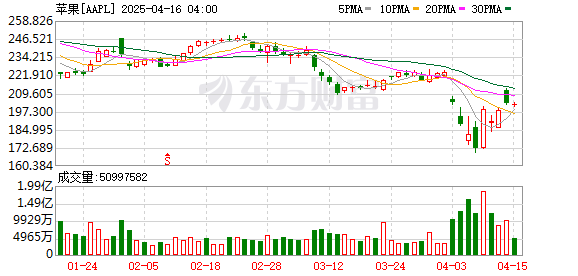
Core Viewpoint - The implementation of "reciprocal tariffs" by the U.S. government has led to significant declines in Apple's stock price and a loss of market value, raising investor concerns about the company's future [2][3] Group 1: Impact of Tariffs - Apple's stock has experienced multiple sharp declines, resulting in the evaporation of hundreds of billions in market value [2] - Analysts suggest that Apple may respond to the tariffs by absorbing costs or raising prices, but achieving large-scale domestic manufacturing in the U.S. is extremely challenging [2] Group 2: Supply Chain Dynamics - Apple has built a low-cost and efficient supply chain over many years, with China playing a crucial role, accounting for over 70% of Apple's global production capacity [2] - The Zhengzhou Foxconn factory in China can source 95% of the components needed for iPhones within a 300-kilometer radius, highlighting China's advantages in terms of industrial support and skilled labor [2] Group 3: Challenges of U.S. Manufacturing - Establishing a comparable supply chain in the U.S. would incur significant time and financial costs, with estimates suggesting it could take at least five years and lead to a dramatic increase in product prices [3] - A Bank of America analyst estimates that moving just the final assembly of iPhones to the U.S. could increase costs by 25%, and with tariffs, total costs could rise by 91% [3] - Even relocating 10% of the supply chain back to the U.S. could take three years and cost $30 billion, resulting in iPhones priced over three times their current cost [3] Group 4: Market Competition and Risks - The current phase is critical for global tech companies in AI transformation, making it essential for firms to maintain their existing business models [3] - Major changes to production locations could introduce significant business uncertainties and market risks, making a return to "Made in America" a potentially unwise decision for Apple [3]