
人工智能金融

Search documents
上海发布全球金融科技中心发展指数 上海北京达“全球顶尖”水平
Yang Shi Xin Wen· 2025-11-30 00:55
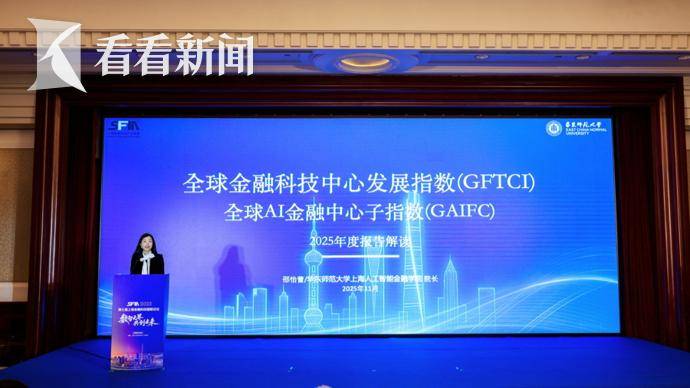
Core Insights - The Global Fintech Center Development Index (2025) was officially released on November 29 during the 7th Shanghai International Fintech Forum, optimizing indicators for fintech development and exploring the construction of a sub-index for AI in finance [1] - The index evaluates the comprehensive level of fintech in 22 core global cities based on dimensions such as industry, technology, talent, system, and environment, providing insights for industry development and policy formulation [1] - New York, Shanghai, Beijing, and San Francisco (Silicon Valley) ranked as the top four global fintech centers [1]
首超伦敦 全球第二!上海在这一排行榜上实现跃升
Sou Hu Cai Jing· 2025-11-29 13:09
Group 1 - Shanghai ranks second globally in the 2025 Global Fintech Center Development Index, surpassing London for the first time [1][5] - The index features a nested evaluation system, assessing cities based on fintech development level, potential, and environment, with a focus on the dual empowerment potential of finance and AI [3] - The Shanghai Fintech Development White Paper (2025) estimates the fintech industry scale in Shanghai to exceed 440 billion yuan, utilizing a new measurement approach based on revenue and other indicators from 396 representative fintech companies [6] Group 2 - Shanghai is also a leader in the number of fintech regulatory innovation projects, with significant improvements in the fintech development environment through various financial technology initiatives [8]

2025世界人工智能大会:AI金融迈向“零幻觉、具身化、多模态”时代
第一财经网· 2025-07-27 12:29
Core Insights - The 2025 World Artificial Intelligence Conference (WAIC2025) highlights the shift in the financial industry's AI applications from conceptual to practical implementations, focusing on "landing," "trustworthiness," and "embodiment" [1] - Innovations such as the Smith RM financial reasoning model and various AI-driven tools are reshaping the future of financial services, while also presenting significant challenges and concerns [1][2] AI Financial Applications - The Smith RM financial reasoning model developed by East China Normal University can generate a 12,000-word credit report in 30 seconds with a hallucination rate of less than 0.3%, a 97% reduction from the previous generation [2] - The Agricultural Bank of China's Shanghai branch has utilized this system to assist in approving 4.7 billion yuan in loans, reducing the average approval time from 5.7 days to 11 minutes [2] - The "Xiao Jiao" embodied intelligent robot from the Bank of Communications offers various customer services, enhancing user experience and providing a new approach to financial service transformation [3] Technological Advancements - Ant Group has restructured its AI financial management system based on advancements in large model technology, leading to the launch of upgraded services like "Ant Insurance" and "Ant Small Finance" [3] - The "Look and Pay" smart glasses payment solution from Ant Group allows users to complete transactions through voice commands and scanning, showcasing innovative payment methods [4] Industry Challenges - Experts at the "FinAI Artificial Intelligence Financial Leaders" forum emphasize that the implementation of AI in finance is not merely a technical issue but requires strategic thinking and management process adjustments [5] - The relationship between fintech companies and banks is crucial, as fintech can drive banks to adopt technology, particularly in areas like cross-border payments [5] Collaboration and Standards - The importance of collaboration between academia, industry, and research is highlighted, with a focus on integrating traditional AI with modern generative AI in finance [6] - The IEEE is actively developing standards for AI technology to ensure ethical development and global cooperation, covering areas such as explainable AI and data sharing [8] Future Outlook - The role of computing power is seen as central to the future of financial innovation, with experts noting that the application of computing power in suitable business contexts is more critical than the power itself [7] - The potential of China's computing power in the global market is emphasized, with the country positioned as the second-largest player despite existing technological bottlenecks [7]