
金融科技服务

Search documents
中国平安业务板块多元:非保险业务与金融科技业务驱动2025年业绩增长
Mei Ri Jing Ji Xin Wen· 2026-03-27 06:27
Core Viewpoint - China Ping An (601318) is not only engaged in insurance but also has diversified non-insurance business segments, including comprehensive finance, healthcare and elderly care, and financial technology, which are expected to drive the company's performance growth by 2025 [1] Group 1: Comprehensive Finance - The comprehensive finance model creates a "one customer, multiple accounts, various products, one-stop service" solution, achieving a customer retention rate of 99% for clients holding three or more product types by 2025 [1] - Internal customer acquisition costs are reduced by 35% to 45% compared to external averages [1] Group 2: Healthcare and Elderly Care - The healthcare and elderly care business serves as a differentiated advantage, with a 4 percentage point increase in the insurance coverage rate for clients using healthcare services by 2025 [1] - Ping An Health achieved operating revenue of 5.468 billion yuan and a net profit of 380 million yuan [1] Group 3: Financial Technology - The financial technology business focuses on "AI in ALL," with a data repository of 33 trillion bytes by the end of 2025 [1] - Model calls are expected to reach 3.65 billion times by 2025, empowering high-quality business development [1] Group 4: Overall Performance - These non-insurance business segments contribute to making China Ping An the largest insurance group globally by asset size, with total assets exceeding 13 trillion yuan [1] - The company has maintained an increase in cash dividends for 14 consecutive years [1]

和大厂“抢人”!银行春招密集开启,全面争夺这类人才
券商中国· 2026-03-26 03:10
Core Viewpoint - The banking industry is experiencing a "talent war" as major banks ramp up recruitment efforts, particularly focusing on technology roles to support digital transformation amidst ongoing pressure on net interest margins [2][3]. Recruitment Trends - Major state-owned banks, including the six largest, are leading the spring campus recruitment for 2026, with China Bank announcing nearly 4,000 positions and Construction Bank over 1,400 positions, both exceeding 1,000 [3]. - The recruitment structure is shifting, with an increasing emphasis on technology talent, while traditional roles in branches remain stable but do not see significant growth [2][4]. Technology Talent Demand - The demand for technology roles is rising, with some banks indicating that tech positions make up a significant portion of their recruitment needs [4]. - China Bank's recruitment highlights a focus on technology-related departments, while Ping An Bank has established a dedicated program for tech talent, emphasizing a "finance + technology" training model [4][5]. Differentiation in Talent Needs - Different types of banks have varying requirements for technology talent: state-owned banks prioritize robust systems and compliance, while joint-stock banks focus on AI applications and practical business scenarios [6]. - The industry is increasingly seeking hybrid talents who understand both finance and technology, particularly in AI and engineering [6][7]. Challenges in Recruitment - Attracting suitable technology talent remains challenging for banks compared to tech giants, which offer more competitive compensation and development opportunities [7]. - Experts suggest that banks should foster an innovative culture and optimize their assessment and selection processes to retain talent [7].


东吴证券晨会纪要-20260324
Soochow Securities· 2026-03-24 00:37
Macro Strategy - The core viewpoint indicates that the current geopolitical tensions in the Middle East and hawkish signals from major central banks during the "Super Central Bank Week" have led to a significant rise in long-term government bond yields, putting pressure on gold and silver prices. The stronger hawkish stance from the Bank of England has strengthened the British pound and euro, while the US dollar index has shown relative weakness, leading to a phenomenon where both the dollar index and gold prices have declined simultaneously. This reflects that gold pricing is influenced not only by US real interest rate expectations but also by global real interest rate expectations [1][36]. Industry Analysis - The Chinese shipbuilding industry has achieved a transformation from "scale expansion" to "quality and quantity improvement," maintaining its position as a global leader in key metrics for 16 consecutive years. This industry is crucial for realizing the strategy of becoming a manufacturing and maritime power [2][37]. Investment Recommendations - Green Town Services (02869.HK) is expected to see steady growth in core profits, with projected net profits of 9.88 billion, 10.98 billion, and 11.90 billion yuan for 2026, 2027, and 2028 respectively, reflecting year-on-year growth rates of 12.2%, 11.2%, and 8.3%. The company maintains a "buy" rating due to its strong cash position and commitment to dividends [7]. - XPeng Motors (09868.HK) has adjusted its revenue forecasts for 2026 and 2027 to 96.2 billion and 126.5 billion yuan, respectively, with a projected net profit of -1.4 billion and 2.1 billion yuan. The company is maintaining a "buy" rating based on its AI capabilities and new model launches [8]. - Longking Environmental Protection (600388) has adjusted its 2026 net profit forecast down to 14.1 billion yuan but maintains a "buy" rating due to its dual-driven growth strategy in green energy and electric mining vehicles [9]. - Tuhu-W (09690.HK) is expected to see improvements in profitability driven by store expansion and product upgrades, with net profit forecasts adjusted to 7.1 billion and 9.5 billion yuan for 2026 and 2027, respectively, maintaining a "buy" rating [12]. - Li Ning (02331.HK) has raised its net profit forecasts for 2026 and 2027 to 30.6 billion and 33.0 billion yuan, respectively, maintaining a "buy" rating due to strong performance in professional categories and refined operations [16]. - Ningde Times (300750) maintains its net profit forecasts for 2026, 2027, and 2028 at 940 billion, 1168 billion, and 1428 billion yuan, respectively, with a "buy" rating based on its leading position in the global battery market [24].
中银香港整合内地科技资源,深圳金融科技布局升级
Sou Hu Cai Jing· 2026-03-18 02:21
Group 1 - Bank of China Hong Kong has integrated its technology resources in mainland China, marking a significant adjustment in its fintech strategy by joining the Shenzhen Financial Technology Association [2] - The core of this adjustment involves the merger of two wholly-owned subsidiaries, with the original Bank of China Information Technology Services (Shenzhen) Co., Ltd. being replaced by the newly established Bank of China Digital Services (Nanning) Co., Ltd. Shenzhen Branch [3] - The new company's positioning has been upgraded from a Shenzhen-based subsidiary to a fintech company serving the Guangdong-Hong Kong-Macao Greater Bay Area and extending its services to Southeast Asia [4] Group 2 - Shenzhen has become a hub for bank technology subsidiaries, with four bank-affiliated tech companies currently established, highlighting its geographical advantages and talent pool [5] - The adjustment reflects a new trend in the banking industry's fintech competition, where banks are increasingly embracing digital transformation and shifting their focus from IT support to innovation [7] - The restructuring indicates that traditional banks are looking to their tech subsidiaries as innovation centers rather than cost centers, with a growing emphasis on roles related to application development and system management [7]

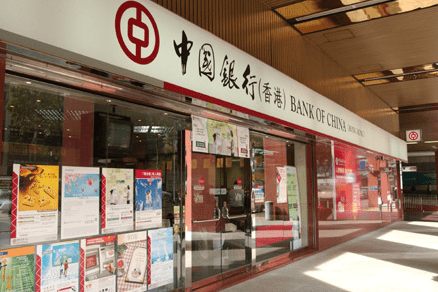
中银香港整合两家内地附属公司,新设深圳信科中心
Xin Lang Cai Jing· 2026-03-17 03:10
Core Insights - Bank of China Hong Kong (BOCHK) is enhancing its fintech presence in Shenzhen by establishing the Shenzhen Fintech Center and joining the Shenzhen Fintech Association [1][11] - BOCHK has merged two wholly-owned subsidiaries in mainland China to improve operational efficiency, indicating a strategic consolidation [3][12] - The Shenzhen Fintech Center is positioned as a software development hub and innovation base, serving the Greater Bay Area and Southeast Asia [5][16] Company Developments - The Shenzhen Fintech Center, officially known as Bank of China Digital Services (Nanning) Co., Ltd. Shenzhen Branch, was established on July 14, 2025, succeeding the earlier entity, Bank of China Information Technology Services (Shenzhen) Co., Ltd. [2][12] - The new center retains the team from the previous entity, with the same management structure, indicating continuity in operations [13] - The center aims to support BOCHK's fintech innovation by developing technologies related to digital transformation [6][17] Financial Performance - For the first half of 2025, BOCHK reported a revenue of HKD 40 billion, a year-on-year increase of 13.3%, and a net profit of HKD 22.2 billion, up 10.5% [18] - Total assets grew by 10% to HKD 4.4 trillion, with an annualized return on equity (ROE) of 12.9%, reflecting a 0.5 percentage point increase [18] Industry Context - Shenzhen currently hosts four bank technology subsidiaries, including BOCHK and other foreign banks, indicating a competitive fintech landscape [8][19] - Other banks, such as CITIC Bank International and foreign entities like Thailand's Kasikorn Bank and Singapore's OCBC Bank, are also establishing fintech operations in Shenzhen, highlighting the city's growing importance as a fintech hub [19][20]
富册金融科技股价剧烈波动,单日反弹9.40%
Jing Ji Guan Cha Wang· 2026-02-13 17:40
Core Viewpoint - The stock price of FTFT experienced significant volatility from February 7 to February 13, 2026, influenced by technical adjustments, a weak sector environment, and fundamental company factors [1]. Stock Performance - On February 9, the closing price was $1.63, with a daily decline of 4.12% [2]. - On February 10, the closing price rose to $1.69, marking a daily increase of 3.68% [3]. - On February 11, the closing price dropped to $1.59, reflecting a daily decrease of 5.92% [4]. - On February 12, the closing price further declined to $1.49, with a daily drop of 6.29% [5]. - On February 13, the stock rebounded to a closing price of $1.63, showing a daily increase of 9.40% and a volatility of 11.54% [6]. Overall Performance - From February 9 to February 13, the stock experienced a cumulative decline of 4.12%, with a total volatility of 21.18% and a trading volume of approximately $150,000, indicating low liquidity amplifying the price fluctuations [6]. - During the same period, the software services sector in the U.S. showed overall weakness, with the Nasdaq index exhibiting minor fluctuations, which negatively impacted individual stocks [6]. Fundamental Data - The company's trailing twelve months (TTM) price-to-earnings ratio is negative, and the price-to-book ratio is 0.19, with a total market capitalization of approximately $0.08 billion, indicating long-term fundamental factors affecting the stock price [6].
富册金融科技股价下跌,板块疲软与基本面因素成主因
Jing Ji Guan Cha Wang· 2026-02-12 20:59
Stock Performance - On February 12, the stock closed at $1.48, experiencing a single-day decline of 6.92% with an intraday volatility of 10.06% [2] - The stock had already dropped 8.28% on February 11, and from February 1 to 11, it recorded a cumulative decline of 24.39% with a total volatility of 41.95% [2] Industry Sector Performance - On February 12, the software services sector in the U.S. stock market fell by 1.66%, following a 2.72% decline on February 11, while the Nasdaq index remained relatively stable during the same period [3] Company Fundamentals - The company currently has a negative price-to-earnings ratio and a price-to-book ratio of 0.17, with a total market capitalization of approximately $0.07 billion [4] - Fundamental factors such as profitability and market capitalization are long-term influences on stock price volatility [4] Market and Technical Factors - The stock has shown low trading activity recently, with a turnover rate of 0.36% on February 12 and a trading volume of only $26,845, indicating that low liquidity may amplify short-term price fluctuations [5]
天阳科技:医药研发、肿瘤创新药属于与公司主业完全无关的领域,不存在业务协同性
Zheng Quan Ri Bao Wang· 2026-02-06 07:49
Core Viewpoint - Tianyang Technology (300872) emphasizes its commitment to focusing on its core business and ensuring business synergy in its investment strategy, which aligns with the general logic of industrial investment among A-share listed companies [1] Group 1: Investment Strategy - The company maintains that its external investments will strictly adhere to the principles of focusing on its main business and achieving business synergy [1] - Investments in areas such as pharmaceutical research and innovative cancer drugs are deemed unrelated to the company's core business, indicating a lack of business synergy [1] - The company plans to continue concentrating on its financial technology core business and will only invest in targets that provide business synergy and support long-term development [1]
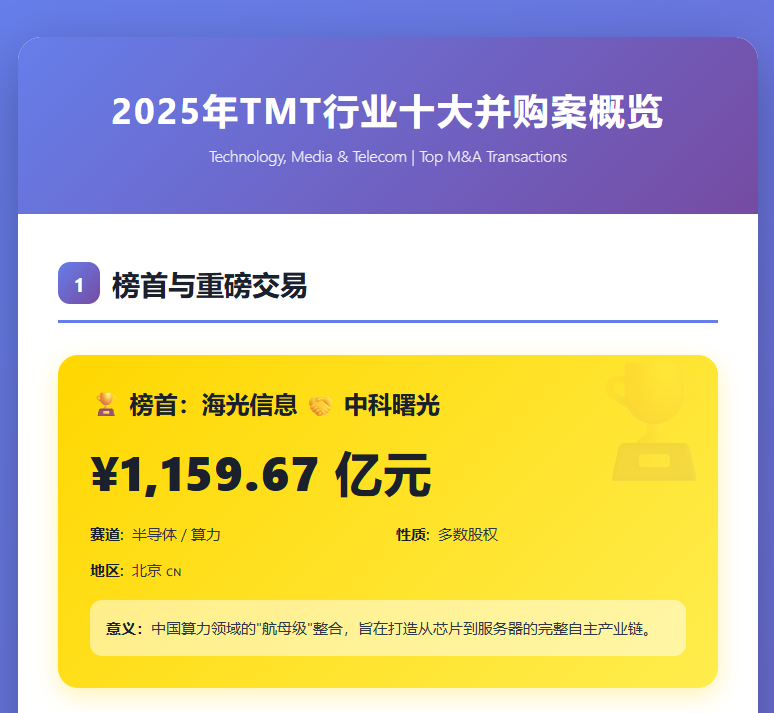
中国2025年 TMT Top10并购案例一图概览
Xin Lang Cai Jing· 2026-01-06 01:12
Core Insights - The article outlines the top ten mergers and acquisitions (M&A) in the Technology, Media, and Telecom (TMT) sector for 2025, highlighting significant transactions that shape the industry landscape [1][11]. M&A Transactions Overview - The largest transaction is the acquisition of Zhongke Shuguang by Haiguang Information for approximately 115.97 billion RMB, focusing on the semiconductor and computing power sectors, aiming to create a complete autonomous industrial chain from chips to servers [2][19]. - Tencent Music acquired a majority stake in Ximalaya for around 24 billion RMB (approximately 2.4 billion USD), enhancing its audio content ecosystem [7][19]. - Baidu purchased YY Live for about 21 billion RMB (approximately 2.1 billion USD), strengthening its position in the live streaming and content sector [8][20]. - TCL Technology acquired Shenzhen Huaxing Semiconductor for 11.56 billion RMB, focusing on the semiconductor display industry to enhance vertical integration [8][20]. - Focus Media acquired New潮传媒 for 8.3 billion RMB, consolidating its position in the outdoor advertising market [8][20]. - Fulede acquired 100% of Fulehua for 6.55 billion RMB, expanding its capabilities in the industrial software sector [8][20]. - JD Technology completed the privatization of Dada Group for approximately 39 billion RMB (around 546 million USD), enhancing its e-commerce technology capabilities [8][20]. - Ant Group acquired a majority stake in Bright Smart for about 2.8 billion RMB (approximately 362 million USD), expanding its fintech operations in Hong Kong [9][21]. - Alibaba invested 1.8 billion RMB (approximately 250 million USD) in Meitu through convertible bonds, focusing on AI applications [9][21]. - China Mobile acquired approximately 10 billion RMB (around 137.6 million USD) of a minority stake in HKBN, aiming to expand its telecommunications market share in Hong Kong [9][21]. Geographic Distribution of M&A - The M&A transactions are concentrated in major Chinese cities, including Beijing, Shanghai, Guangzhou, Chengdu, and Hong Kong, reflecting a strategic focus on key economic regions [4][16].
交银国际(03329.HK)披露股东特别大会投票表决结果,12月18日股价下跌1.37%
Sou Hu Cai Jing· 2025-12-18 10:06
Core Viewpoint - The company, Jiao Yin International (03329), held a special shareholders' meeting on December 17, 2025, where three ordinary resolutions were approved, including the renewal of property leasing agreements and new financial service frameworks until December 31, 2028 [1] Group 1: Shareholder Meeting Outcomes - The special shareholders' meeting resulted in the approval of three ordinary resolutions with a voting outcome of 99.999314% in favor, representing 145,785,167 shares, while only 0.000686% opposed, equating to 1,000 shares [1] - The resolutions included the approval, ratification, and confirmation of an automatic renewal property leasing framework agreement for three years until December 31, 2028, along with the approval of new financial service and fintech service framework agreements for the same period [1] - The voting was conducted by Hong Kong Central Securities Depository Limited, and due to related party transactions, the controlling shareholder, Bank of Communications, which holds approximately 73.14% of the company, abstained from voting [1] Group 2: Stock Performance - As of the close on December 18, 2025, Jiao Yin International's stock price was 0.36 HKD, reflecting a decrease of 1.37% from the previous trading day, with a trading volume of 458,200 HKD [1] - The stock has experienced a 52-week high of 1.08 HKD and a low of 0.25 HKD, indicating significant volatility in its market performance [1]