人权治理

Search documents
以中国智慧引领全球人权治理的方向(和音)
Ren Min Ri Bao· 2026-02-26 00:01
Group 1 - The core viewpoint emphasizes the need for reform and construction of the global governance system to achieve new results, which will help advance global human rights governance towards a more equitable, effective, and inclusive future [1][2] - The global governance initiative proposed by China has received support from over 150 countries and international organizations, marking a significant step forward with the establishment of the "Friends of Global Governance Group" [2][3] - The initiative includes five core concepts that advocate for sovereign equality, adherence to international law, multilateralism, a people-centered approach, and action-oriented strategies to enhance global human rights governance [3][4] Group 2 - China has made significant contributions to international human rights by accelerating global poverty reduction and establishing the world's largest social security system [4] - The country actively participates in UN human rights affairs and collaborates with various nations to promote human rights through initiatives like the Belt and Road Initiative [4] - China aims to continue promoting comprehensive development in human rights, ensuring that the benefits of modernization are shared more equitably among people worldwide [4]
首届中非人权研讨会在埃塞俄比亚举行
Xin Hua She· 2025-08-22 21:43
Group 1 - The first China-Africa Human Rights Seminar was held in Addis Ababa, Ethiopia, with over 200 participants from China and more than 40 African countries discussing the theme of "Building a China-Africa Community of Shared Future and Achieving Development Rights Together" [1][2] - The seminar is seen as a milestone platform for shaping the future of human rights governance and enhancing cooperation between China and Africa [2] - The event was co-hosted by the China Human Rights Research Association, Zhejiang Normal University, and the Ethiopian Policy Research Institute, aiming to implement the "China-Africa Cooperation Forum - Beijing Action Plan (2025-2027)" [2]
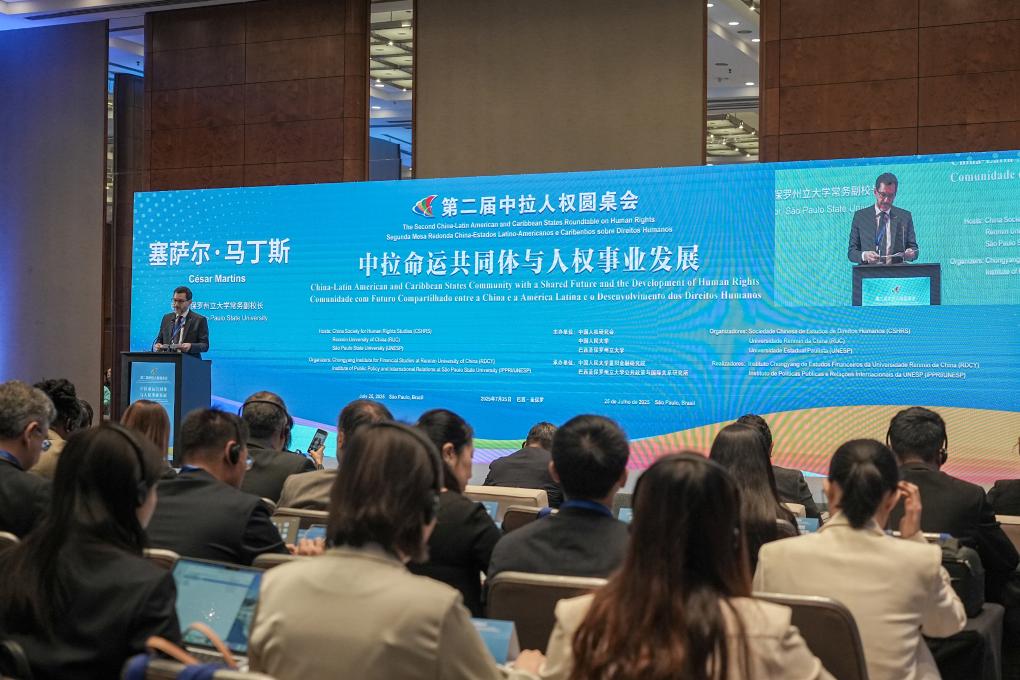
国际观察丨中拉为全球人权治理贡献“南方智慧”
Xin Hua Wang· 2025-07-28 01:01
Core Viewpoint - The second China-Latin America Human Rights Roundtable held in São Paulo emphasizes the contribution of "Southern wisdom" to global human rights governance, focusing on the development of a community of shared destiny between China and Latin America [1][5]. Group 1: Human Rights Philosophy and Practices - Scholars from Latin America recognize China's approach of promoting human rights through development, highlighting its emphasis on people-centered high-quality development and genuine multilateralism as beneficial for Latin American countries facing poverty and economic challenges [3][4]. - The success of China's poverty alleviation efforts is viewed as a significant achievement in the human rights field, providing new vitality and development opportunities for impoverished regions, which Latin American countries can learn from [3][4]. Group 2: Cooperation and Development - The roundtable discussions reveal numerous points of alignment between China and Latin America in human rights philosophy, practical paths, and global governance issues, showcasing the cooperative achievements and experiences of the Global South in human rights governance [5][9]. - China's initiatives, such as the Belt and Road Initiative and BRICS cooperation, are seen as vital for infrastructure development, green energy transition, and digitalization in Latin America, contributing significantly to the region's human rights development [7][11]. Group 3: Future Directions for Cooperation - Experts suggest that future China-Latin America human rights cooperation should expand sustainable development projects and deepen cultural and technological exchanges, emphasizing respect for sovereignty and mutual benefit [6][8]. - The need for a more equitable and inclusive human rights governance system is highlighted, with calls for the Global South to collaboratively redefine human rights beyond Western narratives, advocating for a governance system that ensures dignity for all [9][11].