人造肌肉

Search documents
无需外力,神奇超材料可自行收放
Ke Ji Ri Bao· 2026-02-28 01:21
Core Insights - Researchers at Leiden University have developed a remarkable metamaterial that can autonomously contract and expand without external force, resembling a "breathing" mechanism, opening new avenues for smart reconfigurable materials and micro-robotics [1][2] Group 1: Metamaterial Characteristics - The metamaterial is the first of its kind to exhibit such dynamic behavior at the microscopic level, challenging traditional perceptions of matter where movement is typically attributed to the material itself [1] - The structure is composed of tiny silica spheres assembled into meticulously designed building blocks, with each unit being one-tenth the width of a human hair, arranged in a rhombic pattern [1] - The precise control of particle connections ensures mechanical stability while allowing for free rotation, culminating in a complex architecture known as "cage lattice" [1] Group 2: Mechanism of Movement - Under optical microscopy, these microstructures display the ability to spontaneously contract and expand, driven by thermal energy that facilitates elegant folding and unfolding [2] - The movement is coordinated; when one set of quadrilaterals rotates clockwise, adjacent sets respond by rotating counterclockwise, creating a harmonious rhythm of contraction and expansion [2] - The introduction of magnetic particles allows for control over this microscopic "dance," with magnetic fields enabling precise regulation of the structure's contraction and expansion [2] Group 3: Future Applications - A theoretical framework has been established to describe the interaction between thermal motion and the metamaterial, with experimental results aligning closely with theoretical predictions [3] - This self-breathing metamaterial is expected to lay the groundwork for applications in artificial muscles, adaptive optical devices, and micro-robots that can autonomously respond to environmental changes [3]
无需预载,单步成型!华南理工“大节距”人造肌肉登权威期刊,软体机器人驱动迎来巨变
机器人大讲堂· 2026-01-29 09:06
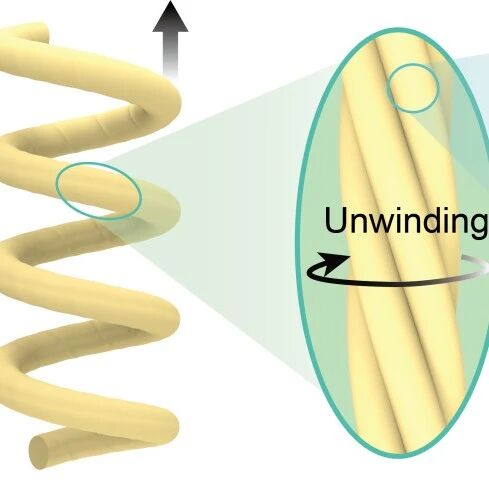
Core Viewpoint - The article discusses a significant breakthrough in soft robotics, specifically in the development of artificial muscles that exhibit remarkable performance characteristics, including a contraction of 95.1% and an extension of 560%, surpassing the power density of cheetah muscles by 35 times [1][10][17]. Group 1: Technical Breakthroughs - The development of soft robots has faced a core contradiction between flexibility and load-bearing capacity, leading to the exploration of twisted helical polymer artificial muscles as a potential solution [2][3]. - A new method called "self-induced large helical pitch (SLiP)" has been proposed, allowing for programmable large deformation and high load capabilities without the need for preloading [5][6]. - The manufacturing process involves a simple adjustment of annealing temperature and time, enabling the creation of SLiP muscles with controllable large pitches in a single thermal treatment [8][10]. Group 2: Performance Metrics - SLiP muscles can achieve a maximum contraction strain of 95.1% under load, meaning a 1 cm long muscle can shrink to less than 0.5 cm [11][13]. - In a free state, the contraction rate reaches 86.6%, demonstrating the core advantage of achieving large deformation without preloading [13]. - The muscles can also achieve an impressive extension of 560% when designed with specific helical configurations, showcasing their potential for robotic applications [15][17]. Group 3: Stability and Reliability - SLiP muscles have shown excellent stability and reliability, with performance fluctuations below 1% over 5000 heating-cooling cycles, indicating their suitability for practical applications [19][21]. - The manufacturing process effectively releases internal stresses in the fibers, maintaining structural stability under repeated thermal-mechanical loads [21][22]. Group 4: Practical Applications - The research team has developed various prototypes, including a bionic robotic arm that can smoothly rotate 72.5° while carrying a 10-gram load, mimicking human arm movements [23][25]. - A soft crawling robot inspired by the inchworm demonstrated a foot length change rate of 41.6%, showcasing the large deformation capabilities of SLiP muscles [25][27]. - A soft tentacle driven by SLiP muscles achieved a bending angle of 256°, exhibiting adaptability in grasping various objects [27][30]. Group 5: Future Challenges - The formation of the helical pitch relies on the thermal relaxation and molecular rearrangement of semi-crystalline fibers, which may limit the range of materials that can be effectively processed [34]. - The design for high strain may reduce muscle stiffness, posing challenges for high-load applications [35]. - Long-term thermal cycling could introduce slow viscoelastic geometric changes in polymer materials, necessitating further investigation into long-term stability under harsher conditions [36].

首款柔性智能材料儿童用外骨骼面世
Ke Ji Ri Bao· 2025-05-09 01:55
Core Insights - The article discusses the development of MyoStep, a flexible intelligent exoskeleton system designed specifically for children with movement disorders, which aims to improve their walking ability and quality of life [1][3]. Group 1: Product Overview - MyoStep is a lightweight, form-fitting, and discreet wearable device that integrates advanced smart materials and wearable sensor technology, designed to seamlessly fit into children's daily lives [3]. - The device is particularly suitable for children with cerebral palsy, a common movement disorder affecting 1-4 out of every 1,000 newborns globally, impacting muscle control and coordination [3][4]. Group 2: Technological Innovations - MyoStep represents a significant breakthrough in pediatric gait assistance, incorporating "artificial muscles," smart fabrics, and a multi-sensor network to enhance comfort, adaptability, and safety compared to traditional exoskeletons [3][4]. - The core of MyoStep consists of a wireless sensor network embedded in flexible fabric, which monitors and transmits user motion data in real-time to determine when to provide assistance to limbs [3][4]. Group 3: Safety Features - Safety is a critical consideration in the design of MyoStep, with all electronic components and actuators isolated from the skin to prevent irritation or discomfort [3]. - The system includes temperature monitoring and an emergency shut-off feature that automatically powers down the device if the surface temperature exceeds a safe threshold, preventing overheating [3]. Group 4: Future Developments - The team is continuously optimizing MyoStep's design to ensure it can adjust as children grow, meeting long-term usage needs [4]. - This innovative achievement not only offers new hope for children with cerebral palsy but also paves the way for future developments in pediatric rehabilitation engineering [4].