
人造金刚石产业

Search documents
价格已腰斩!销量暴增800%!这一市场,闪耀全球
Sou Hu Cai Jing· 2025-12-10 16:30
Core Insights - The artificial diamond industry in China is leading globally, with a diverse range of downstream products including cultivated diamonds and industrial diamond products [1] - The retail price of cultivated diamonds has significantly decreased, making them more accessible compared to natural diamonds, with prices dropping over 50% from their peak [6][9] - The market share of cultivated diamonds in the global diamond jewelry market is projected to exceed 40% by 2025, reflecting an increase of over eight times since 2019 [7] Market Trends - The acceptance of cultivated diamonds among younger consumers is high, with approximately 70% of the customer base being young individuals [9] - Sales of cultivated diamonds have doubled compared to the previous year, indicating a strong growth trend in the market [9] - The complete industrial chain for cultivated diamonds has formed in China, with 46 companies in Henan province covering all aspects from crystal seed cultivation to diamond synthesis and processing [11] Industrial Applications - Diamonds are widely used in industrial applications such as cutting, grinding, and drilling, with advancements in technology allowing for upgrades from low-end to high-end manufacturing [12] - The total industrial output value of superhard materials and products in China is expected to reach approximately 100 billion yuan by 2024 [16] - The thermal conductivity of diamonds is significantly higher than that of copper and aluminum, making them suitable for emerging applications in cooling materials for high-performance electronics [17][19] Future Potential - The market for materials that can replace traditional options is expected to reach hundreds of billions, with synthetic diamonds poised to unlock substantial market potential as semiconductor substrates [23]

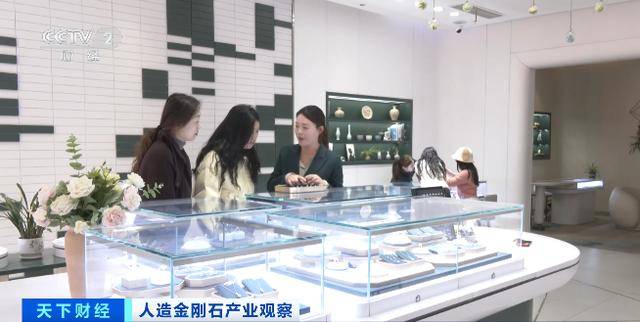
下游产品日益丰富,我国人造金刚石产业规模全球领先
Sou Hu Cai Jing· 2025-12-10 12:13
Industry Overview - The synthetic diamond industry in China is globally leading, with a growing range of downstream products including cultivated diamonds and industrial diamond products [1] - The retail price of cultivated diamonds has dropped over 50% from peak levels in recent years, with a 1-carat high-quality cultivated diamond now priced around 3,500 yuan, compared to over 40,000 yuan for a natural diamond [9] Market Dynamics - The consumer base for cultivated diamonds is predominantly young, with approximately 70% of buyers being under this demographic [11] - The sales of cultivated diamonds are expected to double this year compared to last year, indicating a significant market expansion [11] Production and Technology - Companies are investing in research and development to improve the production efficiency of large particle cultivated diamonds, achieving a 30% increase in production efficiency and a corresponding decrease in costs [15] - The industry has formed a complete supply chain in China, with 46 companies in Henan province covering all aspects from seed cultivation to diamond synthesis and cutting [17]

培育钻石价格腰斩 培育钻石销量占比已超40%
Ge Long Hui· 2025-12-10 06:57
Core Viewpoint - The synthetic diamond industry in China is leading globally, with a growing variety of downstream products and increasing consumer interest, particularly among younger demographics [1] Industry Overview - Natural diamonds are the hardest substances in nature, while synthetic diamonds can be created from graphite under high temperature and pressure [1] - The retail price of cultivated diamonds has dropped over 50% from its peak in recent years, with a 1-carat high-quality cultivated diamond now priced around 3,500 yuan, down from approximately 8,000 yuan in 2020 [1] Market Trends - In the global diamond jewelry market, the sales proportion of cultivated diamonds is expected to exceed 40% by 2025, representing an increase of over 8 times compared to 2019 [1] - The demand for cultivated diamonds is reflected in the increasing foot traffic in stores specializing in these products, indicating a shift in consumer preferences [1]