任务复杂度

Search documents
AgentIF-OneDay发布,评估全场景长时复杂任务
红杉汇· 2026-01-21 00:06
Core Insights - The article discusses the advancements in the Agent field, highlighting the impressive performance of large models in short-term tasks while revealing their limitations in long-term tasks. It emphasizes the need for a more scientific evaluation framework to assess the multi-modal understanding and complex problem-solving capabilities of these models [1][4]. Evaluation Framework - The introduction of the AgentIF-OneDay evaluation system aims to measure the ability of agents to solve complex tasks rather than just their knowledge base. This system explores the transition from OneHour to OneDay capabilities, revealing the true performance of mainstream agents in workflow execution, implicit inference, and iterative editing [1][6][10]. - The evaluation framework is designed to observe the evolution of industry technology routes and predict the upper limits of model capabilities, focusing on utility and economic value [6][10]. Task Complexity - Task complexity is defined not by the depth of knowledge or reasoning difficulty but by the human time investment required to complete a task, which correlates with its potential economic and utility value [6][7]. - The evolution of agent capabilities is expected to follow two main axes: scaling context (time dimension of tasks) and scaling domain (task type complexity). These axes determine the upper limits of task complexity that agents can handle [6][7]. Agent Capabilities - The AgentIF-OneDay framework tests agents' abilities to complete a full set of tasks within a day without human intervention, covering diverse domains such as life, learning, and work [10][11]. - Three primary task types are identified: Workflow Execution, Latent Instruction Inference, and Iterative Refinement, each representing different user interaction scenarios [11][14][15]. Testing Results - The evaluation of mainstream agent systems revealed that Manus, Genspark, and ChatGPT-Agent scored between 0.62 and 0.65 in overall task success rates, indicating similar capabilities across different systems [17][18]. - ChatGPT is identified as the best productivity tool for work, Manus as the best life assistant, and Genspark as the best study partner, showcasing the varying strengths of these agents in different domains [18][19]. Future Directions - The article anticipates that by 2026, agents will begin to challenge one-week human workloads, with the development of the OneWeek evaluation set already underway. This will involve more complex tasks and stricter rubric designs [22][23]. - The need for agents to possess active learning capabilities in real or semi-real environments is emphasized, suggesting that future advancements will rely on continuous learning and adaptation rather than static training methods [24][25].


真高管的长成:小B、Nick与老A的故事
3 6 Ke· 2025-08-21 01:33
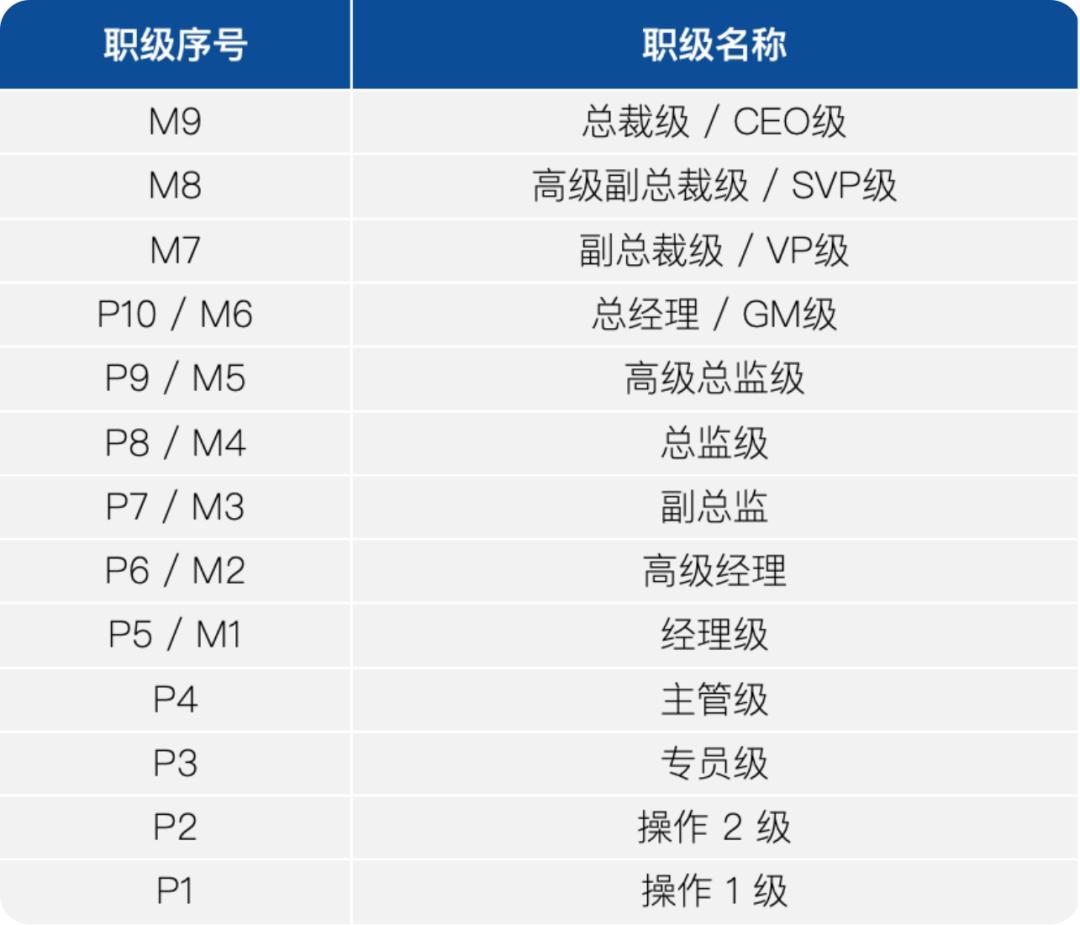
一说到"真高管",我们很容易想到那些成功的大公司里面的明星高管(方洪波、余承东、Tim Cook等)。 这些"真高管"是怎么长成的?我怎样才能成为这样的人?我们公司怎样才能发展出这样的人才? 于是,有些人就会去分析大公司的人才发展体系。最容易看到的就是那些动辄就十几个级别的"职业等级体系"。举个例子,一个大公司的典型职级体系长 成这样: | 职级序号 | 职级名称 | | --- | --- | | M9 | 总裁级 / CEO级 | | M8 | 高级副总裁级 / SVP级 | | M7 | 副总裁级 / VP级 | | P10 / M6 | 总经理 / GM级 | | P9 / M5 | 高级总监级 | | P8 / M4 | 总监级 | | P7 / M3 | 副总监 | | P6 / M2 | 高级经理 | | P5 / M1 | 经理级 | | P4 | 主管级 | | РЗ | 专员级 | | P2 | 操作 2 级 | | P1 | 操作 1 级 | 那些成功大公司,要接待一波波的参观者、学习者。用职级体系去解释这些高管的发展是个省时省力又"专业"的方式,所以公司内的人也乐见外部这样理 解他们那 ...