传统手工艺传承与创新

Search documents
打造浙西龙坦窑特色陶瓷文化名片
Xin Lang Cai Jing· 2026-02-06 17:54
Core Viewpoint - Traditional handicrafts are an essential part of Chinese culture, facing challenges in inheritance and development due to the rise of artificial intelligence, with the Longtan Kiln serving as a case study for promoting traditional porcelain craftsmanship and creating a unique cultural brand [1] Group 1: Historical Background of Longtan Kiln - Longtan Kiln, an important folk kiln in western Zhejiang, dates back to the late Yuan Dynasty, flourished in the Ming Dynasty, and declined in the Qing Dynasty, being the earliest known site to use local "Zhejiang materials" for blue-and-white porcelain [2] - The kiln site was officially recognized as a cultural heritage site in 1994 and was included in significant archaeological discoveries in 2017, with the site being designated as a provincial-level cultural protection unit in June 2023 [2] Group 2: Cultural Significance - The Longtan Kiln site is significant for three reasons: it is the earliest discovered blue-and-white porcelain kiln in Zhejiang, it reveals unique structural features of Ming Dynasty dragon kilns, and it provides substantial material for studying "blue-and-white Zhejiang materials" [3] Group 3: Challenges Faced - The Longtan Kiln faces challenges in development and innovation, including the need to explore cultural values, enhance the kiln's recognition compared to other famous kilns, and innovate cultural products amidst industrialization [5] Group 4: Sustainable Development Strategies - The revitalization of Longtan Kiln has seen initial success, but sustainable development requires a robust ecosystem, focusing on supporting artisans, deepening industry-academia collaboration, and emphasizing regional characteristics in product development [6] - Key figures in the revitalization, such as national-level intangible cultural heritage inheritors, have played crucial roles in rediscovering lost techniques and innovating traditional craftsmanship [6] - Collaborative efforts with academic institutions and local cultural initiatives are essential for the ongoing development and innovation of Longtan Kiln, integrating local culture with modern aesthetic and functional demands [7]
云南丽江珐琅银器:银丝为骨,釉上写“诗”
Ren Min Ri Bao Hai Wai Ban· 2025-10-21 01:55
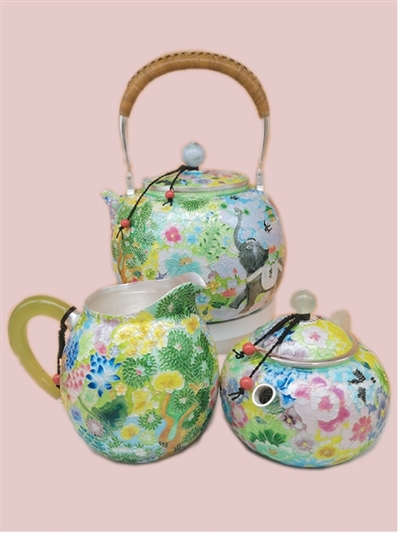
谭志平在展会上向外国参观者展示产品"彩银之蓝"。受访者供图 谭志平设计的茶具作品"彩银之蓝",包含花朵、大象、孔雀等云南特色元素。受访者供图 本版照片除 标注外均为朱远灵拍摄 在银胎上"掐丝"。 谭志平(右)在伯父谭继成指导下为银胎"填蓝"。 裁剪银片,准备打制银胎。 在银胎上"焊丝"。 透明滴管中盛着翠蓝珐琅釉料,银壶表面是掐丝绘就的牡丹纹样。沾着颜料的手轻轻捧起壶身,谭志平 目光专注,如同手握银针的绣娘。"填蓝跟绣花一样,是个精细活。" 1976年,谭志平出生于云南省丽江市永胜县三川镇金官街的银匠世家,是"谭记银匠"第四代传人。他正 在制作的是掐丝珐琅银器。永胜掐丝珐琅银器已有800余年历史,集冶金、铸造、锻打、雕、錾、锤、 绘画、窑烤等多种工艺于一体,因器形优美、装饰繁丽远销缅甸、印度,成为茶马古道上的珍品。2021 年,永胜珐琅银器制作技艺(银胎掐丝珐琅器制作技艺)被列入国家级非物质文化遗产代表性项目名 录。 "以银为胎,掐丝为骨,珐琅作魂"是谭志平制作珐琅银器的秘诀。烧制银器成型后,谭志平用极细的银 丝勾勒图案,这一步叫"掐丝"。"0.3毫米的银丝要18次弯折,才能勾勒出牡丹的美。"谭志平说,银丝 ...