
低碳化工制造

Search documents
【科技日报】为铁基费托合成装上“分子开关”
Ke Ji Ri Bao· 2025-12-24 03:54
Core Insights - The research team successfully reduced carbon dioxide byproduct content in iron-based Fischer-Tropsch synthesis from approximately 30% to below 1% by adding halogen compounds at a concentration of one part per million, while increasing the yield of high-value olefins to over 85% [1][2][3]. Group 1: Current Challenges in Fischer-Tropsch Synthesis - Fischer-Tropsch synthesis is a crucial catalytic reaction technology in the chemical industry, primarily used to convert syngas (a mixture of carbon monoxide and hydrogen) into liquid fuels or high-value chemicals [2]. - The iron-based catalyst is favored in over two-thirds of industrial processes due to its low cost and high oil production rate, but it is associated with significant carbon dioxide emissions [2][3]. - Traditional iron-based Fischer-Tropsch synthesis processes often have a carbon dioxide selectivity as high as 30%, meaning that for every 100 carbon atoms converted, 30 become greenhouse gases [2][3]. Group 2: Innovative Halogen Regulation Strategy - The research introduces a trace halogen regulation strategy, where halogen compounds like bromomethane and iodomethane are added to the reaction gas at a concentration of one part per million [3][4]. - This strategy acts as a "molecular switch," effectively blocking the pathway that generates carbon dioxide while enhancing the production of olefins [4]. - The addition of halogen compounds prevents excessive hydrogenation of hydrocarbons, allowing more carbon atoms to be utilized for olefin production [4]. Group 3: Practical Implications and Future Directions - The halogen regulation strategy is practical and convenient, requiring no major modifications to existing catalysts or equipment, only the addition of trace halogen gases at the inlet [4][5]. - The research team is actively collaborating with relevant enterprises for pilot-scale testing and long-term stability assessments, aiming to expedite the industrial application of this strategy [5]. - Key challenges for industrialization include precise dosing and concentration control of halogen compounds, ensuring the stability of iron-based catalysts over long operational periods, and adapting the strategy to different gasification feedstock compositions [5].

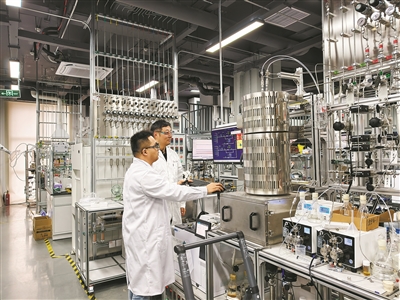
我国科学家在绿色催化技术上取得新突破
Xin Hua She· 2025-11-04 02:44
Core Insights - A new catalytic control technology has been developed by Chinese scientists that significantly reduces carbon dioxide emissions during the Fischer-Tropsch synthesis process, enhancing the yield of liquid fuels and olefins, thus providing a new strategy for low-carbon chemical manufacturing [1][2] Group 1: Fischer-Tropsch Synthesis Overview - Fischer-Tropsch synthesis is a crucial catalytic reaction technology in the chemical industry, primarily used to convert syngas (a mixture of carbon monoxide and hydrogen) into liquid fuels or high-value chemicals like olefins [1] - Traditionally, iron-based catalysts have dominated Fischer-Tropsch synthesis, accounting for over two-thirds of global production capacity, due to their low cost and high oil yield [1] Group 2: Environmental Impact and Innovation - The conventional iron-based catalysts produce a significant amount of carbon dioxide, with emissions often reaching 30%, leading to carbon resource wastage [1] - The research team discovered that introducing trace amounts of halogenated compounds, such as bromomethane and iodomethane, can precisely control the reaction pathways on the surface of iron-based catalysts, effectively shutting down the pathways that generate carbon dioxide, achieving near "zero emissions" [1][2] Group 3: Benefits and Future Implications - The new method increases the proportion of high-value olefins produced to over 85%, surpassing the industry average [1] - This innovative approach does not alter the existing catalyst structure or require equipment replacement, making it highly adaptable for engineering applications [2] - The development addresses the significant challenge of carbon dioxide emissions in Fischer-Tropsch synthesis, providing a simple and effective technical solution for green and low-carbon production of olefins or liquid fuels, potentially paving new pathways for decarbonization in China's coal chemical processes [2]
攻克高碳排放难题!我国科学家取得新突破
中国能源报· 2025-10-31 12:09
Core Insights - Chinese scientists have made significant breakthroughs in green catalytic technology, specifically in Fischer-Tropsch synthesis, which is crucial for converting syngas into liquid fuels and high-value chemicals with minimal CO2 emissions [1][3] Group 1: Breakthrough in Catalytic Technology - A new catalytic control technology has been developed that allows Fischer-Tropsch synthesis to produce almost zero CO2 emissions while significantly increasing the yield of liquid fuels or olefins [1][2] - The introduction of trace halogen compounds, such as bromoform and iodomethane, enables precise control over the reaction pathways of iron-based catalysts, effectively closing the CO2 generation pathway [2][3] Group 2: Industry Implications - Fischer-Tropsch synthesis is a key pillar of China's coal chemical and syngas industries, but CO2 emissions have been a major challenge for its green upgrade [3] - The new method enhances the proportion of high-value olefins to over 85%, surpassing the industry average, and provides a simple and effective technical solution to the global challenge of high carbon emissions in Fischer-Tropsch synthesis [2][3]

攻克高碳排放难题!我国科学家在绿色催化技术上取得新突破
Xin Hua She· 2025-10-31 07:45
Core Insights - The development of a new catalytic regulation technology for Fischer-Tropsch synthesis significantly reduces carbon dioxide emissions and enhances the yield of liquid fuels and olefins, providing a new strategy for low-carbon chemical manufacturing [1][2] Group 1: Technology and Innovation - The new technology allows for nearly zero carbon dioxide emissions during the Fischer-Tropsch synthesis process by introducing trace amounts of halogenated compounds, such as bromomethane and iodomethane, which precisely control the reaction pathways on iron-based catalysts [1][2] - The method does not alter the existing catalyst structure or require equipment changes, likened to adding a "molecular seasoning" in cooking to achieve dynamic control and improve carbon atom utilization efficiency [2] Group 2: Industry Impact - Fischer-Tropsch synthesis is a crucial pillar of China's coal chemical and syngas industries, with the challenge of carbon dioxide emissions being a significant barrier to its green upgrade [2] - Traditional methods could only reduce carbon dioxide generation from 30% to 10%, while the new approach offers a simple and effective solution to the global challenge of high carbon emissions in Fischer-Tropsch synthesis, paving the way for decarbonization in China's coal chemical processes [2]