
费托合成技术

Search documents
加点“料” 老工艺焕新(唠“科”)
Ren Min Ri Bao· 2025-11-21 22:25
Core Insights - The article discusses the breakthrough in Fischer-Tropsch synthesis, a nearly century-old process that converts syngas (a mixture of carbon monoxide and hydrogen) into valuable chemical products, including liquid fuels and olefins, which remains a backbone of the global energy and chemical industry [1][2] Group 1: Technology and Innovation - Researchers have discovered a method to significantly reduce carbon dioxide emissions during the Fischer-Tropsch synthesis by adding a trace amount of halogenated methane (e.g., bromomethane) at a concentration of 20 parts per million (ppm), which reduces CO2 generation from 30% to less than 1% under specific conditions [2][3] - The addition of bromine atoms creates a protective layer on the catalyst's surface, effectively altering the reaction environment and preventing unwanted side reactions, thus enhancing the efficiency of the process [3] Group 2: Environmental Impact - This innovation addresses the challenge of high carbon emissions in the Fischer-Tropsch synthesis, providing a new pathway for the green transformation of carbon resources such as coal, natural gas, and biomass in alignment with China's carbon neutrality goals [2][3] - The technique not only improves the efficiency of traditional energy industries but also has the potential to be applied to other catalytic systems, indicating a significant shift in carbon resource utilization strategies [3]
加点“料”,老工艺焕新(唠“科”)
Ren Min Ri Bao· 2025-11-21 22:12
Core Insights - The F-T synthesis process, a nearly century-old technology, converts syngas (a mixture of carbon monoxide and hydrogen) into valuable chemical products like liquid fuels and olefins, remaining a backbone in the global energy and chemical sectors [1] - A recent breakthrough involves adding a trace amount of halogenated methane (e.g., bromomethane) to significantly reduce CO2 emissions during the F-T synthesis process, achieving a drop in CO2 generation from 30% to less than 1% with just 20 ppm of bromomethane [2][3] - This innovative approach not only enhances efficiency but also transforms carbon resource utilization, indicating a promising direction for the future of green chemistry [3] Industry Implications - The new method addresses the longstanding challenge of high carbon emissions in the F-T synthesis process, aligning with China's dual carbon goals and providing a pathway for the green transformation of carbon resources like coal, natural gas, and biomass [2] - The principle behind this technology involves the halogen atom acting as a protective layer on the catalyst surface, effectively preventing unwanted side reactions and guiding the reaction towards desired products [3] - This strategy of using minimal additives to control the microenvironment of catalysts could be applicable to other reaction systems, representing a significant advancement in chemical engineering and a potential key direction for future green chemical processes [3]

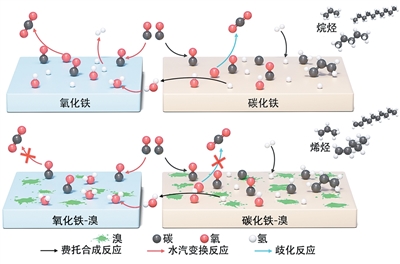
攻克高碳排放难题!我国科学家在绿色催化技术上取得新突破
Xin Hua She· 2025-10-31 07:45
Core Insights - The development of a new catalytic regulation technology for Fischer-Tropsch synthesis significantly reduces carbon dioxide emissions and enhances the yield of liquid fuels and olefins, providing a new strategy for low-carbon chemical manufacturing [1][2] Group 1: Technology and Innovation - The new technology allows for nearly zero carbon dioxide emissions during the Fischer-Tropsch synthesis process by introducing trace amounts of halogenated compounds, such as bromomethane and iodomethane, which precisely control the reaction pathways on iron-based catalysts [1][2] - The method does not alter the existing catalyst structure or require equipment changes, likened to adding a "molecular seasoning" in cooking to achieve dynamic control and improve carbon atom utilization efficiency [2] Group 2: Industry Impact - Fischer-Tropsch synthesis is a crucial pillar of China's coal chemical and syngas industries, with the challenge of carbon dioxide emissions being a significant barrier to its green upgrade [2] - Traditional methods could only reduce carbon dioxide generation from 30% to 10%, while the new approach offers a simple and effective solution to the global challenge of high carbon emissions in Fischer-Tropsch synthesis, paving the way for decarbonization in China's coal chemical processes [2]