体外资金池

Search documents
万科郁亮被爆疑似失联
Xin Lang Cai Jing· 2026-01-28 05:00
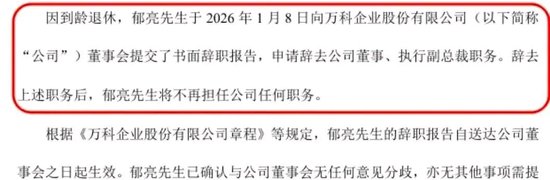
Core Viewpoint - The former chairman of Vanke Group, Yu Liang, has reportedly been missing for half a month following his resignation from all positions on January 8, 2025, amid significant changes in the company's management structure and financial challenges [1][10]. Group 1: Management Changes - Yu Liang resigned from all positions at Vanke Group on January 8, 2025, after a 36-year career with the company, with a smooth transition of his shares [2][11]. - On January 27, 2025, Zhu Jiasheng, the then-president and CEO, also resigned due to "health reasons," and was later confirmed to be under criminal investigation [2][11]. - Following these resignations, Vanke underwent a major management reshuffle, with Yu Liang demoted to executive vice president and new management taking over [7][12]. Group 2: Career Highlights of Yu Liang - Yu Liang joined Vanke in 1990 and quickly became a key executor of the strategic plans laid out by then-chairman Wang Shi [3][11]. - He played a significant role in Vanke's B-share listing in 1993, raising HKD 450 million, and was instrumental in the company's strategic decisions during the "Junwan War" in 1994 [4][11]. - After the "Baowan War" concluded in 2017, Yu Liang succeeded Wang Shi as chairman, marking a significant leadership transition [5][12]. Group 3: Company Performance and Challenges - Under Yu Liang's leadership, Vanke pursued a diversification strategy, but the company's high turnover model began to show weaknesses as industry adjustments exceeded expectations [7][12]. - By the time of Yu Liang's retirement, Vanke was facing a debt crisis, contrasting sharply with the stable conditions during Wang Shi's tenure [8][12].


深交所通报2个体外资金池IPO现场督导案例、2个离职人员入股核查、2个创业板定位的典型审核案例
梧桐树下V· 2026-01-13 09:31
Group 1 - The article discusses the recent issuance of the Shenzhen Stock Exchange's latest "IPO Review Dynamics," highlighting two cases of external funding pools that were not disclosed during the IPO process [1][2] - Case 1 involves Issuer A, which had an external funding pool balance of approximately 15 million yuan, with inflows totaling about 30 million yuan and outflows of 40 million yuan during the reporting period [3][5] - Case 2 involves Issuer B, which had an external funding pool balance of 700,000 yuan, with inflows of 1.5 million yuan and outflows of 1.4 million yuan during the reporting period [3][5] Group 2 - The Shenzhen Stock Exchange emphasizes the importance of the authenticity and accuracy of financial data in the IPO review process, implementing strict regulatory measures for serious violations [2][6] - Issuer A faced severe penalties, including a one-year ban on submitting IPO application documents and public reprimands for its actual controller and certain board members [5][6] - Issuer B received a public reprimand, with disciplinary actions against its actual controller and senior management based on the severity of the situation [6] Group 3 - The article outlines the necessity for issuers to fully disclose the existence of external funding pools, their cash flows, and the impact on financial data reliability, as well as to cooperate with intermediaries during due diligence [4][5] - The cases illustrate the consequences of failing to rectify and disclose the existence of external funding pools, which significantly affects the assessment of whether issuers meet IPO conditions [5][6] Group 4 - The article presents two typical review cases regarding the involvement of departing personnel in shareholding of IPO candidates, emphasizing the need for thorough verification by intermediaries [7][8] - Case 1 involves a union shareholder where the intermediary could not obtain specific member information due to confidentiality, but confirmed no involvement of departing personnel [8][11] - Case 2 highlights challenges in tracing foreign shareholders and natural person shareholders, with intermediaries confirming no improper shareholding by departing personnel after extensive verification [9][10] Group 5 - The article discusses two typical review cases related to the positioning of the ChiNext board, with Issuer A meeting the quantitative indicators for ChiNext despite being in a traditional industry [12][15] - Issuer A's products align with consumer upgrade trends and demonstrate competitive advantages through technological innovation and process optimization [12][15] - Conversely, Issuer B, which produces lithium battery modules, faced challenges due to low innovation and significant competition, leading to the withdrawal of its IPO application [13][14][15]