
俄中合作

Search documents
俄罗斯人士:愿马年俄中合作再创佳绩
Xin Hua She· 2026-02-07 06:24
Core Viewpoint - The Chinese Embassy in Russia hosted a New Year reception, emphasizing the importance of Sino-Russian cooperation and cultural ties as both nations celebrate the Lunar New Year. Group 1: Diplomatic Relations - Ivan Melnikov, First Deputy Chairman of the State Duma and Chairman of the Russia-China Friendship Association, expressed hopes for strengthened mutual trust and expanded cooperation in the new year [1] - Gennady Zyuganov, Chairman of the Central Committee of the Communist Party of the Russian Federation, wished success for China's new five-year plan, which aims to position China as a leader in economic development, technological advancement, and environmental protection [1] - Dmitry Novikov, First Deputy Chairman of the International Affairs Committee of the State Duma, praised the achievements of the Chinese people and expressed confidence in their future successes [1] Group 2: Cultural Significance - The horse symbolizes vitality, dynamism, resilience, and loyalty in traditional culture, reflecting the aspirations for the new year [1] - Andrei Klimov, First Deputy Chairman of the International Affairs Committee of the Federation Council, conveyed New Year greetings in Chinese, highlighting the cultural exchange between the two nations [1]
扎哈罗娃摊煎饼挺成功
Xin Lang Cai Jing· 2026-01-24 15:27
Core Viewpoint - The event at the Chinese Embassy in Moscow highlighted the importance of the Russia-China partnership in providing stability on the global stage amid current geopolitical tensions [1] Group 1: Event Summary - The Chinese Embassy in Russia hosted a media reception on January 23, where Russian Foreign Ministry spokesperson Maria Zakharova participated in a cooking activity, making pancakes [1] - Zakharova described her pancake as "barely up to standard" and presented it to a guest at the event [1] Group 2: Bilateral Relations - During the media reception, Zakharova emphasized that the Russia-China partnership plays a significant role in global stability, especially in the context of current geopolitical uncertainties [1] - She expressed confidence that the bilateral relationship will continue to progress steadily towards new heights [1] - When asked about the state of Russia-China cooperation by the end of 2025, Zakharova stated that the words "reliable" and "trust" would best summarize the relationship, which she believes will remain relevant in 2026 as well [1]
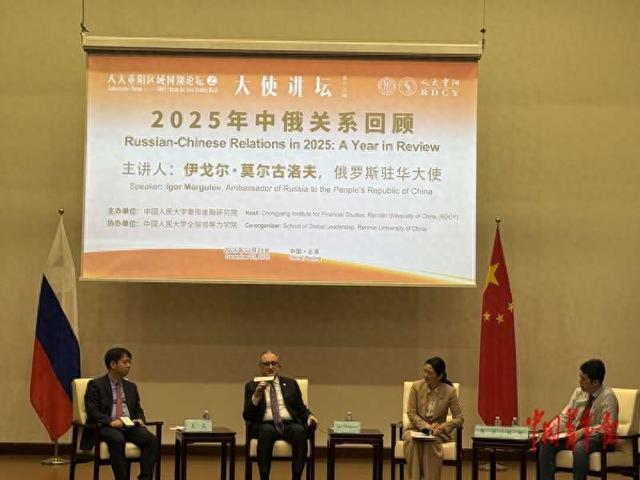
俄罗斯驻华大使引用毛主席的话勉励年轻人投身中俄合作
Zhong Guo Qing Nian Bao· 2025-12-24 09:07
Core Viewpoint - The Russian Ambassador to China, Igor Morgulov, emphasized the importance of youth in fostering the future development of Sino-Russian relations, highlighting the historical significance and current strength of the bilateral relationship [1][3]. Group 1: Diplomatic Relations - Morgulov stated that the Sino-Russian relationship has reached an unprecedented level of depth and mutual trust, becoming a model for constructive interaction among major powers in the 21st century [3]. - The year 2026 will mark the 25th anniversary of the signing of the Sino-Russian Treaty of Good-Neighborliness and Friendly Cooperation and the 30th anniversary of the establishment of their strategic partnership [3]. Group 2: Economic and Trade Cooperation - The two countries have successfully established efficient communication channels and new production logistics chains, along with a reliable bilateral settlement mechanism, primarily using the ruble and yuan for transactions [4]. - Ongoing discussions are taking place regarding the construction of a natural gas pipeline through Mongolia, which will secure gas supplies for Chinese consumers for decades to come [4]. Group 3: Educational and Cultural Exchange - The upcoming "Sino-Russian Education Year" is planned for 2026-2027, with current statistics showing 66,000 Chinese students studying in Russia and over 21,000 Russian students in China [5]. - The number of visa applications from Chinese citizens for study in Russia is expected to increase by 25% by 2025, with a target of achieving 100,000 academic exchanges by 2030, likely to be met ahead of schedule [5]. Group 4: Talent Development - Morgulov highlighted the need for professionals who are not only bilingual in Russian and Chinese but also possess expertise in international trade, finance, and relevant industries to support deepening cooperation [5]. - He expressed confidence that young individuals who align their academic and career aspirations with Sino-Russian cooperation will find ample opportunities in the job market [5].

记者手记|俄罗斯远东最小州涌动俄中合作潮
Xin Hua She· 2025-12-17 08:36
Core Insights - The cooperation between Russia and China is intensifying, particularly in the logistics and trade sectors, facilitated by the newly opened cross-river railway bridge connecting the two countries [1][2] Group 1: Infrastructure and Trade - The cross-river railway bridge between China and Russia, operational since November 2022, spans approximately 2,200 meters and has an annual cargo capacity of about 21 million tons, with current trade volume at over 5 million tons [1] - The primary exports from Russia to China include coal, iron ore, plywood, and cardboard, while imports from China consist mainly of electronic machinery and consumer goods [1] - Modernization efforts at the railway port include the construction of three new cargo stations to enhance transportation capacity and promote trade growth between the two nations [1] Group 2: Economic Development and Tourism - The Jewish Autonomous Oblast, the smallest region in the Russian Far East, is leveraging its proximity to China and its connection to the Trans-Siberian Railway to enhance its logistics potential [2] - Key industries in the region include logistics, agriculture, mineral development, and tourism, with increasing cooperation and exchanges with China [2] - Recent visa policy changes, including a temporary entry decree for Chinese citizens and a visa waiver for Russian citizens traveling to China, are expected to boost tourism and cultural exchanges [2]
记者手记|俄罗斯远东最小州涌动俄中合作潮
Xin Hua She· 2025-12-17 00:59
Core Insights - The article highlights the growing cooperation between Russia and China, particularly through the newly opened cross-river railway bridge connecting the two countries, which enhances trade and logistics opportunities [1][2]. Group 1: Infrastructure and Trade - The cross-river railway bridge between China and Russia, spanning approximately 2,200 meters, has a cargo capacity of about 21 million tons per year, with current annual import-export freight volume exceeding 5 million tons [1]. - The primary goods transported from Russia to China include coal, iron ore, plywood, and cardboard, while China exports electronic machinery and consumer goods to Russia [1]. - Modernization efforts at the railway port include plans to construct three new freight stations to increase transportation capacity and promote trade growth between the two nations [1]. Group 2: Regional Development and Cooperation - The Jewish Autonomous Oblast, the smallest region in the Russian Far East, is leveraging its proximity to China and its connection to the Trans-Siberian Railway to enhance its logistics potential [2]. - Key industries in the region include logistics, agriculture, mineral development, and tourism, with increasing cooperation and exchanges with China [2]. - Recent policy changes, such as the temporary entry of Chinese citizens into Russia and the visa exemption for Russian citizens traveling to China, are expected to boost tourism and cultural exchanges [2].
全球瞭望丨俄媒:中文在俄罗斯人职业发展中的“含金量”持续上升
Xin Hua She· 2025-12-15 05:36
Core Viewpoint - The increasing interest among Russians in learning Chinese is driven by the deepening economic, cultural, and technological cooperation between Russia and China, with Chinese seen as a key skill for enhancing career competitiveness [1]. Group 1: Economic and Professional Demand - The demand for Chinese language skills in Russia is primarily concentrated in sectors such as economics, finance, retail, e-commerce, information technology, logistics, media, design, and marketing [1]. - The motivation for Russian adults to learn Chinese stems from the need to meet professional demands in business and international cooperation, as well as a personal interest in Chinese culture and acquiring new skills [1]. Group 2: Cultural Understanding - Mastering Chinese is recognized as essential not only for language proficiency but also for a deep understanding of the cultural factors that shape Chinese thinking and behavior, which is crucial for effective career development [1]. - Experts emphasize that in the context of a rapidly evolving international landscape, proficiency in Chinese is becoming a key factor for integration into the global labor market and scientific community, as well as for cross-cultural communication [1].
俄媒:中文在俄罗斯人职业发展中的“含金量”持续上升
Xin Hua She· 2025-12-15 05:28
Core Insights - The article highlights the increasing importance of the Chinese language among Russians as a means to enhance professional competitiveness due to deepening economic, cultural, and technological cooperation between Russia and China [1] Group 1 - The growing trend of learning Chinese in Russia is linked to the strengthening of economic ties with China [1] - More Russians are recognizing Chinese as a valuable skill for career advancement [1]
俄外交部发言人:俄方视中方为优先合作伙伴
news flash· 2025-07-18 10:32
Core Viewpoint - Russia views China as a priority partner for cooperation, emphasizing their alignment on key international issues and the need for reform in the international system [1] Group 1 - The spokesperson for the Russian Foreign Ministry, Zakharova, stated that Russia and China will consider each other as priority partners on the international stage [1] - Both countries share similar or closely aligned positions on fundamental issues and major international topics [1] - One of the main goals of Russia-China cooperation is to promote reforms in the international system and enhance the role of the majority of countries in the decision-making process of the international agenda [1]
俄外交部发言人:俄中合作为金砖国家发展作出重要贡献
news flash· 2025-07-09 14:01
Group 1 - The core viewpoint is that the cooperation between Russia and China significantly contributes to the development of BRICS nations, emphasizing constructive collaboration that does not target any third parties [1] Group 2 - Russia's Foreign Ministry spokesperson, Zakharova, highlighted the importance of Russia-China cooperation in various aspects, including the BRICS mechanism [1] - The collaboration is framed as beneficial and constructive, indicating a positive outlook for the relationship between the two countries [1] - The statement suggests that the partnership is strategic and aimed at enhancing the influence of BRICS without antagonizing other nations [1]