保险原理

Search documents
遭吐槽的9.9元“延误险”,已下线!
Zhong Guo Jing Ji Wang· 2025-08-31 00:08
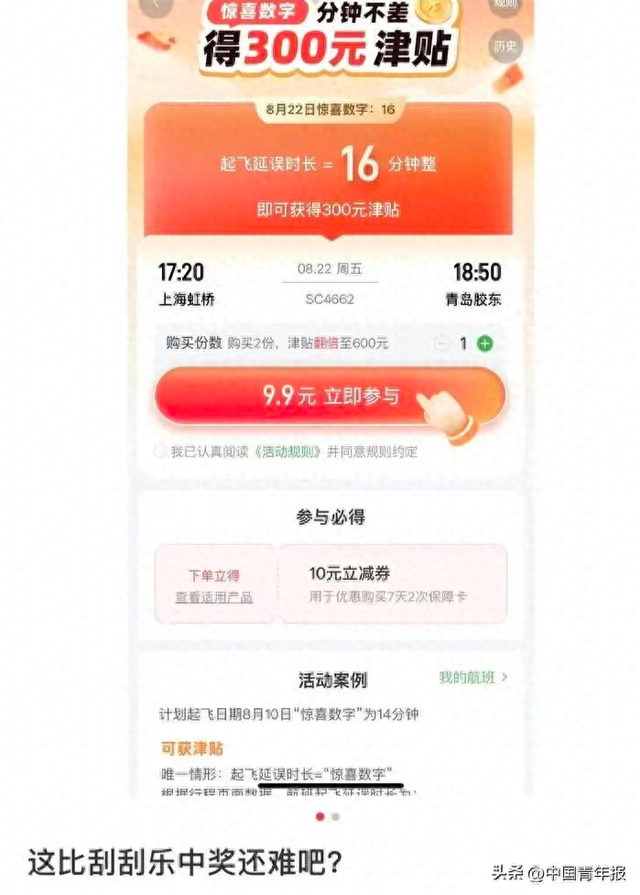
Core Viewpoint - The launch of the "Surprise Number" precise delay insurance by the company has faced significant consumer backlash due to its complicated payout conditions and perceived lack of genuine insurance characteristics [1][2][3]. Group 1: Product Details - The "Surprise Number" insurance costs 9.9 yuan and requires the actual delay time to match a specific number to qualify for compensation [3]. - The compensation is only applicable if the flight delay is exactly equal to the "Surprise Number," leading to consumer complaints about the low probability of receiving payouts [2][4]. Group 2: Consumer Reactions - Many consumers have criticized the product as a form of "wordplay" and likened it to a gambling game rather than a legitimate insurance product [4][5]. - Complaints highlight that the insurance appears to be more of a marketing gimmick than a viable risk-sharing mechanism, raising concerns about consumer rights and legal implications [5]. Group 3: Expert Opinions - Experts have pointed out that the precise minute-based trigger for payouts undermines the fundamental principles of insurance, making it resemble a gambling game rather than a risk-sharing product [4][5]. - There is a call for regulatory clarity to define the boundaries of such products and ensure that the industry maintains ethical standards [5].

遭吐槽的9.9元延误险,已下线!
Zhong Guo Qing Nian Bao· 2025-08-29 12:31
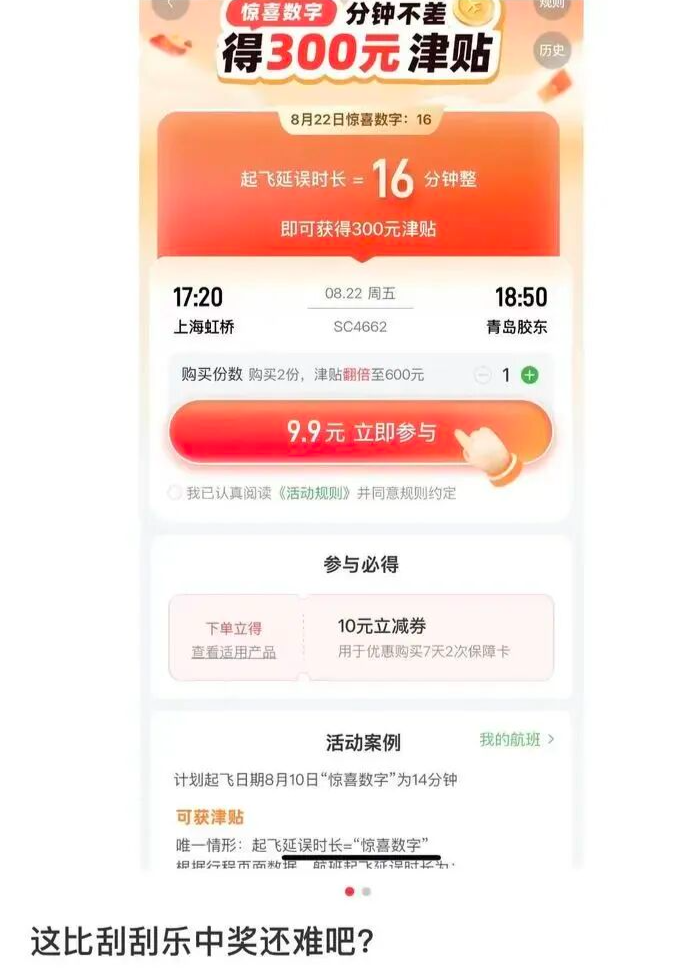
Core Viewpoint - The launch of the "Surprise Number" precise delay insurance by the company has faced significant consumer backlash, with many perceiving it as a gambling-like scheme rather than a legitimate insurance product [1][2][4]. Summary by Sections Product Overview - The "Surprise Number" insurance was priced at 9.9 yuan, promising compensation if the flight delay matched a specific number displayed on the app [1][3]. - The compensation condition required the delay to be exactly equal to the "Surprise Number," leading to confusion among consumers regarding the actual payout conditions [2][3]. Consumer Reactions - Many consumers expressed dissatisfaction, claiming the payout probability was nearly zero and likening the product to a guessing game [2][3]. - Complaints highlighted that the product felt more like a lottery or a game rather than a traditional insurance offering, with accusations of the company playing "word games" [3][4]. Expert Opinions - Experts criticized the insurance model, stating it violates fundamental insurance principles and resembles a gambling game rather than a legitimate insurance product [4][5]. - The precise payout mechanism was deemed problematic, as it significantly reduced the probability of claims, undermining the essence of risk-sharing inherent in insurance [5]. Regulatory Considerations - There are calls for regulatory bodies to clarify the boundaries of such insurance products to protect consumer rights and maintain industry integrity [5].