信用应用

Search documents
市场监管总局:让“无形信用”转化为服务发展的“有形动能”
Xin Hua Wang· 2026-02-05 09:47
Core Viewpoint - The market regulatory authority aims to enhance regulatory efficiency and optimize resource allocation by leveraging credit information, with a target of collecting 154.6 billion credit data entries by the end of 2025 [1] Group 1: Credit Information Collection and Sharing - By the end of 2025, the market regulatory authority plans to accumulate 154.6 billion entries of various credit information from business entities and achieve cross-departmental data sharing of 122.7 billion entries [1] - The implementation of national standards will help create precise credit profiles for enterprises and promote the application of credit data in financial credit and government services, effectively reducing institutional transaction costs [1] Group 2: Credit Risk Classification and Management - The market regulatory authority has implemented credit risk classification management for over 64 million enterprises nationwide, placing 14,900 severely untrustworthy enterprises on a "blacklist" [1] - Through annual report data analysis, the authority has identified and addressed issues related to large enterprises' overdue payments, achieving a problem detection rate exceeding 85% for high-risk enterprises [1] - As of the end of 2025, the authority aims to assist 45.79 million business entities in restoring their credit and guide over 18 million entities in compliant operations [1] Group 3: Continuous Improvement of Credit Regulation - The market regulatory authority will continue to deepen credit regulation reforms, enhancing the precision and effectiveness of supervision while expanding credit application scenarios [2] - The goal is to promote the concentration of credit resources towards high-quality enterprises, fostering a consensus among various business entities on the importance of "knowing, keeping, and using credit" [2]
我市一案例获评全国信用应用场景优秀实践
Nan Jing Ri Bao· 2025-12-24 02:32
Core Insights - The seventh China Urban Credit Construction Summit was held in Taizhou, Zhejiang, where the results of the "Xinhua Credit Cup" national credit application scenario practice and excellent micro-video evaluation were announced [1] - Among 1,767 credit practice cases, Nanjing's emergency management bureau's "Safety Production 'Code Credit' 'Instant Approval Integrity Service'" was recognized as an excellent practice [1] Group 1 - The "Instant Approval Integrity Service" integrates credit commitment with blockchain storage, ensuring the authenticity of identities through a digital ID issued by the Ministry of Public Security [2] - The system requires training institutions and examiners to use CA certification for encrypting key documents, ensuring clear accountability and traceability [2] Group 2 - The "One Code for Safety Certificates" system eliminates data barriers between provincial and municipal business systems, allowing for online submission of materials and reducing the need for physical documents [3] - AI-driven pre-review processes have been implemented, covering 208 review templates and utilizing 100,000 historical data points, significantly reducing exam application processing time from 90 days to under 20 days [3] - The innovative case has gained national media attention and attracted over 20 provinces and cities for targeted research and exchange [3] Group 3 - Nanjing's emergency management bureau plans to further enhance the application of the "Code Credit" and "Instant Approval Integrity Service," promoting data sharing across departments to build a more comprehensive safety production credit service system [3]
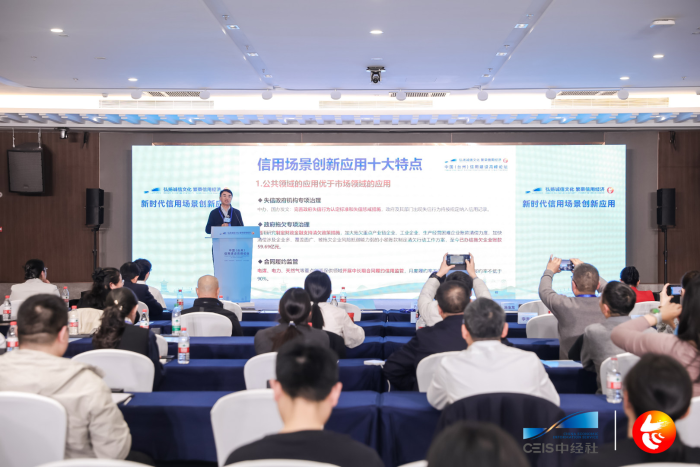
曾光辉:构建信用场景创新应用生态 为高质量发展注入信用动能
Zhong Guo Jin Rong Xin Xi Wang· 2025-12-15 06:37
Core Viewpoint - The China Urban Credit Construction Summit Forum emphasizes the importance of innovative credit application scenarios to drive high-quality development in the credit system, advocating for a comprehensive ecosystem supported by government guidance, market dynamics, and social collaboration [1][5]. Group 1: Credit Construction Framework - The essence of credit work is encapsulated in the "53324" framework, which includes five types of entities (government, market participants, social organizations, individuals, and judicial bodies), three categories of obligations (legal, contractual, and voluntary), and three stages (credit acceptance, evaluation, and utilization), supported by incentives and penalties across four dimensions (system, technology, application, and culture) [2]. - The statement "no scenario, no credit" highlights that credit must be embedded in specific scenarios to effectively reduce transaction costs, optimize resource allocation, and mitigate market risks [2]. Group 2: Current Characteristics of Credit Application - Current characteristics of credit application in China include: - Public sector applications outperform market applications - Industries with top-level design show more significant results - Punitive applications are more effective than incentive applications - Specific scenarios are preferred over universal scenarios - Corporate perception is stronger than individual perception - Urban credit is superior to rural credit - Eastern regions outperform central and western regions - Economic scenarios are prioritized over social scenarios - Institutional development in applications is favored over cultural development - Credit regulation is prioritized over credit services - Existing issues include insufficient breadth and depth, imbalanced development, and a lack of diverse scenarios, leading to an incomplete and unsustainable ecosystem [2]. Group 3: Recommendations for Credit Scene Innovation - Eight recommendations for building a credit scene innovation ecosystem include: - Accelerating the credit legislation process to solidify institutional foundations - Enhancing data collection and sharing quality to enrich data elements, focusing on market credit data integration - Promoting integrated credit platform services using technologies like big data, AI, and blockchain for precise credit profiling and dynamic monitoring - Expanding market-oriented, inclusive, and personal credit scenarios, including the promotion of personal credit scores - Facilitating cross-regional, cross-sector, and cross-industry credit scenario interoperability - Accelerating the cultivation of credit service institutions and encouraging collaborative innovation - Upholding data security and compliance to prevent credit misuse - Strengthening the promotion of integrity culture to foster a societal ethos of "knowing, keeping, and using credit" [3]. Group 4: Forum Overview - The China Urban Credit Construction Summit Forum serves as a high-level exchange platform for social credit system construction, focusing on cutting-edge topics in credit development, and has successfully held multiple sessions [5].