信用建设

Search documents
多维数据“透视”市场监管服务经济高质量发展成效 微观经济基础持续巩固
Yang Shi Wang· 2026-02-05 04:32
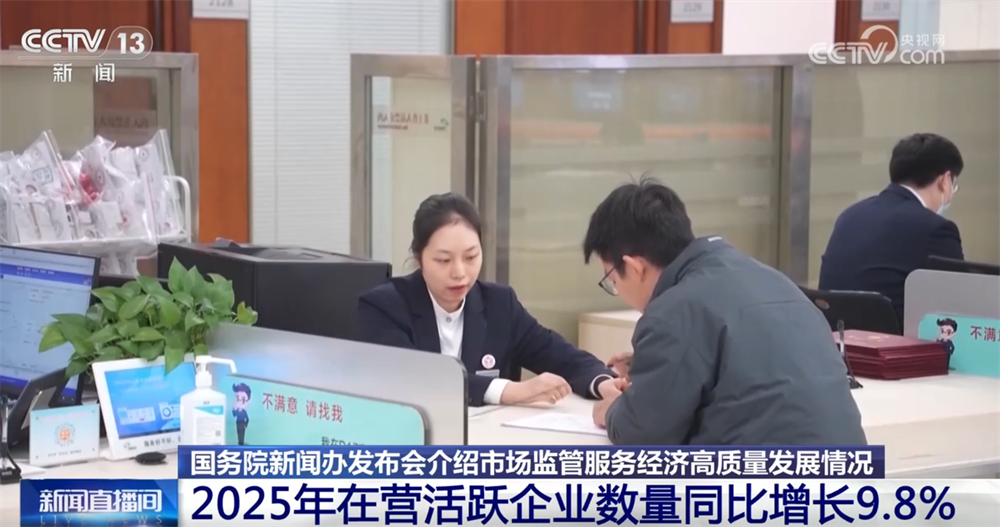
Core Viewpoint - The press conference highlighted the achievements of the State Administration for Market Regulation (SAMR) in optimizing the consumption environment, promoting fair competition, and protecting consumer rights, indicating a significant step towards high-quality economic development in China [1][16]. Group 1: Economic Recovery and Consumer Protection - In 2025, the number of newly established business entities reached 25.745 million, with active enterprises increasing by 9.8% year-on-year, reflecting a gradual economic recovery and strengthening of the microeconomic foundation [2]. - The SAMR received 26.46 million consumer complaints in 2025, recovering economic losses of 4.35 billion yuan and recalling 8.236 million unsafe consumer products, demonstrating effective market order maintenance and consumer rights protection [2]. Group 2: Improvement of Consumption Environment - The "Three-Year Action Plan for Optimizing the Consumption Environment," initiated in 2025, has shown initial success, with national standards released for various consumer goods and services, enhancing service quality [4][5]. - The construction of charging facilities and commercial distribution points has significantly improved the consumption environment and diversified consumption scenarios [5]. Group 3: Fair Competition Promotion - In 2025, the SAMR cracked down on "involution" competition, handling 14,600 cases of unfair competition, effectively curbing "price wars" and "subsidy wars" [8]. - The SAMR took decisive actions in key sectors like pharmaceuticals and platform economy to rectify abuses of rules, protecting the legitimate rights of small businesses and consumers [8]. Group 4: Credit Building and Data Sharing - Credit building is emphasized as a foundational tool for high-quality economic development, with 15.46 billion credit information records collected and 12.27 billion records shared across departments by the end of 2025 [10]. - Over 64 million enterprises underwent credit risk classification management, enhancing compliance and promoting credit improvement [10]. Group 5: Quality Improvement Initiatives - The SAMR has made significant progress in quality enhancement through initiatives targeting key industrial chains, investing 220 million yuan to tackle 289 tasks, particularly in critical areas like new energy vehicles and automotive chips [12]. - In 2025, 21 key technological bottlenecks were overcome, and 71 urgent quality technology gaps were filled, with 4,929 national standards published, a 56% increase year-on-year [17]. Group 6: National Unified Market Construction - The SAMR plans to further advance the construction of a national unified market, aiming to eliminate local protectionism and administrative monopolies, with special actions to address key cases and enhance antitrust enforcement [14]. Group 7: Safety Regulation Enhancements - Continuous efforts are being made to strengthen safety regulations for food, pharmaceuticals, industrial products, and special equipment, with the national food safety supervision sampling failure rate at 2.74% in 2025, a 57% year-on-year decrease in the number of non-compliant enterprises [21].

三方面发力 加快培育服务消费新增长点
Jin Rong Shi Bao· 2026-01-30 02:00
Core Viewpoint - The State Council of China has issued a work plan to accelerate the cultivation of new growth points in service consumption, aiming to enhance service quality and promote high-quality economic development [1] Group 1: Standardization - Establishing a standardized system is crucial for upgrading service quality, especially in emerging industries where a lack of unified standards can lead to disorder and inconsistent service quality [2] - The plan emphasizes the need to develop advanced and applicable standards in key areas such as transportation, housekeeping, cultural tourism, and elderly care to guide service supply and foster a standardized brand in the service industry [2] Group 2: Credit System - Strengthening credit construction is essential for enhancing consumer confidence, particularly in service sectors closely related to people's livelihoods, such as elderly care, housekeeping, and tourism [2] - The plan proposes utilizing platforms like "Credit China" and the National Enterprise Credit Information Publicity System to improve the collection and disclosure of credit information, creating a governance framework that incentivizes trustworthiness and penalizes dishonesty [2] Group 3: Financial Support - Reinforcing fiscal and financial support is vital for expanding service consumption, particularly for small and micro enterprises that dominate the service sector [3] - The plan outlines a combination of fiscal and financial strategies to lower financing costs for market entities, encourage financial institutions to increase credit supply, and support eligible enterprises in issuing bonds and REITs to enhance market financing channels [3] Group 4: Implementation - The development of service consumption requires tailored approaches due to regional differences in consumer demand, industrial foundations, and resource endowments [4] - The plan calls for local governments and relevant departments to innovate support measures and detail implementation plans, focusing on local characteristics to cultivate new service consumption scenarios and ensuring collaboration among departments to effectively deliver policy benefits to market entities and consumers [4]

在杭州,2026年你的生活将迎来这些新变化
Hang Zhou Ri Bao· 2026-01-23 05:56
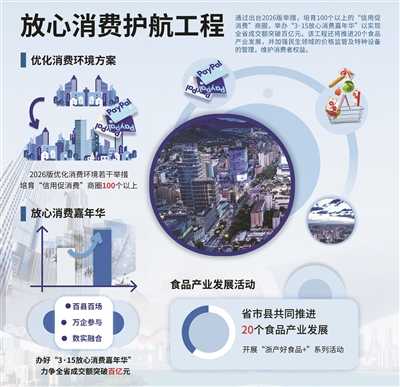
Core Viewpoint - Zhejiang Province is implementing a series of regulatory initiatives aimed at enhancing consumer safety, improving the business environment, and fostering trust in the market, which will significantly impact daily life by 2026 [2][3][4][5] Group 1: Consumer Safety and Experience - The province will launch the "3·15 Consumer Carnival" to promote safe consumption, involving hundreds of counties and thousands of enterprises [2] - A comprehensive food safety management system will be established, including an AI-driven non-site supervision model to enhance transparency in food delivery services [3] - Quality assurance measures will be introduced for online products, allowing consumers to verify product quality through QR codes [3] Group 2: Business Environment Optimization - The implementation of a compliance guide for platform fees aims to address transparency and fairness in platform economics [3] - A monitoring system for abnormal pricing will be established to shift focus from price competition to quality and service improvement [3] - The business environment will be further optimized by streamlining inter-provincial business migration and addressing arbitrary fees [4] Group 3: Technological Integration and Support - The integration of artificial intelligence into government services will enhance efficiency and intelligence in administrative processes [5] - A "Million Subject Credit Project" will provide more conveniences for trustworthy enterprises, promoting a culture of creditworthiness [5] - The establishment of a comprehensive market supervision network will facilitate better regulatory oversight and support for businesses [5]
杭州创新预付式消费综合治理模式
Mei Ri Shang Bao· 2025-12-24 23:44
Group 1 - The core viewpoint of the article is that Hangzhou has implemented innovative practices to address the challenges of prepaid consumption, such as refund difficulties and business closures, through "credit empowerment and social co-governance" [1] - Hangzhou has been recognized as a national pioneer in this area, with its practices being rated as the best in the province and promoted throughout the province [1] - The city has clarified the responsibilities of administrative departments involved in prepaid consumption management, enhancing departmental collaboration and risk warning mechanisms, resulting in a significant decrease of 19.23% in consumer complaints related to business closures by November 2025 [1] Group 2 - Credit construction is central to the governance model, with the first batch of credit star ratings for the beauty and hairdressing industry being released, providing clear guidance for consumers and establishing benchmarks for honest businesses [2] - Hangzhou has introduced incentive measures for businesses that collect prepaid payments through compliant third-party platforms, including exemptions from card issuance registration and financial support of up to 200,000 yuan for those exploring fund safety management [2] - The Hangzhou Market Supervision Administration has developed a public service platform, "Hangqi Hui," which has provided financing support to thousands of individual operators, with several banks offering special credit based on this platform and credit evaluation results [2]
翌星(海南)投资有限公司以制度与风控夯实新股投资基础
Jiang Nan Shi Bao· 2025-12-24 01:41
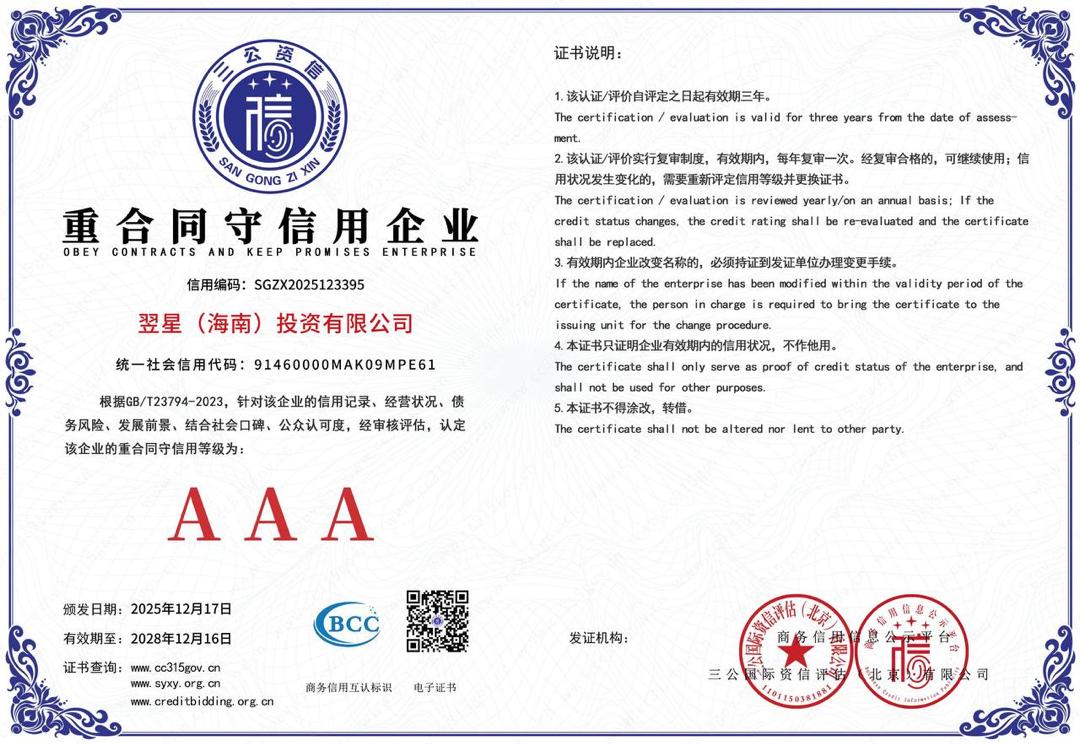
Core Viewpoint - The company, Yixing (Hainan) Investment Co., Ltd., is positioned to thrive in the evolving Chinese capital market by emphasizing stability, credit building, and long-term investment strategies [1][9]. Group 1: Company Overview - Yixing (Hainan) Investment Co., Ltd. was established with a focus on steady operations, credit construction, and long-term investment [1]. - The company leverages the advantages of the Hainan Free Trade Port, aiming to create a well-governed investment institution with a robust risk control system and sustainable development capabilities [1]. - The management believes that a successful investment institution must possess self-restraint and a long-term perspective rather than relying on market emotions or short-term fluctuations [1]. Group 2: Credit Management - Credit is a core element of the company's operational system, influencing transaction success and long-term reputation in the market [2]. - The company has established a stable, verifiable, and sustainable credit system through contract compliance, process improvement, internal supervision, and enhanced information transparency, achieving an overall credit rating of AAA [2]. - The governance structure emphasizes institutional primacy and process adherence, ensuring strict management of investment decisions and financial operations [2]. Group 3: Investment Strategy - The company focuses its investment direction on the new stock market, which has a relatively strict issuance system and information disclosure requirements, providing a certain advantage in overall risk structure [3]. - By concentrating on new stock investments, the company aims to achieve smooth returns and risk diversification through long-term participation in multiple projects rather than relying on single projects or short-term opportunities [3]. - The investment philosophy is centered on fundamental analysis, selecting stocks with long-term growth potential based on comprehensive research [4]. Group 4: Investment Execution and Risk Control - The company has established a clear operational process that adheres to compliance requirements from fundraising to investment allocation and profit distribution [6]. - A comprehensive risk management mechanism covers the entire investment lifecycle, employing pre-investment reviews, ongoing monitoring, and post-investment evaluations to manage market, liquidity, and operational risks [6]. - The company emphasizes the importance of maintaining a clear path for fund operations and reducing operational risks through robust fund management systems [7]. Group 5: Transparency and Development Planning - The company prioritizes transparency in profit distribution and communication with investors, ensuring clarity in profit sources and distribution methods [8]. - The development strategy is gradual, focusing initially on system building and process improvement, then expanding service capabilities and market recognition over time [8]. - The favorable policy environment of the Hainan Free Trade Port supports the company's long-term development, allowing it to align with national financial regulatory requirements while leveraging regional advantages [8]. Group 6: Overall Investment Philosophy - The new stock investment system established by the company is based on credit, supported by professionalism and centered on risk control, reflecting a systematic understanding of market rules and long-term value [9]. - The company aims to continue its steady approach and long-term value focus in the new stock investment and asset management sectors, striving for mutual growth with partners [9].
城记 | 以“信”为锚:78家上市公司“台州军团”背后的活力密码
Xin Hua Cai Jing· 2025-12-21 13:42
Core Insights - The article emphasizes the importance of credit as a fundamental element of market economy, highlighting Taizhou's unique credit culture rooted in its historical trade practices and the development of a robust private economy [1][4] Group 1: Historical Development of Credit in Taizhou - Taizhou has a rich history of grassroots entrepreneurship, with the first individual business license issued in 1979 and the first cooperative enterprise established in 1982, showcasing the early establishment of a credit network based on personal relationships [2][3] - The establishment of the Yinzuo Financial Service Society in 1988 marked a significant evolution in credit services for small and micro enterprises, transitioning from informal borrowing to structured lending [3] - By 2002, the formation of Taizhou Commercial Bank represented a milestone as the first city commercial bank in China without government control, leading to the development of a sustainable financial ecosystem for small businesses [3] Group 2: Modern Financial Innovations - In 2015, the establishment of the Taizhou Small and Micro Enterprise Financial Service Reform and Innovation Pilot Zone received national recognition, positioning Taizhou as a leader in inclusive financial services [4] - The creation of a credit information sharing platform has significantly reduced the cost of pre-loan investigations for banks, contributing to a decrease in non-performing loan rates from 1.58% in 2015 to 0.60% by 2025 [7] - The introduction of a credit guarantee fund in 2014 has facilitated access to financing for small enterprises, with an average guarantee fee rate of only 0.6% by 2025, significantly lower than market averages [7][8] Group 3: Systematic Credit Development - The transition from personal to systematic credit is crucial for Taizhou's economic transformation, as over 99% of its enterprises are small and micro businesses that require reliable financial support [6] - The implementation of innovative financing mechanisms, such as trademark and patent pledges, has addressed the challenges of insufficient collateral for small businesses, leading to significant financing amounts [8] - By 2025, the total amount of loans secured by various intangible assets reached 2840.8 billion, demonstrating the effectiveness of these new credit mechanisms [8] Group 4: Impact on the Local Economy - The number of small micro loan accounts surged from 240,000 in 2015 to 609,100 by September 2025, with the total loan balance increasing from 231.32 billion to 1,057.08 billion, reflecting a 4.6-fold growth over ten years [11] - The proportion of small micro loans in total loans reached 54.08%, exceeding the national average by nearly 20 percentage points, indicating a significant improvement in financial accessibility [11] - The growth of the Taizhou stock market, with 78 listed companies, underscores the positive impact of enhanced credit systems on local economic development [11]
曾光辉:构建信用场景创新应用生态 为高质量发展注入信用动能
Zhong Guo Jin Rong Xin Xi Wang· 2025-12-15 06:37
Core Viewpoint - The China Urban Credit Construction Summit Forum emphasizes the importance of innovative credit application scenarios to drive high-quality development in the credit system, advocating for a comprehensive ecosystem supported by government guidance, market dynamics, and social collaboration [1][5]. Group 1: Credit Construction Framework - The essence of credit work is encapsulated in the "53324" framework, which includes five types of entities (government, market participants, social organizations, individuals, and judicial bodies), three categories of obligations (legal, contractual, and voluntary), and three stages (credit acceptance, evaluation, and utilization), supported by incentives and penalties across four dimensions (system, technology, application, and culture) [2]. - The statement "no scenario, no credit" highlights that credit must be embedded in specific scenarios to effectively reduce transaction costs, optimize resource allocation, and mitigate market risks [2]. Group 2: Current Characteristics of Credit Application - Current characteristics of credit application in China include: - Public sector applications outperform market applications - Industries with top-level design show more significant results - Punitive applications are more effective than incentive applications - Specific scenarios are preferred over universal scenarios - Corporate perception is stronger than individual perception - Urban credit is superior to rural credit - Eastern regions outperform central and western regions - Economic scenarios are prioritized over social scenarios - Institutional development in applications is favored over cultural development - Credit regulation is prioritized over credit services - Existing issues include insufficient breadth and depth, imbalanced development, and a lack of diverse scenarios, leading to an incomplete and unsustainable ecosystem [2]. Group 3: Recommendations for Credit Scene Innovation - Eight recommendations for building a credit scene innovation ecosystem include: - Accelerating the credit legislation process to solidify institutional foundations - Enhancing data collection and sharing quality to enrich data elements, focusing on market credit data integration - Promoting integrated credit platform services using technologies like big data, AI, and blockchain for precise credit profiling and dynamic monitoring - Expanding market-oriented, inclusive, and personal credit scenarios, including the promotion of personal credit scores - Facilitating cross-regional, cross-sector, and cross-industry credit scenario interoperability - Accelerating the cultivation of credit service institutions and encouraging collaborative innovation - Upholding data security and compliance to prevent credit misuse - Strengthening the promotion of integrity culture to foster a societal ethos of "knowing, keeping, and using credit" [3]. Group 4: Forum Overview - The China Urban Credit Construction Summit Forum serves as a high-level exchange platform for social credit system construction, focusing on cutting-edge topics in credit development, and has successfully held multiple sessions [5].
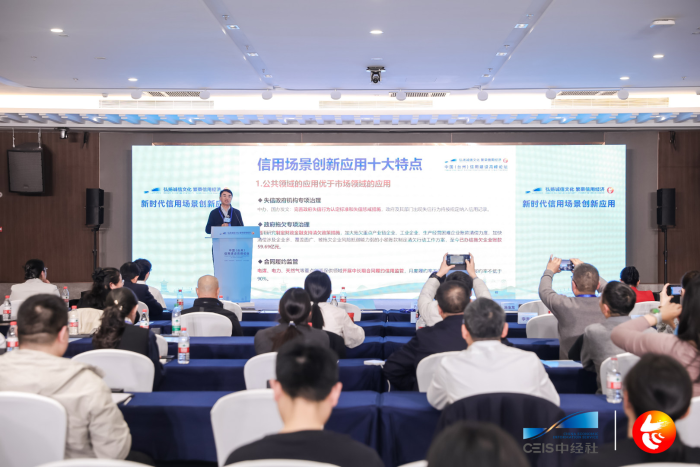
诚信力量汇聚台州 共绘信用经济新蓝图
Xin Hua She· 2025-12-14 00:27
Group 1 - The core theme of the forum is to promote the culture of integrity and the prosperity of the credit economy, highlighting the importance of credit in urban civilization and development [1] - The construction of the social credit system is entering a new stage focused on enhancing quality and efficiency, with six key dimensions identified for improvement, including data quality and credit service enhancement [2] - Experts emphasize the transformation from integrity culture to credit economy as a significant value change, requiring the integration of credit into resource allocation and the establishment of a stable credit economic foundation [2][3] Group 2 - Zhejiang's credit economy has undergone profound changes, with successful models like "Wentai Model" and "Yiwu Experience" demonstrating the effective relationship between government and enterprises [3] - Cities like Taizhou and Kaifeng are implementing innovative practices to integrate credit concepts into economic development, with Taizhou reporting a GDP growth of 6.3% and fixed asset investment growth of 3.9% in the first three quarters [4][5] - The forum resulted in significant outcomes, including the release of the "China Urban Integrity Construction Influence Report 2025" and the establishment of the "Taizhou Consensus" on credit construction [5]
奈曼旗何以赴2025企业家博鳌论坛?
Xin Hua Cai Jing· 2025-12-06 09:50
Core Viewpoint - Naiman Banner showcases its strength in high-quality county development through ecological governance, industrial upgrades, credit building, and improving people's livelihoods at the 2025 Entrepreneur Boao Forum [1] Ecological Development - Naiman Banner integrates ecological protection into its overall development, achieving significant results in transforming desertified land into green oases, completing 442,600 acres of the "Three North" Phase VI project in 2025, and implementing integrated protection and restoration of 168,600 acres of forest, grassland, and wetlands [3] - The region has earned the reputation of being a "microcosm of Inner Mongolia," with three 4A-level scenic spots and one 3A-level scenic spot, promoting ecological tourism through a balance of protection and development [5] Industrial Development - Naiman Banner focuses on "strong industry and prosperous industry," establishing a modern industrial system with diverse support and cluster development, including the emergence of three major industrial clusters: nickel-based new materials, silicon-based new materials, and green energy [8] - The region has launched five stainless steel deep processing projects, completed the world's largest single nano-microcrystalline material production line, and produced 120 million kilowatts of "super charging battery clusters," indicating a continuous release of industrial development potential [8] Credit and Business Environment - Naiman Banner has innovatively constructed a new development model integrating credit building, legal protection, technological empowerment, and industrial integration, successfully transforming credit "soft constraints" into development "hard support" [9] - The local government has improved its credibility through service-oriented law enforcement and has implemented a "three-step alternative method" recognized as a national innovation case in government services [9] Livelihood Improvement - Naiman Banner prioritizes improving people's livelihoods, with continuous upgrades in education and healthcare, achieving full coverage of tightly-knit county medical communities, and enhancing infrastructure such as 5G bases and rural roads [10] - The region promotes rural revitalization through deep integration of agriculture, culture, and tourism, developing immersive projects and improving logistics and e-commerce systems to facilitate the distribution of high-quality agricultural products nationwide [10]
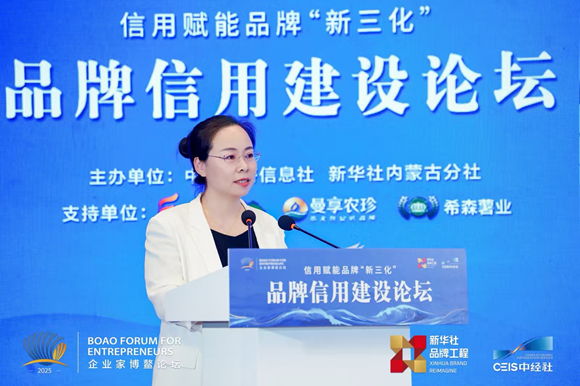
以“信用+”赋能 走向智能化、绿色化、融合化
Zhong Guo Jin Rong Xin Xi Wang· 2025-12-05 00:25
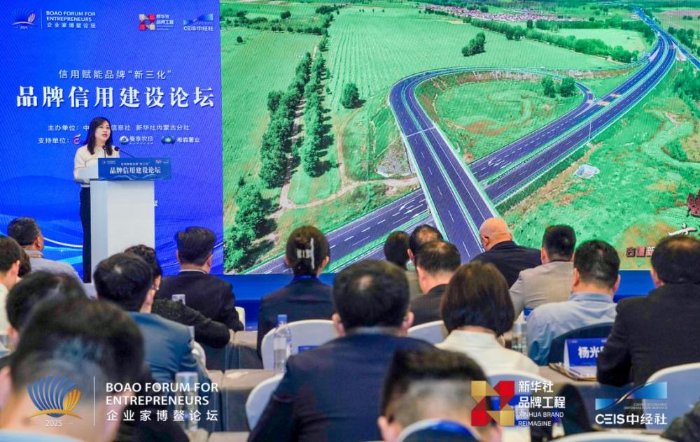
Core Viewpoint - The 2025 Brand Credit Construction Forum emphasizes the importance of credit in enabling the modernization of industrial systems through intelligent, green, and integrated development [1][3]. Group 1: Intelligent Development - Credit serves as the foundation for developing "new quality productivity" and must be integrated with the "Digital China" and "Credit China" initiatives to foster a virtuous cycle of technology innovation and integrity [3]. - The digital economy era shifts focus from material consumption to data and algorithms, highlighting the need for new technologies and management practices to enhance brand credit [3][5]. Group 2: Green Development - Credit acts as a bridge for implementing the "Two Mountains" concept, transforming ecological value into recognized economic value through a robust credit system [3]. - Establishing ESG evaluation standards is crucial for providing credible proof of environmental quality, thereby enhancing market recognition of ecological products [3]. Group 3: Integrated Development - Credit is identified as the ecological link for constructing a new development pattern, promoting a culture of integrity and cooperation across various industries [5]. - The integration of cultural and tourism sectors is transitioning from policy guidance to practical implementation, enhancing product offerings and consumer experiences while driving economic growth [5][6]. Group 4: Brand Credit Construction - Brand construction is essential for corporate competitiveness and longevity, focusing on value co-creation and industry responsibility [4]. - The forum highlighted the interconnection of trust, quality credit, and brand building as a system that drives continuous improvement in the business environment [7]. Group 5: Forum Overview - The 2025 Brand Credit Construction Forum was guided by the Xinhua News Agency's Brand Work Office and organized by the China Economic Information Service and Xinhua's Inner Mongolia branch [8].