
储能行业市场化

Search documents
新能源车ETF(159806)涨超1%,锂电行业需求增长显著
Mei Ri Jing Ji Xin Wen· 2025-12-11 03:21
Group 1 - The lithium battery industry is experiencing significant demand growth, with shipments expected to exceed 1.2 TWh in the first three quarters of 2025, representing a year-on-year increase of 60% [1] - The demand for power and energy storage batteries is robust, and material prices are beginning to recover after hitting a low point [1] - Solid-state battery technology is advancing rapidly, with increased policy support anticipated to lead to mass production by 2027 and a projected global shipment of 614.1 GWh by 2030, driving rapid growth in lithium metal anode demand [1] Group 2 - The energy storage industry is progressing towards marketization, with new energy storage installations in China expected to surpass 100 GW for the first time in the first half of 2025, reflecting a year-on-year increase of 110% [1] - The offshore wind power sector is thriving, with a focus on deep-sea development and accelerated implementation of floating technology, projecting an addition of 36 GW of new installations globally by 2030 [1] - The overall industry is showing a recovery trend characterized by significant growth in niche segments (lithium battery storage, offshore wind) and technological advancements (nuclear fusion, solid-state batteries, AIDC) [1] Group 3 - The New Energy Vehicle ETF (159806) tracks the CS New Energy Vehicle Index (399976), which selects listed companies involved in electric vehicles, batteries, and related industries from the Shanghai and Shenzhen markets [1] - This index reflects the overall performance of listed companies in the new energy vehicle sector, characterized by high industry concentration and technological orientation, providing a comprehensive view of the development trends in China's new energy vehicle industry [1]
海外储能需求激增 国内电芯厂商订单排期满满
Zheng Quan Shi Bao· 2025-09-02 18:12
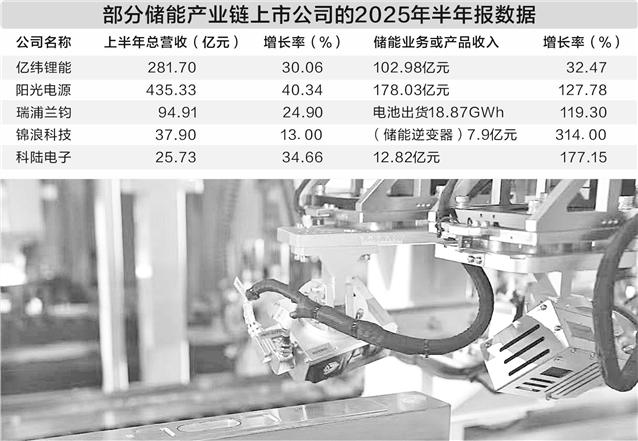
Core Viewpoint - The energy storage industry is experiencing explosive growth in demand, particularly in overseas markets, leading to significant increases in orders and production capacity among domestic companies [3][5][6]. Group 1: Financial Performance of Companies - Yihui Lithium Energy reported total revenue of 28.17 billion yuan, a growth rate of 30.06%, with energy storage product revenue of 10.298 billion yuan, growing by 32.47% [1]. - Sunshine Power achieved total revenue of 43.533 billion yuan, a growth rate of 40.34%, with energy storage business revenue of 17.803 billion yuan, increasing by 127.78% [1]. - Ruipu Lanjun's energy storage battery shipments reached 18.87 GWh, reflecting a year-on-year growth of approximately 119.3% [1][6]. - Kelu Electronics reported energy storage business revenue of 1.282 billion yuan, a significant increase of 177.15%, accounting for 49.83% of total revenue [1][6]. Group 2: Market Demand and Production Capacity - The energy storage sector is currently facing a "one cell is hard to find" situation due to surging overseas demand, with companies experiencing order backlogs [3][5]. - Hai Chen Energy's Chongqing factory has been operating at full capacity since March, with orders already scheduled through October [4]. - The global energy storage cell shipment volume reached 226 GWh in the first half of 2025, marking a year-on-year increase of 97%, with Chinese companies accounting for over 90% of the market [6]. Group 3: Overseas Market Expansion - In the first half of 2025, Chinese companies secured 199 new overseas energy storage orders totaling over 16 GWh, a year-on-year increase of 220.28% [7]. - The Middle East emerged as the fastest-growing market, with orders reaching 37.55 GWh, while Australia and Europe also contributed significantly to the demand [7]. - Companies are increasingly focusing on overseas markets due to higher profit margins and robust demand, particularly in emerging markets [7][8]. Group 4: Policy and Market Dynamics - The implementation of the market-oriented pricing reform for renewable energy has accelerated project construction, leading to a surge in energy storage orders [9][11]. - The new policies are expected to enhance the economic viability of energy storage, transitioning the industry from policy-driven to market-driven growth [10][11]. - The high demand in the energy storage sector has prompted several companies to pursue listings in Hong Kong to support capacity expansion and international market engagement [11].

储能行业市场化洗牌,出海多点开花破局
2 1 Shi Ji Jing Ji Bao Dao· 2025-05-30 11:35
Core Viewpoint - The recent policy changes in China's energy storage sector, particularly the implementation of the "136 document" and the "394 document," are driving a shift from policy-driven growth to market-oriented operations, leading to a mixed response from companies in the industry [1][4]. Group 1: Policy Changes and Market Impact - The "136 document" mandates that new energy projects will operate under a market-based pricing mechanism, with all electricity from new projects entering market trading [1]. - The "394 document" aims for nationwide coverage of the electricity spot market by the end of 2025, promoting the optimization of energy storage resources and the elimination of outdated capacity [1][3]. - The transition has led to a divergence in company strategies, with some rushing to complete projects before the policy changes take full effect, while others are delaying or exiting the energy storage business [2][3]. Group 2: Industry Trends and Company Responses - The energy storage market has seen a decline in installed capacity for the first quarter of this year, marking a shift from rapid expansion to a focus on quality and efficiency [2][3]. - Over eight listed companies have announced delays or cancellations of their energy storage projects this year, reflecting the cautious investment climate [3][4]. - Leading companies like CATL and BYD are increasing their investments in energy storage, anticipating significant market growth in the coming years [5]. Group 3: Global Market Dynamics - Chinese companies are gaining a competitive edge in the global energy storage market, with significant breakthroughs in both AC and DC sectors, surpassing Tesla in the AC market [6][7]. - The first quarter of this year saw a surge in overseas orders for Chinese energy storage companies, particularly in Australia, indicating strong international demand despite tariff challenges [7]. - The European energy storage market is expected to shift from residential storage to large-scale storage solutions, with significant growth projected in countries like the UK and Italy [8][9].