僵尸化

Search documents
AI冲击下,软件业走向“僵尸化”?
智通财经网· 2026-02-11 08:45
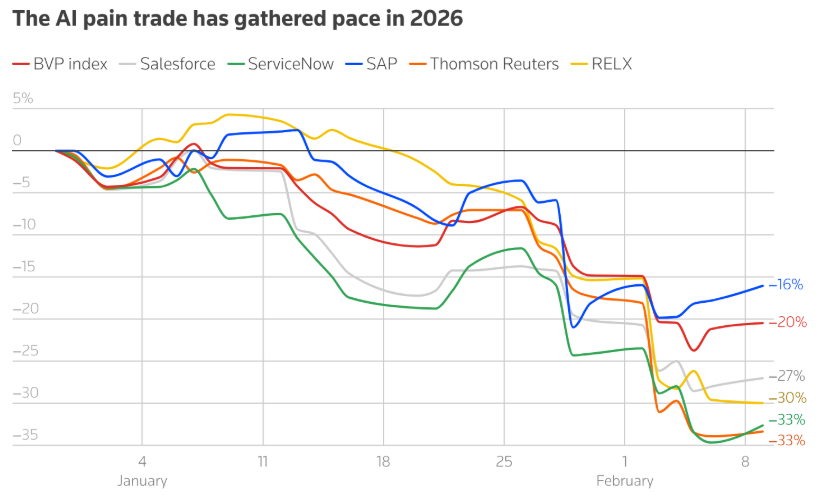
Group 1 - The core viewpoint is that artificial intelligence will impact existing software, data, and professional services companies, but it will not completely destroy them. Investors seem to share this perspective, as indicated by a Breakingviews analysis comparing valuation drops with recent analyst forecasts [1] - The BVP Nasdaq Emerging Cloud Index, a benchmark for software stocks, has declined by 20% year-to-date, raising concerns that AI chatbots like Claude from Anthropic could serve as flexible alternatives to existing company products [1] - Companies such as RELX and Thomson Reuters have seen their stock prices drop by approximately one-third since the end of 2025 due to this panic [1] Group 2 - ServiceNow's enterprise value is estimated at $105 billion, with free cash flow projected to grow from $5.8 billion this year to $10.3 billion by 2029. The implied value of recent cash flows, discounted at a 10% rate, is $27 billion [4] - After subtracting this amount from the enterprise value, ServiceNow's business value from 2030 onwards is approximately $78 billion, which translates to $114 billion in 2030 dollars using a 10% discount rate [5] - The long-term growth rate required to achieve this figure is only 0.9%, significantly lower than the previous year's growth rate of 5.7% [5] Group 3 - A study of 76 stocks, including BVP index components and some European software companies, shows a median long-term growth rate of 0.9%. About 60% of these companies are expected to grow from 2030, but only one-third will exceed a growth rate of 2% [6] - Companies like Monday.com, RingCentral, and Wix.com are exceptions that reflect expectations of significant declines in free cash flow starting in 2030 [6] Group 4 - Analysts caution that the analysis may be overly simplistic, as sell-side brokers might not have adjusted their forecasts for 2029, and a uniform 10% discount rate may not be appropriate across different industries [8] - The analysis suggests that AI is more likely to "zombify" existing companies rather than quickly eliminate them, raising questions about how CEOs should respond to this reality [8] - Stocks like SAP are trading close to what is termed "liquidation value," indicating a scenario where management accepts decline and cuts all growth-related spending to maximize cash extraction [8] Group 5 - Currently, no major data or software companies are pursuing a liquidation strategy, as many, like ServiceNow, continue to show strong growth. However, the market signals that many companies may soon stagnate or even face rapid decline [9] - If investors are pricing these companies as if they are zombie firms, it raises concerns about whether these companies will operate in a manner similar to actual zombie enterprises [9]