
全球系统重要性银行(G-SIB)

Search documents
2025全球系统重要性银行公布!五家大行评分齐涨,工行升至第三组
Xin Lang Cai Jing· 2025-12-02 00:50
Core Points - The Financial Stability Board (FSB) released the 2025 Global Systemically Important Banks (G-SIBs) list, maintaining the number of Chinese banks at five, with the Industrial and Commercial Bank of China (ICBC) moving up to the third group, marking it as the first Chinese bank in this category [1][4][3] - The other four Chinese banks, namely Agricultural Bank of China, Bank of China, and China Construction Bank, remain in the second group, while Bank of Communications stays in the first group [4][5] Group Summaries - **G-SIB Group Rankings**: The 2025 G-SIB list includes five groups, with ICBC in the third group, requiring an additional capital requirement increase from 1.5% to 2.0%. The fourth group remains occupied by JPMorgan Chase, while the second group includes nine institutions, and the first group consists of 15 banks [4][5][12] - **Score Changes**: ICBC's score increased significantly by 33 points to 332, while Bank of China rose by 32 points to 314, Agricultural Bank by 15 points to 272, Construction Bank by 10 points to 259, and Bank of Communications by 9 points to 138 [8][10] - **Impact of Exchange Rates**: Analysts noted that exchange rate factors may have influenced the scoring of Chinese G-SIBs, with potential implications for their 2026 ratings. The historical context suggests that exchange rates have previously alleviated pressure on scores [10][7] - **TLAC Bond Issuance**: To meet the total loss-absorbing capacity (TLAC) requirements, major state-owned banks have been actively issuing TLAC bonds. For instance, Agricultural Bank issued TLAC bonds worth 20 billion yuan, and Bank of Communications issued bonds worth 30 billion yuan [13][12]






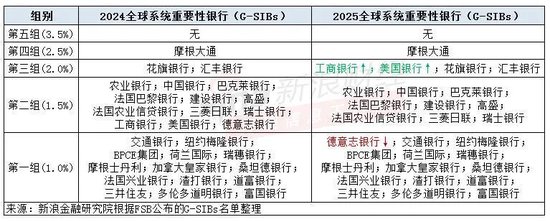
工行晋升全球系统重要性银行第三组 为中资银行首家
2 1 Shi Ji Jing Ji Bao Dao· 2025-11-28 13:00
Core Viewpoint - The Financial Stability Board (FSB) announced the 2025 Global Systemically Important Banks (G-SIB) list, with the Industrial and Commercial Bank of China (ICBC) moving from the second group to the third group, marking it as the first Chinese bank to enter the G-SIB third group, indicating an increased significance of Chinese banks in the global financial system [1] Group 1: G-SIB Classification and Capital Requirements - ICBC's additional capital requirement will increase from 1.5% to 2.0% following its group adjustment, while the other four Chinese banks maintain their current group standings [1] - The G-SIB evaluation framework, established post-2007 financial crisis, aims to enhance capital requirements for large banks to mitigate systemic risks [1] Group 2: Scoring Changes and Influencing Factors - The scoring changes for Chinese G-SIBs this year show that scale is no longer the primary driver for score increases, with ICBC and China Bank seeing significant score increases of 33 and 32 points respectively due to multiple sub-factors [2] - Currency fluctuations have positively impacted the scores of Chinese institutions this year, contrasting with historical trends where such factors typically alleviated score increases; however, future currency volatility may suppress scores [2] Group 3: Basel Committee Adjustments and Future Outlook - The Basel Committee is considering changing the G-SIB identification framework from year-end static data to average values over the year, with a preference for quarterly averages among feedback [3] - Standard & Poor's Ratings indicated that ICBC is capable of meeting the higher capital requirements, with a total loss-absorbing capacity capital ratio of 21.52% as of September 30, 2025, exceeding the minimum requirement for the third group [3] - ICBC's conservative growth strategy is expected to support capital retention and manage capital buffer pressures, with projected asset growth remaining controlled and loan growth likely in single digits over the next two years [3]