
总损失吸收能力非资本债券(TLAC债券)

Search documents
2025全球系统重要性银行公布!五家大行评分齐涨,工行升至第三组
Xin Lang Cai Jing· 2025-12-02 00:50
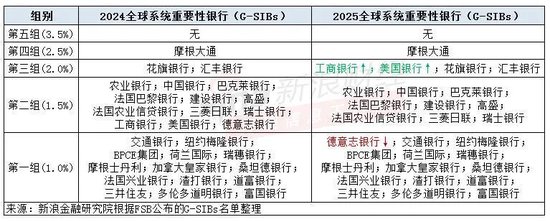
Core Points - The Financial Stability Board (FSB) released the 2025 Global Systemically Important Banks (G-SIBs) list, maintaining the number of Chinese banks at five, with the Industrial and Commercial Bank of China (ICBC) moving up to the third group, marking it as the first Chinese bank in this category [1][4][3] - The other four Chinese banks, namely Agricultural Bank of China, Bank of China, and China Construction Bank, remain in the second group, while Bank of Communications stays in the first group [4][5] Group Summaries - **G-SIB Group Rankings**: The 2025 G-SIB list includes five groups, with ICBC in the third group, requiring an additional capital requirement increase from 1.5% to 2.0%. The fourth group remains occupied by JPMorgan Chase, while the second group includes nine institutions, and the first group consists of 15 banks [4][5][12] - **Score Changes**: ICBC's score increased significantly by 33 points to 332, while Bank of China rose by 32 points to 314, Agricultural Bank by 15 points to 272, Construction Bank by 10 points to 259, and Bank of Communications by 9 points to 138 [8][10] - **Impact of Exchange Rates**: Analysts noted that exchange rate factors may have influenced the scoring of Chinese G-SIBs, with potential implications for their 2026 ratings. The historical context suggests that exchange rates have previously alleviated pressure on scores [10][7] - **TLAC Bond Issuance**: To meet the total loss-absorbing capacity (TLAC) requirements, major state-owned banks have been actively issuing TLAC bonds. For instance, Agricultural Bank issued TLAC bonds worth 20 billion yuan, and Bank of Communications issued bonds worth 30 billion yuan [13][12]






总损失吸收能力非资本债券密集发行
Jin Rong Shi Bao· 2025-08-08 07:59
Core Viewpoint - The issuance of Total Loss-Absorbing Capacity (TLAC) bonds by China's globally systemically important banks (G-SIBs) is a proactive measure to enhance their loss absorption capabilities and align with international regulatory standards [1][3][6] Group 1: TLAC Bond Issuance - Three out of five G-SIBs in China have issued TLAC non-capital bonds to improve their total loss-absorbing capacity [1] - The first bank to issue TLAC bonds in 2025 was Bank of Communications, followed by Agricultural Bank of China and Bank of China, with respective issuance amounts of RMB 300 billion, RMB 500 billion, and RMB 400 billion [2] - The approved issuance limits for the banks are RMB 600 billion for Industrial and Commercial Bank of China, RMB 1800 billion for Agricultural Bank of China, RMB 1500 billion for Bank of China, and RMB 3000 billion for Bank of Communications [2] Group 2: Regulatory Framework and Compliance - The People's Bank of China, along with other regulatory bodies, established a TLAC regulatory framework in October 2021, requiring G-SIBs to meet specific external TLAC ratio requirements by early 2025 and 2028 [4] - Banks are encouraged to develop detailed timelines and strategies for achieving TLAC compliance, alongside optimizing capital management [4][5] Group 3: Market Impact and Strategic Importance - The issuance of TLAC bonds is seen as a milestone for China's financial system, enhancing the banks' capital and risk management capabilities while increasing the variety of credit bonds available in the domestic market [5] - Achieving TLAC compliance is viewed as essential for the international development of the five major banks, reflecting their commitment to global financial standards and enhancing China's banking sector's international reputation [6]