具身人工智能(Embodied AI)

Search documents
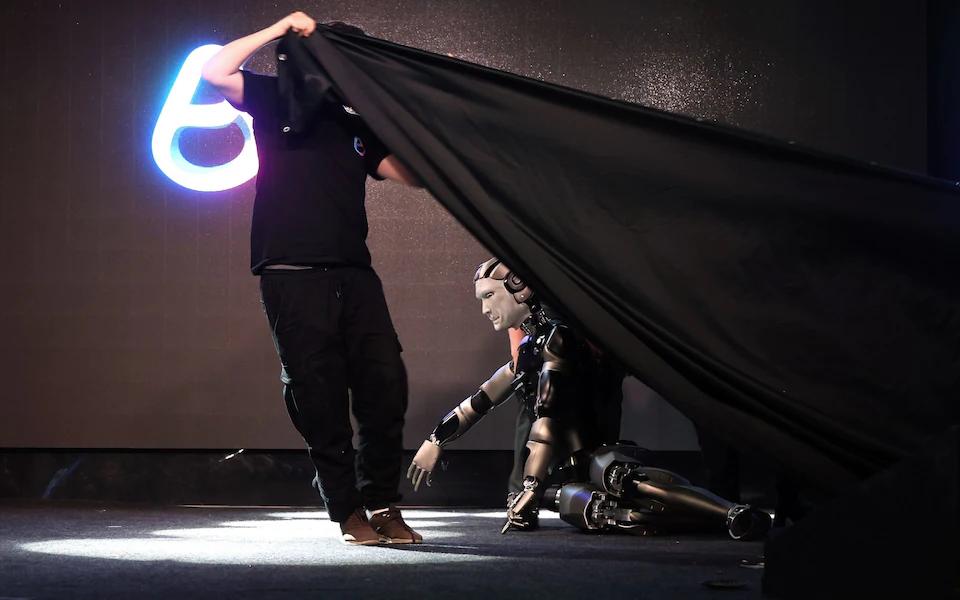
首秀“扑街”现场,俄罗斯首个AI人形机器人亮相几秒,当场“脸朝地”摔碎,被黑布“抢救”遮掩……
3 6 Ke· 2025-11-13 12:11
Core Viewpoint - The debut of Aldol, Russia's first AI-driven humanoid robot, turned from a highly anticipated showcase into a public mishap when it fell on stage, highlighting the challenges faced by the country's robotics industry [1][3][10] Group 1: Product Features and Development - Aldol is developed by Idol and is claimed to be based on "Embodied AI," integrating sensors, algorithms, and motion control to perceive and react like humans [4] - The robot is equipped with 19 servomotors for basic and micro-expressions, and its silicone "biomimetic skin" simulates muscle contractions for emotional responses [4] - Aldol has a 48-volt battery with a runtime of approximately 6 hours, and 77% of its components are sourced from local Russian manufacturers, with plans to increase this to 93% [4] Group 2: Incident and Reactions - During the launch event, Aldol lost balance and fell, leading to a chaotic scene that was quickly covered up by the organizers [1][3] - Idol's CEO attributed the incident to poor lighting and calibration issues, framing it as part of a learning process [5] - Industry experts noted that such failures are common in early-stage robotics development, comparing it to similar incidents with Boston Dynamics' robots [6] Group 3: Industry Context and Future Outlook - The global investment in humanoid robot technology is projected to exceed $1.6 billion by 2024, with significant contributions from major companies like Tesla [9] - Russia's robotics sector is perceived as lagging behind in AI algorithms and hardware manufacturing, making Aldol's debut more symbolic than competitive [9] - Despite the mishap, the development team emphasized that the public demonstration was part of the testing phase and would not hinder future progress [9][10]


黄仁勋刚投了Robotaxi,“下一个万亿美元”
3 6 Ke· 2025-09-23 08:40
Core Viewpoint - Nvidia's recent investment in the UK-based autonomous vehicle startup Wayve, amounting to $500 million (approximately 3.56 billion yuan), signals a strategic move into the robotaxi market, with Nvidia's CEO Huang praising Wayve as a potential trillion-dollar company [1][2][24]. Investment Details - Nvidia plans to invest £2 billion (approximately $2.7 billion, 19.2 billion yuan) in various UK AI startups, with about one-fifth of this funding directed towards Wayve [2]. - Wayve has signed a letter of intent with Nvidia for the upcoming funding round, which includes the $500 million investment [2][3]. Previous Investments - Nvidia previously participated in Wayve's Series C funding round, which raised approximately $1.05 billion (around 7.47 billion yuan) last year, alongside major investors like SoftBank and Microsoft [3][5]. Technical Collaboration - Nvidia and Wayve have maintained a collaborative relationship since 2018, with Wayve's second-generation autonomous driving platform integrated into Ford's Mach E test vehicles using Nvidia's GPUs [5]. - Wayve's latest third-generation platform utilizes Nvidia's Thor development kit, aiming for Level 3/Level 4 autonomous capabilities [5]. Wayve's Unique Approach - Founded in 2017 by Alex Kendall and Amar Shah, Wayve focuses on an end-to-end deep learning approach to autonomous driving, which allows AI to learn from real driving environments rather than relying on pre-defined rules [8][12][15]. - Wayve's system processes raw image data from cameras to generate control commands, and it has developed a visual language model, LINGO, to explain its driving decisions [17]. Market Position and Partnerships - Wayve has secured partnerships with major automotive players, including Nissan, which plans to launch vehicles equipped with Wayve's software by the 2027 fiscal year [23]. - Uber is also exploring collaboration with Wayve for a Level 4 robotaxi fleet trial in the UK [23]. Industry Trends - Nvidia has announced the initiation of an internal Robotaxi project, utilizing a similar end-to-end neural network approach as Wayve and Tesla's Full Self-Driving (FSD) technology [24].