农信系统深化改革

Search documents
江西农商联合银行获批22亿元“上参下”,参股省内19家农商行
Hua Xia Shi Bao· 2025-12-17 09:01
Core Viewpoint - Jiangxi Rural Commercial Bank has taken a significant step in its "upward participation and downward investment" model by obtaining approval to invest up to 220.475 million yuan in 19 rural commercial banks, enhancing the governance and risk management of the rural financial system in Jiangxi province [2][3][6]. Group 1: Investment Details - The investment involves 19 rural commercial banks across Nanchang, Shangrao, and Pingxiang, with each holding at least 5% [2][3]. - The highest stake is in Hengfeng Rural Commercial Bank at 34.22%, while the lowest is in Yiyang Rural Commercial Bank at 5.08% [4]. - The total investment amount approved is 220.475 million yuan, marking a substantial financial commitment to strengthen local banks [3][6]. Group 2: Institutional Context - Jiangxi Rural Commercial Bank, established in April 2023, is the seventh provincial-level rural commercial bank in China, overseeing 85 banks and over 2,200 branches, with total assets of 1.4 trillion yuan [3][6]. - The "upward participation and downward investment" model aims to enhance the coordination and governance of rural financial institutions by creating a capital link between provincial and county-level banks [6][8]. Group 3: Challenges and Opportunities - Many of the banks involved in this investment face common issues such as high non-performing loan rates and insufficient capital [7]. - For instance, Ganchang Rural Commercial Bank reported a non-performing loan rate of 4.6% and a capital adequacy ratio of 10.59% as of the end of 2024, indicating the need for improved financial health [7]. - The investment is expected to enhance the capital levels of these banks, providing them with more room to manage non-performing assets [6][7].


大动作,贵阳农商行拟吸收合并七家农信法人机构 农信改革迈出关键一步
Mei Ri Jing Ji Xin Wen· 2025-11-18 11:49
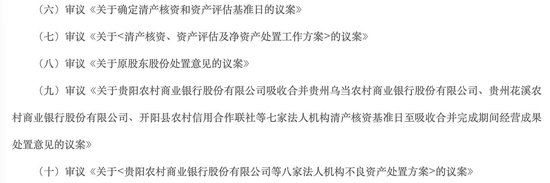
Core Viewpoint - Guiyang Rural Commercial Bank is set to hold its first extraordinary shareholders' meeting on December 1, 2025, to review a series of proposals for the absorption and merger of seven rural credit institutions, marking a significant step in the reform of unified legal person rural commercial banks in Guiyang [1][2]. Group 1: Reform Framework - The announcement outlines over ten proposals that detail the overall framework of the reform, including the merger of institutions such as Guizhou Wudang Rural Commercial Bank and Guizhou Huaxi Rural Commercial Bank [2]. - This reform is characterized as a systematic restructuring rather than a simple consolidation, with the shareholders' meeting set to review a comprehensive plan including feasibility studies and implementation strategies [2][3]. Group 2: Asset Evaluation and Shareholder Concerns - A key aspect of the merger process is determining the baseline date for asset evaluation, which will serve as an objective basis for assessing the value of each institution's assets and determining share conversion ratios [4]. - Proposals will clarify how existing shareholders' rights will transition into the new unified legal entity, with plans for targeted capital raising to enhance the merged bank's risk resilience and growth capacity [4]. Group 3: Operational Efficiency and Governance - The reform aims to mitigate localized financial risks and optimize financial resource allocation to better support rural revitalization and local economic development [5]. - Notable governance proposals include extending the term of the second board of directors to ensure stability during the reform and the potential elimination of the supervisory board, indicating a shift towards a modern governance model [5]. Group 4: Future Prospects and Challenges - Upon successful merger, the new bank is expected to significantly expand its asset scale, branch coverage, and overall business volume, becoming a crucial pillar in the local financial system [6]. - The merger presents both opportunities and challenges, including the integration of corporate cultures, management systems, and information technology, which are critical for achieving operational efficiency and market competitiveness [6].
事关省级农商行筹建,这地迎来重大进展!
券商中国· 2025-08-11 07:29
Core Viewpoint - Gansu Province is making significant progress in the establishment of a provincial rural commercial bank, transitioning from the initial plan of a "Gansu Rural Commercial Union Bank" to a unified legal entity model for the "Gansu Rural Commercial Bank" [1][2][4]. Group 1: Progress in Establishment - Gansu Jinchang Rural Commercial Bank and Gansu Yongchang Rural Commercial Bank announced temporary shareholder meetings to discuss the establishment of the Gansu Rural Commercial Bank [1][4]. - The Gansu rural financial institutions currently include 37 rural commercial banks, 5 rural cooperative banks, and 41 county-level cooperatives, covering 86% of administrative villages and 90% of farmers [1]. - The asset quality of Gansu's rural financial institutions has been inconsistent, with non-performing loan rates exceeding 6% for three consecutive years from 2019 to 2021 [1]. Group 2: Government Support and Reforms - In 2021 and 2022, Gansu issued special bonds of 12.6 billion and 30 billion yuan respectively to support the development of small and medium-sized banks [2]. - The 2023 government work report indicated a shift in focus towards the establishment of a unified legal entity model for the Gansu Rural Commercial Bank, moving away from the previously proposed union bank model [2][4]. - The Gansu Rural Credit Union's 2024 work report suggests that the reform plan is nearing approval, with 2025 marked as the year for the implementation of the reform [3]. Group 3: Reform Models and Trends - The unified legal entity model is seen as a more thorough reform approach, suitable for provinces with fewer legal entities and a higher level of economic development [6]. - Other provinces, such as Henan and Xinjiang, have also switched to the unified legal entity model, indicating a broader trend in regional financial reforms [8][11]. - The central government's focus on rural credit cooperative reform has been consistent, with multiple provinces successfully establishing new "trillion banks" [14].