
联合银行模式

Search documents
“一省一策”落地贵州 农商联合银行添丁
Zhong Guo Zheng Quan Bao· 2025-12-22 20:42
Core Viewpoint - The establishment of Guizhou Rural Commercial Bank marks a significant breakthrough in the reform of rural credit cooperatives in Guizhou, with the participation of Kweichow Moutai as a key shareholder, enhancing the bank's capital strength and market credibility [1][2] Group 1: Guizhou Rural Commercial Bank Establishment - Guizhou Rural Commercial Bank has a registered capital of 10.458 billion yuan, with shareholding ratios of 15.032% by Guizhou Provincial Finance Department, 65.844% by Guizhou Financial Holding Group, 9.562% by Kweichow Moutai, and 9.562% by Guizhou Qiansheng State-owned Assets Management [2] - The establishment of Guizhou Rural Commercial Bank is a crucial step in the reform of rural credit cooperatives in Guizhou, aiming to implement the provincial-level bank model as outlined in the 2025 government work report [2][4] Group 2: Benefits of Moutai's Participation - Moutai's investment in Guizhou Rural Commercial Bank is expected to enhance the bank's capital strength, improve corporate governance and market image, and increase its credit and financing capabilities [2][3] - For Moutai, the stake in the bank will strengthen financial collaboration across its supply chain, improving financial accessibility and risk control for distributors and logistics [3] Group 3: Reform Strategy and Implementation - The "one province, one policy" approach to rural credit cooperative reform emphasizes tailored strategies for different provinces, with Guizhou adopting a joint bank model to integrate resources from 84 county-level institutions [4][5] - The joint bank model features a two-tier legal structure, allowing provincial banks and county-level rural commercial banks to maintain independent legal status while forming a collaborative system [4] Group 4: Future Focus and Goals - Experts predict that the focus of rural credit cooperative reform in the coming year will be on stabilizing risks, strengthening governance, supplementing capital, and enhancing capabilities [6][7] - Key areas of reform will include accelerating the establishment of unified legal entities at the municipal level, improving capital supplementation mechanisms, and building digital risk control platforms [7]
“一省一策”落地贵州农商联合银行添丁
Zhong Guo Zheng Quan Bao· 2025-12-22 20:19
Group 1 - Guizhou Rural Commercial Bank has been approved for establishment, marking a significant breakthrough in the reform of rural credit cooperatives in Guizhou [1] - China Guizhou Moutai Distillery Co., Ltd. has become a key shareholder, which is expected to enhance the bank's capital strength, market reputation, and synergy within the industrial chain [1][2] - The registered capital of Guizhou Rural Commercial Bank is 10.458 billion yuan, with shareholding ratios of 15.032% for the Guizhou Provincial Finance Department, 65.844% for Guizhou Financial Holdings Group, and 9.562% each for Moutai Group and Guizhou Qiansheng State-owned Assets Management [1] Group 2 - The introduction of quality industrial capital from Moutai Group is anticipated to improve the governance and market image of Guizhou Rural Commercial Bank, enhancing its credit and financing capabilities [2] - Moutai Group's stake is expected to strengthen financial collaboration across its supply chain, improving financial accessibility and risk control for upstream and downstream partners [2] - The "one province, one policy" approach to rural credit cooperative reform has been emphasized in the central government's documents for six consecutive years, with various provinces adopting different models [2][3] Group 3 - The joint bank model features a two-tier legal structure, allowing provincial joint banks and county-level rural commercial banks to maintain independent legal status while forming a collaborative system [3] - Guizhou's decision to establish a provincial joint bank aims to integrate resources from 84 county-level institutions to address weaknesses in individual institutions and improve risk control [3] - The joint bank model allows for gradual risk management and targeted restructuring of high-risk institutions, facilitating collaboration with local finance and state-owned assets [3] Group 4 - Experts predict that the focus of rural credit cooperative reform in the coming year will be on stabilizing risks, strengthening governance, supplementing capital, and enhancing capabilities [4] - The reform will accelerate the establishment of unified legal entities at the municipal level and improve capital supplementation mechanisms [4] - There will be an emphasis on digital transformation to enhance services for agriculture and small enterprises, alongside the development of supportive policies for capital, tax incentives, and non-performing asset management [4]
含“茅”量超9%!这家农商联合银行获批开业
券商中国· 2025-12-16 05:39
Core Viewpoint - Guizhou Rural Commercial Bank has been approved to commence operations, with a registered capital of 10.458 billion RMB, and significant shareholding from Guizhou Moutai and Guizhou Financial Holdings [1][2]. Shareholding Structure - Guizhou Provincial Finance Department contributed 1.572 billion RMB, holding 15.032% of shares - Guizhou Financial Holdings contributed 6.886 billion RMB, holding 65.844% of shares - Guizhou Moutai contributed 1 billion RMB, holding 9.562% of shares - Guizhou Qiansheng State-owned Assets Management contributed 1 billion RMB, holding 9.562% of shares [1][2]. Bank Formation and Leadership - The establishment of Guizhou Rural Commercial Bank was approved following the termination of the original Guizhou Provincial Rural Credit Cooperative Union, with all debts and credits transferred to the new bank - The first leadership team includes Yang Song as Chairman and Yang Hongjun as Vice Chairman and President [2]. Rapid Development - The bank's establishment process took less than a year, indicating a swift development [3]. Banking Model - The "Joint Bank" model was adopted for the reform, allowing provincial banks to control county-level banks while retaining their legal status, which is seen as a cost-effective and flexible approach [4][5]. Asset Scale - Guizhou Rural Commercial Bank is expected to become the first bank in Guizhou with assets exceeding 1 trillion RMB, with the provincial rural credit system's total assets reaching 1.1591 trillion RMB by October 2025, showing a significant increase since 2020 [6].


来宾农商行“六合一”!广西地级市统一法人农商行落地
Hua Xia Shi Bao· 2025-11-27 11:17
Core Viewpoint - The recent approval by the Guangxi Regulatory Bureau of the National Financial Supervision Administration for the merger of Laibin Rural Commercial Bank with five other rural financial institutions signifies a trend towards consolidating local rural banks into unified legal entities, enhancing financial resource allocation efficiency and risk management [2][3][4]. Summary by Sections Merger Details - Laibin Rural Commercial Bank will absorb and merge with Wuxuan Rural Commercial Bank, Jinxiu Rural Commercial Bank, Xiangzhou Rural Cooperative Bank, Xincheng County Rural Credit Cooperative, and Heshan Rural Credit Cooperative, leading to the cancellation of their legal entities and their transformation into branches of Laibin Rural Commercial Bank [3][4]. - The merger plan has been in preparation since July 1, with clear guidelines on asset, business, and shareholder rights transfer [4]. Background and Context - Laibin Rural Commercial Bank has undergone several reforms since its establishment in 1953, evolving through various stages to its current form [5]. - The merger reflects a broader trend in the Guangxi rural financial system aimed at "reducing quantity and improving quality," with the establishment of the Guangxi Rural Commercial Union Bank serving as a guiding framework for such consolidations [5]. Exploration of Models - The reform of rural financial systems in China is accelerating, with two main models being explored: the unified legal entity model and the joint bank model [6]. - The unified legal entity model has been adopted in provinces like Liaoning, Hainan, and Henan, focusing on resource consolidation through mergers [9]. Expert Opinions - Experts highlight the advantages of the unified legal entity model in risk management and resource allocation, while also noting the challenges such as high reform costs and potential loss of local flexibility [10][11]. - The joint bank model retains local independence but may face limitations in risk management and structural issues [11].

农信系统改革稳步推进 河南农商行吸收合并82家机构
Xin Lang Cai Jing· 2025-09-30 00:33
Core Insights - The core viewpoint of the news is that Henan Rural Commercial Bank has officially absorbed and merged 82 institutions, marking a significant step in the reform of the rural credit system in Henan Province [1][9]. Summary by Sections Announcement of Merger - On September 28, Henan Rural Commercial Bank announced the approval from the National Financial Supervision Administration of Henan to absorb and merge 82 institutions, including rural commercial banks and village banks from nine cities [1][2]. Implications of the Merger - This merger is seen as a crucial measure in the ongoing reform of the rural credit system, reflecting the "one province, one policy" approach and the practice of a unified legal entity model [1][9]. Details of the Merger - Following the merger, Henan Rural Commercial Bank will inherit all assets, liabilities, businesses, personnel, branches, and other rights and obligations of the absorbed institutions, with existing customer accounts and services remaining unchanged [3]. Historical Context of Reforms - The reform of the rural credit system in Henan has been gradual, with previous adjustments including the approval of a reform plan in 2022 and the establishment of Henan Rural Commercial Bank in 2023 [4][5]. Shift in Reform Strategy - The reform strategy has shifted from a "joint bank" model to a "unified legal entity" model, which is more comprehensive and suitable for provinces with fewer legal entities [7][8]. Broader Trends in Other Provinces - Other provinces, such as Xinjiang and Gansu, are also transitioning from a joint bank model to a unified legal entity model, indicating a broader trend in the reform of rural credit systems across China [8][9].
事关省级农商行筹建,这地迎来重大进展!
券商中国· 2025-08-11 07:29
Core Viewpoint - Gansu Province is making significant progress in the establishment of a provincial rural commercial bank, transitioning from the initial plan of a "Gansu Rural Commercial Union Bank" to a unified legal entity model for the "Gansu Rural Commercial Bank" [1][2][4]. Group 1: Progress in Establishment - Gansu Jinchang Rural Commercial Bank and Gansu Yongchang Rural Commercial Bank announced temporary shareholder meetings to discuss the establishment of the Gansu Rural Commercial Bank [1][4]. - The Gansu rural financial institutions currently include 37 rural commercial banks, 5 rural cooperative banks, and 41 county-level cooperatives, covering 86% of administrative villages and 90% of farmers [1]. - The asset quality of Gansu's rural financial institutions has been inconsistent, with non-performing loan rates exceeding 6% for three consecutive years from 2019 to 2021 [1]. Group 2: Government Support and Reforms - In 2021 and 2022, Gansu issued special bonds of 12.6 billion and 30 billion yuan respectively to support the development of small and medium-sized banks [2]. - The 2023 government work report indicated a shift in focus towards the establishment of a unified legal entity model for the Gansu Rural Commercial Bank, moving away from the previously proposed union bank model [2][4]. - The Gansu Rural Credit Union's 2024 work report suggests that the reform plan is nearing approval, with 2025 marked as the year for the implementation of the reform [3]. Group 3: Reform Models and Trends - The unified legal entity model is seen as a more thorough reform approach, suitable for provinces with fewer legal entities and a higher level of economic development [6]. - Other provinces, such as Henan and Xinjiang, have also switched to the unified legal entity model, indicating a broader trend in regional financial reforms [8][11]. - The central government's focus on rural credit cooperative reform has been consistent, with multiple provinces successfully establishing new "trillion banks" [14].

贵州农信改革重要动向!筹建农商联合银行,这些股东将入股
券商中国· 2025-07-31 13:58
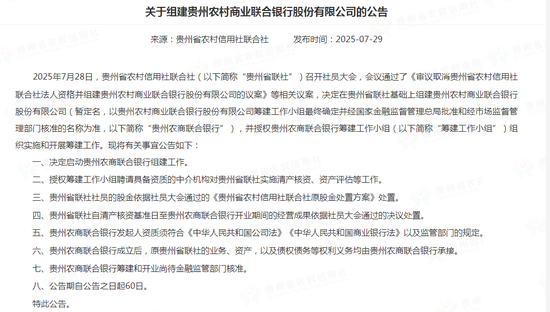
Core Viewpoint - The establishment of the Guizhou Rural Commercial Union Bank is officially underway, aiming to enhance local financial institutions and support rural credit reforms in Guizhou province [1][3]. Group 1: Establishment and Structure - The Guizhou Rural Commercial Union Bank will be formed by canceling the legal status of the Guizhou Rural Credit Cooperative Union and establishing a new joint-stock company [3]. - The new bank will inherit all business, assets, and liabilities from the Guizhou Rural Credit Cooperative Union, pending approval from financial regulatory authorities [3]. - The establishment process will involve hiring qualified intermediaries for asset evaluation and financial audits [3]. Group 2: Financial Performance and Scale - Guizhou Rural Credit has a network of 2,293 branches and over 28,000 employees, with deposits exceeding 922.9 billion and loans surpassing 709.5 billion [4]. - The total assets of Guizhou Rural Credit exceeded 1 trillion, reaching 1,070.45 billion [4]. Group 3: Involvement of State-Owned Enterprises - Guizhou Financial Holding Group and Qiansheng State-owned Assets will play significant roles in the reform process [5][8]. - Guizhou Financial Holding Group, established in December 2016, operates across various financial sectors, including banking and asset management [6]. - Qiansheng State-owned Assets focuses on capital operation management and holds stakes in several companies, enhancing its financial capabilities [7]. Group 4: Reform Models and Trends - The joint bank model is seen as a cost-effective reform that maintains a multi-level governance structure, suitable for provinces with many quality rural commercial banks [9][10]. - The "upward participation" model allows the provincial bank to optimize the equity structure of rural financial institutions, improving governance [10]. Group 5: Broader Context of Rural Bank Reforms - Other provinces, such as Jilin, are also advancing their rural bank reforms, with Jilin Rural Commercial Bank's establishment approved recently [11][12]. - The trend of establishing provincial rural commercial banks is accelerating, with several banks already launched in 2024 [14]. - The Xinjiang region is also working towards establishing a unified rural commercial bank, aiming for completion by 2025 [15].

再添一员!“贵州农商联合银行”落地进入倒计时,贵州金控等或将入股
Xin Lang Cai Jing· 2025-07-31 10:51
Core Viewpoint - The establishment of Guizhou Rural Commercial Bank is a significant step in the ongoing reform of rural credit cooperatives in China, with the aim of enhancing local financial institutions and improving their operational efficiency [1][2][5]. Group 1: Establishment of Guizhou Rural Commercial Bank - Guizhou Rural Commercial Bank is set to be established based on the Guizhou Provincial Credit Union, with all business, assets, and liabilities being transferred to the new entity upon its formation, pending regulatory approval [1][2]. - The decision to form the bank was made during a member meeting of the Guizhou Provincial Credit Union, which also authorized a working group to oversee the establishment process [2][5]. Group 2: Acceleration of Rural Credit Cooperative Reforms - As of now, six provinces in China have established provincial-level rural commercial banks, including Zhejiang, Shanxi, Sichuan, Guangxi, Jiangsu, and Jiangxi, while four provinces have set up provincial-level rural commercial banks [1][8]. - The Guizhou provincial government has included the acceleration of rural credit cooperative reforms in its work reports for multiple years, indicating a strong commitment to this initiative [2][4]. Group 3: Support from Local Financial Institutions - Guizhou Financial Holdings Group has engaged in discussions with the Guizhou Provincial Credit Union regarding potential investments and support for the reform process [5]. - The Guizhou Provincial Credit Union is actively seeking partnerships with local state-owned enterprises to facilitate the reform and enhance its capital structure [5][6]. Group 4: Broader Context of Rural Financial Reforms - The ongoing reforms are part of a larger trend across China, with various provinces moving towards establishing unified legal entities for rural commercial banks to streamline operations and improve governance [10][11]. - The reform models being adopted vary, with some provinces opting for a unified legal entity model while others maintain a cooperative structure, reflecting the diverse needs and conditions of different regions [11].
广东首度“官宣”省联社改革方向 将积极推动改制组建农商联合银行
2 1 Shi Ji Jing Ji Bao Dao· 2025-05-06 11:28
Core Viewpoint - The Guangdong Provincial Association of Rural Credit Cooperatives has outlined its reform direction, emphasizing the establishment of rural commercial banks and the promotion of a joint banking model as part of the ongoing rural financial system reform [1][3]. Group 1: Reform Overview - The Guangdong Provincial Association has been pivotal in the reform of the rural credit system, focusing on financial supply-side structural reforms and the establishment of rural commercial banks [1][2]. - The reform aims to enhance the management autonomy of well-performing rural commercial banks while maintaining a competitive market structure [1][2]. - The joint banking model is identified as a mainstream reform approach, aligning with the existing development framework of Guangdong's rural credit system [1][6]. Group 2: Historical Context - The reform initiative began in 2017, with the goal of transforming all rural credit cooperatives into rural commercial banks by 2020, which was successfully achieved [2]. - By 2020, 64 rural credit cooperatives had been restructured, and several rural commercial banks have since been managed directly by local governments [2][4]. - The current competitive landscape features a mix of banks managed by the provincial association and those under local government control, creating a diverse banking ecosystem [2][3]. Group 3: Financial Performance - As of the end of 2024, the total assets of the 81 rural commercial banks in Guangdong reached 4.80 trillion yuan, reflecting a year-on-year growth of 3.79% [4]. - The banks collectively reported a financial income of 160.56 billion yuan, with a pre-provision profit of 46.30 billion yuan and a net profit of 24.29 billion yuan [4]. Group 4: Leadership Changes - In October 2024, Mai Yanthou was appointed as the chairman of the Guangdong Provincial Association, having previously held various positions in the financial sector [5]. - Liu Peng was also appointed as the deputy secretary of the association, bringing experience from regulatory roles in the banking sector [5]. Group 5: Joint Banking Model - The joint banking model allows for the preservation of the independent legal status of rural financial institutions while facilitating resource integration and business collaboration [6][8]. - This model is seen as cost-effective and less disruptive, minimizing potential conflicts during the reform process [7][8]. - The approach can be implemented through either a top-down or bottom-up method, with various provinces adopting different strategies for their reforms [7][8].
4.75万亿江苏农商联合银行首届领导班子落定
2 1 Shi Ji Jing Ji Bao Dao· 2025-04-01 08:27
Core Viewpoint - The leadership team of Jiangsu Rural Commercial Bank has been established, with Hu Jianbin as Chairman and Yin Lihong as President, marking a significant step in the bank's formation after receiving regulatory approval for its establishment [1][2]. Group 1: Leadership and Management Structure - Hu Jianbin, the Chairman, has extensive experience in the financial sector, having worked in various roles at Huatai Securities and Jiangsu Rural Credit Cooperative Union [3]. - Yin Lihong, the President, has a 30-year banking career, previously serving in leadership roles at Bank of China and Huatai Securities [4][5]. - The management structure includes one Chairman and three Vice Presidents, with the team comprising Hu Jianbin, Yin Lihong, and Vice Presidents Wu Yaoxiang, Wang Jun, and Song Bo [2][5]. Group 2: Bank Formation and Regulatory Approval - The establishment of Jiangsu Rural Commercial Bank was approved by the National Financial Regulatory Administration in January 2025, with the bank's official opening following in March 2025 [6][1]. - The bank has a registered capital of 7.7 billion yuan, with the Jiangsu Provincial Finance Department contributing 5 billion yuan, representing 64.9% of the total capital [6][7]. Group 3: Industry Context and Impact - The Jiangsu Rural Commercial Bank operates within a broader context of reform in rural financial institutions, with a total asset size of 4.75 trillion yuan across the provincial rural banking system [6][9]. - The bank is expected to play a crucial role in supporting local economies, particularly in agricultural financing, with significant contributions to rural loans and small micro-enterprises [10][9].