冷链物流3.0时代

Search documents
预见2025:《2025年中国冷链物流行业全景图谱》(附市场现状、竞争格局和发展趋势等)
Qian Zhan Wang· 2026-02-26 02:09
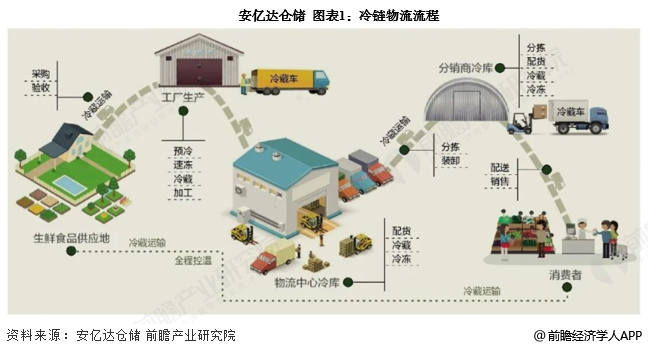
Industry Overview - Cold chain logistics is defined as a specialized logistics process that utilizes temperature control and preservation technologies to ensure that cold chain products remain within specified temperature environments throughout their entire lifecycle, including processing, storage, transportation, and distribution [1] - The products involved in cold chain logistics include agricultural products, poultry, seafood, flowers, processed foods, frozen foods, ice cream, dairy products, fast food ingredients, and beverages, as well as special items like pharmaceuticals and chemicals [1] Industry Chain Analysis - The cold chain logistics industry chain consists of upstream segments such as refrigerated vehicle manufacturing, cold storage construction, and equipment manufacturing; midstream segments include transportation (both trunk and distribution), warehousing, and value-added services; and downstream applications span food, pharmaceuticals, chemicals, and floriculture [3][4] Industry Development History - The cold chain logistics industry in China has evolved through three stages since 1998: 1. The initial stage (1998-2007) was characterized by a lack of resources and outdated facilities, with many companies relying on second-hand refrigerated vehicles [6][9] 2. The rapid expansion stage (2008-2017) saw the emergence of organized operations and the establishment of national distribution networks, driven by the growth of the frozen food industry and the entry of major players [9] 3. The current stage (2018-present) marks the transition to cold chain logistics 3.0, characterized by upgrades in industry environment, awareness, technology, management, and business philosophy [9] Industry Policy Background - Cold chain logistics is recognized as a crucial component of modern agricultural development, significantly impacting food quality, safety, and public health [10] - Recent policies emphasize enhancing cold chain infrastructure, particularly in rural areas, to improve agricultural product distribution and consumption [11] Current Industry Status - The total demand for food cold chain logistics in China is projected to reach 365 million tons in 2024, reflecting a year-on-year growth of 4.3% [12] - The cold chain logistics market size is expected to exceed 530 billion yuan in 2024, driven by rising demand for agricultural product refrigeration [13] - The total capacity of cold storage facilities in China is estimated at 25.3 million cubic meters, with a year-on-year increase of 10.96% [14] - The number of refrigerated vehicles in China is projected to reach 495,000 by 2024, marking a year-on-year growth of 14.58% [17] Industry Competition Landscape - The competitive landscape of the cold chain logistics industry is categorized into three tiers: leading companies like SF Express, JD Logistics, and Rongqing Logistics dominate the national market; regional players such as Hongxing Cold Chain and Daxiang Logistics have established strong local networks; while smaller enterprises face challenges in scaling [18][20] - The provinces with the highest number of star-rated cold chain logistics companies are Anhui and Shandong, each with 32 companies, followed by Henan with 28 [22] Industry Development Outlook and Trends - The cold chain logistics market in China is expected to exceed 670 billion yuan by 2030, with a compound annual growth rate (CAGR) of approximately 4% over the next five years [24][25] - Key trends include the expansion of infrastructure, the evolution of business models, and the enhancement of industry standards, driven by economic growth, urbanization, and increasing consumer demand for food safety [27][29]