创新雁阵

Search documents
王振:以可运行的协同治理打造长三角产业共振接口
Xin Lang Cai Jing· 2026-02-18 01:54
Core Viewpoint - The focus of regional development is shifting from "physical connectivity" to "institutional collaboration," emphasizing the need for effective mechanisms to facilitate cooperation and resource flow in the Yangtze River Delta region [1][15]. Group 1: Regional Economic Structure - By 2025, the Yangtze River Delta's economic structure is expected to evolve into a robust "innovation formation," with a combined GDP of approximately 34.66 trillion yuan, representing nearly 4% of the national territory [3][4]. - The region has transitioned from conceptual collaboration to observable structural changes, indicating a stronger integration of economic activities [3]. Group 2: Industry and Innovation - Shanghai's influence in the "innovation formation" is highlighted by its economic growth and advancements in high-end services, particularly in integrated circuits, biomedicine, and artificial intelligence, with related industries exceeding 2 trillion yuan [4]. - Other cities like Nanjing, Hangzhou, and Suzhou are developing their ecosystems in sectors such as new energy vehicles and advanced materials, contributing to a layered and mature industrial organization [4][5]. Group 3: Collaborative Mechanisms - Three types of collaborative mechanisms are emerging: 1. Normalization of shared innovation resources, allowing for cross-regional access to large-scale research facilities [5]. 2. Institutionalization of joint efforts through platforms like the G60 Science and Technology Corridor, which has supported over 80 collaborative projects with total investments exceeding 1.7 billion yuan [6]. 3. Expansion of "innovation enclaves" that connect Shanghai's advantages with surrounding cities' manufacturing capabilities [6]. Group 4: Challenges and Solutions - The main challenge lies in reducing administrative inertia that hampers smooth collaboration, as existing rules and public services often create friction in resource allocation [7][8]. - To address these issues, a "interface engineering" approach is proposed, focusing on establishing a unified market, clarifying profit-sharing mechanisms, and improving public service accessibility [9]. Group 5: Future Directions - The Yangtze River Delta's development narrative is shifting towards measuring "system efficiency" rather than just GDP, necessitating a transformation from administrative-driven collaboration to market-driven mechanisms [15][16]. - The region must enhance its collaborative governance capabilities, ensuring that partnerships are sustainable and results are measurable, thereby converting regional advantages into long-term competitive strength [15].


长三角四省市科创力量共同崛起
Xin Lang Cai Jing· 2025-12-19 23:35
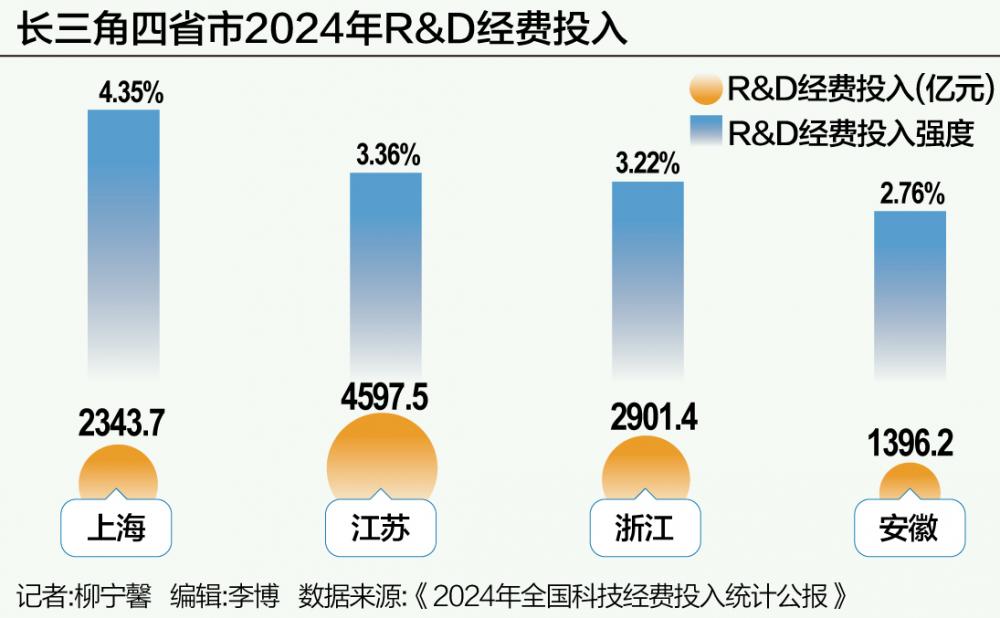
Core Viewpoint - The article emphasizes the strategic importance of the Yangtze River Delta (YRD) region in fostering innovation and entrepreneurship, highlighting the collaborative efforts of cities within the region to build a world-class international technology innovation center [1][4]. Group 1: Regional Development and Innovation - Emerging companies in the YRD, such as Ku Fei and Jiaxing Enhe, are leveraging the region's strong technological capabilities for long-term growth, with plans for multi-city operations [1]. - The central economic work conference has outlined the goal of establishing international technology innovation centers in key regions, including the YRD, to enhance China's global competitiveness in technology [4]. - The YRD is transitioning from a single-city innovation model to a multi-polar structure, with Shanghai leading and cities like Nanjing, Hangzhou, and Suzhou serving as critical support points [1][4]. Group 2: R&D Investment and Resources - In 2024, Shanghai's R&D expenditure is projected to reach 234.37 billion yuan, with an R&D intensity of 4.35%, ranking among the top in the country [5]. - Jiangsu's R&D investment is expected to hit 459.75 billion yuan in 2024, with an R&D intensity of 3.36%, indicating a strong position among innovative regions [6]. - Zhejiang's R&D funding is anticipated to be 290.14 billion yuan, marking a historical high with an intensity of 3.22% [7]. Group 3: Higher Education and Research Institutions - The YRD is home to 37 universities included in the "Double First-Class" initiative, accounting for a quarter of the total in China, with significant funding allocated to institutions like Zhejiang University and Shanghai Jiao Tong University [8]. - New research universities are emerging in the YRD, contributing to the region's innovation landscape, with institutions like Westlake University focusing on cutting-edge research [8]. - The collaboration between universities and research institutions is crucial for driving technological innovation and industry integration in the YRD [13]. Group 4: Strategic Infrastructure and Innovation Platforms - The YRD has over 40 large scientific facilities, making it a hub for advanced research and innovation, with significant projects in Shanghai and Hefei [10][11]. - Major scientific installations, such as the National Major Science and Technology Infrastructure in Jiangsu, are enhancing the region's research capabilities and facilitating groundbreaking innovations [11]. - The G60 Science and Technology Corridor exemplifies the integration of multiple cities in the YRD, promoting deep connections between technological achievements and industrial applications [14][15]. Group 5: Policy and Collaborative Framework - The recent legislative measures aim to break down administrative barriers and foster a more competitive innovation ecosystem in the YRD [15]. - The focus is on creating a resilient innovation system that allows for efficient resource flow and collaboration among cities, enhancing the overall innovation capacity of the region [12][13]. - The strategic alignment of key cities in the YRD is essential for enhancing international competitiveness and fostering collaborative innovation efforts [15].