
加密货币信心危机

Search documents
比特币一度触及6万美元,价格距高位腰斩
2 1 Shi Ji Jing Ji Bao Dao· 2026-02-06 01:59
Group 1 - Bitcoin experienced a significant drop, reaching a low of $60,000, with a daily decline exceeding 11%, marking a decrease of over 52% from its historical high of $126,000 in October 2025 [1] - Major cryptocurrencies such as ETH, SOL, and DOGE also fell by more than 10%, with nearly 590,000 liquidations occurring globally, totaling over $2.7 billion [1] Group 2 - The cryptocurrency market is facing a "crisis of confidence," with opinions diverging on its future, as some analysts suggest that Bitcoin's narrative as "digital gold" is weakening [5] - A bearish sentiment is prevalent, with analysts indicating that Bitcoin has entered a bear market, and the current trading patterns are distinctly "bearish," suggesting a phase of capitulation among market participants [5] Group 3 - Market experts express skepticism about Bitcoin reaching new all-time highs in 2026, with some advising major holders to remain patient as significant price increases may not occur in the next 1,000 days [6] - The stance of the new Federal Reserve Chairman, particularly regarding cryptocurrency policies, is a point of interest, especially given past positive remarks about Bitcoin as a "new gold" for younger generations [6] - Historical patterns indicate that Bitcoin took 28 months to recover after its peak in 2021, and the current downturn may lead to a prolonged period of low prices, heavily influenced by market sentiment and belief [6]

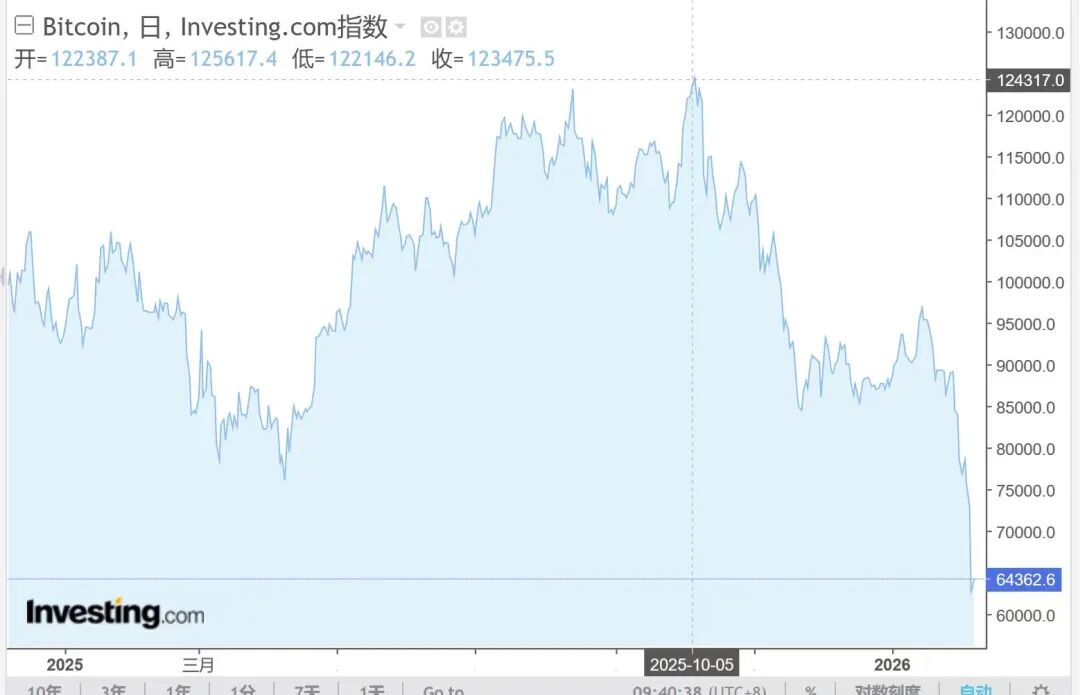
金融市场遭遇“黑色星期四”:加密货币“雪崩”致43万人爆仓,美股、贵金属、油价齐挫
Jin Rong Jie· 2026-02-05 23:54
Group 1: Cryptocurrency Market - The cryptocurrency market experienced a significant crash, with Bitcoin dropping by 12.81% to $63,860.8, marking a cumulative decline of over 48% since its peak in October last year, reducing its total market capitalization from $2.48 trillion to $1.27 trillion [1] - Ethereum fell by 13.1%, XRP plummeted over 22%, and other cryptocurrencies like SOL and Dogecoin saw declines exceeding 14%. Over 430,000 traders were liquidated in the last 24 hours, with total liquidations amounting to $2.069 billion (approximately 14.4 billion yuan) [1] Group 2: Market Sentiment and Analysis - Analysts noted a shift in market sentiment towards risk aversion, with significant liquidation sizes indicating a market driven more by balance sheet mechanisms. Bitcoin has failed to act as a safe-haven asset recently, leading to a bearish outlook [2] - Following a net inflow of $562 million into Bitcoin ETFs, there was a subsequent outflow of over $800 million in the following two trading days, reflecting a loss of confidence in the cryptocurrency market [2] - Predictions indicate an 82% probability of Bitcoin dropping below $65,000 within the year, and a 60% chance of falling below $55,000 [2] Group 3: Stock Market Impact - The U.S. stock market saw all three major indices decline, with the Nasdaq dropping 1.59%, marking the worst three-day sell-off since April of the previous year. The S&P 500 and Dow Jones fell by 1.23% and 1.2%, respectively [2] - Major tech stocks suffered significant losses, with Amazon and Microsoft both dropping over 4%, while Tesla fell over 2% and Nvidia declined by over 1% [2] Group 4: Employment Data and Economic Indicators - Weak employment data further dampened market sentiment, with U.S. employers announcing 108,435 layoffs in January, the highest for that month since the global financial crisis. Initial jobless claims also rose more than expected [3] - The number of job vacancies fell to the lowest level since September 2020, indicating potential economic challenges ahead [3] Group 5: Commodities Market - The precious metals market faced severe declines, with spot silver dropping over 19% and gold falling more than 3%. Both commodities are still searching for price bottoms following historic sell-offs [3] - International oil prices also saw significant drops, with WTI crude futures down 2.84% to $63.29 per barrel and Brent crude futures down 2.75% to $67.55 per barrel [3] Group 6: Regulatory Response - In response to market volatility, the Chicago Mercantile Exchange (CME) announced an increase in margin requirements for certain gold, silver, and aluminum futures contracts, with new margin ratios set to take effect after the market close on February 6 [4]