
劳动力平均年龄

Search documents
最新报告:全国劳动力平均受教育程度的性别差异正在逐渐消失
Nan Fang Du Shi Bao· 2025-12-17 14:41
Core Insights - The latest China Human Capital Report 2025 indicates that the average years of education for urban male laborers is 11.63 years, while for females it is 11.92 years, showing a gradual reduction in gender disparity in education levels [1][4] Group 1: Human Capital Growth - As of 2023, the total human capital in China is valued at 437.563 trillion yuan, with a growth from 43.02 trillion yuan in 1985 to 83.627 trillion yuan in 2023, representing an increase of over 18 times [3] - The average annual growth rate of human capital stock from 1985 to 2023 is 8.25%, attributed to the exit of low-education older populations from the labor market and the higher expected education levels of new labor entrants [3] - In 2023, the actual total human capital increased by 4.392 trillion yuan compared to 2022, with previous years' data showing values of 63.055 trillion, 70.643 trillion, 74.712 trillion, and 79.236 trillion yuan from 2019 to 2022 [3] Group 2: Education Levels - From 1985 to 2023, the average years of education for the national labor force increased from 6.14 years to 11.03 years, with urban areas rising from 8.23 years to 11.76 years and rural areas from 5.47 years to 9.44 years [4] - In 2023, all provinces showed that urban labor populations had higher average years of education compared to rural populations, with significant disparities in less economically developed provinces, such as a 3.63-year difference in Tibet [4] Group 3: Gender Disparities - The report indicates that while the education level of women is increasing at a faster rate than that of men, the gap in actual human capital remains significant, with men having an average human capital of 379,200 yuan and women 179,700 yuan, a difference of 199,500 yuan [5] - The reduction in the number of individuals without education is faster for women than for men, and gender disparities in higher education have significantly decreased [5] Group 4: Age Trends - The average age of the labor force in China increased from 32.25 years in 1985 to 39.66 years in 2023, with urban laborers rising from 33.03 years to 39.25 years and rural laborers from 31.99 years to 40.54 years [5] - Since 2021, the average age of rural laborers has exceeded 40 years, with the average age gap between urban and rural laborers narrowing until 2010, after which rural laborers' average age began to surpass that of urban laborers [5]

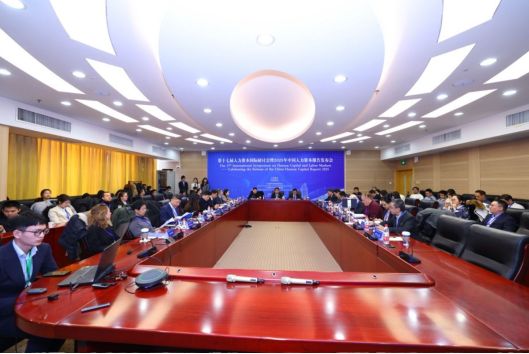
报告显示,中国劳动力平均年龄升至39.66岁
Xin Jing Bao· 2025-12-15 09:23
Core Insights - The "China Human Capital Report 2025" reveals the latest estimates of human capital in China, indicating a significant increase in the average age of the labor force from 32.25 years in 1985 to 39.66 years in 2023 [1][4] Group 1: Human Capital Metrics - The total human capital in China for 2023 is estimated at 43.76 trillion yuan, with urban areas contributing 40.09 trillion yuan (91.63%) and rural areas 3.66 trillion yuan (8.37%) [2] - The average years of education for the labor force increased from 6.14 years in 1985 to 11.03 years in 2023, with urban areas rising from 8.23 years to 11.76 years and rural areas from 5.47 years to 9.44 years [4][5] - The proportion of the labor force with a college degree or higher increased from 1.04% in 1985 to 27.39% in 2023, with urban areas rising from 3.78% to 35.82% and rural areas from 0.16% to 9.08% [5] Group 2: Regional Rankings - The provinces with the highest total human capital in 2023 are Guangdong, Shandong, Jiangsu, Henan, and Zhejiang, while the lowest are Gansu, Hainan, Ningxia, Qinghai, and Tibet [2] - The provinces with the highest per capita human capital in 2023 are Beijing, Shanghai, Tianjin, Jiangsu, and Shandong, while the lowest are Hainan, Yunnan, Xinjiang, Gansu, and Qinghai [3] - The provinces with the highest average education levels in 2023 are Beijing, Shanghai, Tianjin, Jiangsu, and Liaoning, while the lowest are Xinjiang, Guizhou, Qinghai, Yunnan, and Tibet [5]