
募资补流

Search documents
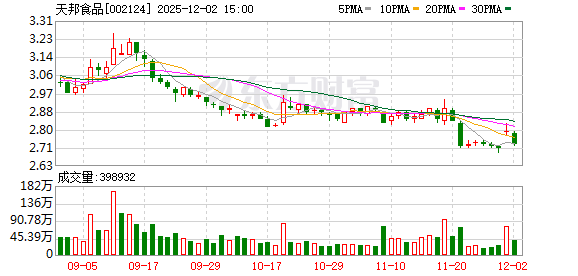
天邦食品叫停募投项目 上市猪企集体补流“过冬”
Bei Jing Shang Bao· 2025-12-02 12:44
Core Viewpoint - The pig farming industry is experiencing a "winter" period, leading to multiple listed companies, including Tianbang Food, terminating fundraising projects to conserve cash for survival [2][4]. Company Summary - Tianbang Food announced the termination of the "Tianbang Shares Smart Pig Farm Upgrade Project" on December 1, 2023, after increasing the total investment commitment from 872 million yuan to 1.306 billion yuan [3]. - The company raised 1.187 billion yuan through a private placement in December 2023, with 872 million yuan initially allocated for the project [3]. - As of November 24, 2025, the project had only seen an investment progress of 11.19%, with a total investment of 146 million yuan [3]. - Tianbang Food plans to temporarily use 1.16 billion yuan of idle fundraising for working capital [3]. Industry Summary - The pig farming industry has seen significant capacity expansion since 2020, resulting in oversupply and persistently low pig prices [6]. - As of December 2, 2023, the prices for external and internal three-yuan pigs had decreased by 30.32% and 30.28% year-on-year, respectively, reaching 11.47 yuan/kg and 11.49 yuan/kg [6]. - Other listed pig companies, such as Tangrenshen and Yisheng, have also terminated fundraising projects and redirected funds to working capital due to similar market conditions [6][7]. - The collective strategy of "fundraising for liquidity and contraction for survival" reflects a consensus among companies that short-term pig prices are unlikely to rebound, emphasizing the importance of cash flow for survival [7].


两年分红1.58亿元 皇冠新材冲击上市
Bei Jing Shang Bao· 2025-12-01 16:36
Core Viewpoint - Crown New Materials Technology Co., Ltd. is initiating an IPO on the A-share market, backed by strong financial performance, but is also planning to raise funds despite significant cash dividends in recent years [1][2]. Group 1: Company Overview - Established in 2000, Crown New Materials focuses on functional new materials, including industrial-grade and electronic-grade adhesives, as well as functional film materials [2]. - The company's products are widely used across various sectors, including light industry, home appliances, automotive manufacturing, new energy batteries, consumer electronics, smart IoT, and semiconductors [2]. Group 2: Financial Performance - Crown New Materials reported revenues of approximately 25.67 billion, 28.95 billion, 31.59 billion, and 15.92 billion for the years 2022 to the first half of 2025, respectively [2]. - Corresponding net profits for the same periods were approximately 2.06 billion, 2.78 billion, 3.02 billion, and 1.55 billion [2]. - The company plans to distribute cash dividends of approximately 752.39 million and 825.35 million for 2023 and 2024, totaling around 1.58 billion [2]. Group 3: IPO and Fundraising - The IPO aims to raise approximately 919 million, which will be allocated to expansion projects, a research center, and working capital [3]. - The company intends to invest 100 million specifically for working capital [3]. Group 4: Shareholding Structure - The actual controllers, Mai Huixia and Mai Huiquan, collectively hold 87.17% of the company's shares, with no single shareholder owning more than 50% [4][5]. - Mai Huiquan directly holds 25.92% of the shares and controls an additional 48.58% through various entities, while Mai Huixia holds 38.59% directly [4]. Group 5: Governance and Risks - Concerns have been raised regarding the high ownership concentration and potential conflicts of interest, despite the company's established governance structure [5]. - The company has indicated that it has measures in place to prevent the actual controller from harming the interests of the company and public shareholders [5]. Group 6: Financial Ratios - Crown New Materials has a lower R&D expense ratio compared to industry peers, with rates of 3.9%, 4.59%, 4.77%, and 4.81% over the reporting period, against peer averages of 4.42%, 5.48%, 5.21%, and 5.04% [6]. - The company's sales expense ratio is higher than the industry average, with rates of 2.01%, 2.5%, 2.75%, and 2.93%, compared to peer averages of 1.74%, 2.22%, 2.14%, and 2.36% [6].
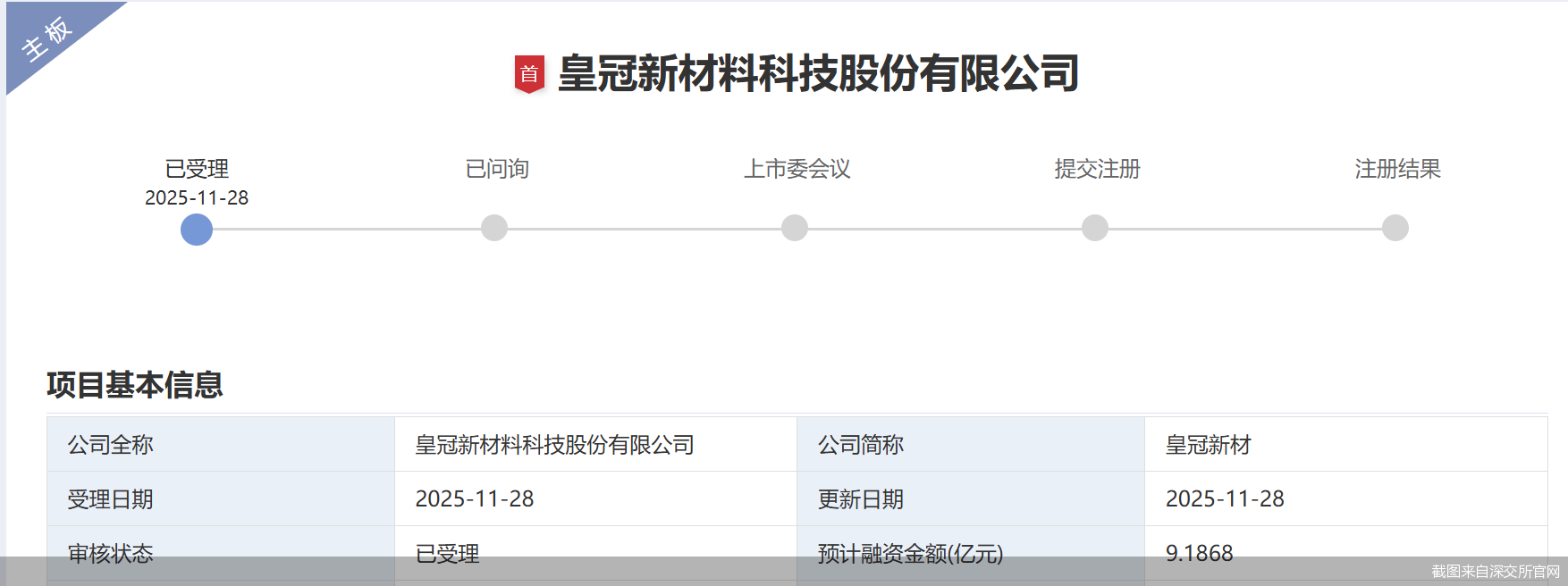
实控人手握近九成股权、两年分红1.58亿元,皇冠新材冲击IPO
Bei Jing Shang Bao· 2025-12-01 10:35
Core Viewpoint - Crown New Materials Technology Co., Ltd. (Crown New Materials) is initiating an IPO on the A-share market, backed by strong financial performance, including continuous growth in annual net profits, despite significant cash dividends prior to the IPO [1][3]. Financial Performance - Crown New Materials reported revenues of approximately 25.67 billion, 28.95 billion, 31.59 billion, and 15.92 billion for the years 2022 to 2025 (first half) respectively [3]. - Corresponding net profits for the same periods were approximately 2.06 billion, 2.78 billion, 3.02 billion, and 1.55 billion [3]. - The company’s net profit after deducting non-recurring items was approximately 2.26 billion, 2.75 billion, 3.07 billion, and 1.54 billion for the same periods [3]. Dividend Distribution - In 2023 and 2024, Crown New Materials distributed cash dividends of approximately 752.39 million and 825.35 million respectively, totaling around 1.58 billion [4][5]. Fundraising Plans - The company plans to raise approximately 9.19 billion through the IPO, with funds allocated for expansion projects, research and development, and to supplement working capital [5][6]. Shareholder Structure - The actual controllers, Mai Huixia and Mai Huiquan, collectively hold 87.17% of the company's shares, with no single shareholder owning more than 50% [7][8]. - Mai Huiquan directly holds 25.92% of the shares and controls an additional 48.58% through various entities, while Mai Huixia holds 38.59% directly [7]. Governance Concerns - The high ownership concentration raises concerns about potential conflicts of interest, as the actual controllers may prioritize personal interests over those of minority shareholders [8]. Research and Sales Expenses - Crown New Materials has a lower R&D expense ratio compared to industry peers, with rates of 3.9%, 4.59%, 4.77%, and 4.81% against peer averages of 4.42%, 5.48%, 5.21%, and 5.04% [9]. - The company's sales expense ratio is higher than the industry average, recorded at 2.01%, 2.5%, 2.75%, and 2.93% compared to peer averages of 1.74%, 2.22%, 2.14%, and 2.36% [9].
净利刚刚扭亏 联讯仪器冲刺IPO
Bei Jing Shang Bao· 2025-08-19 16:16
Core Viewpoint - Suzhou Lianxun Instrument Co., Ltd. is seeking to go public on the A-share market after experiencing explosive growth in 2024, with revenue increasing over 180% and net profit turning positive, despite rising debt levels and concerns over past equity holding arrangements [1][2][4]. Financial Performance - In 2024, the company achieved approximately 789 million yuan in revenue, a year-on-year increase of 185.87%, and a net profit of about 140 million yuan, marking a turnaround from previous losses [2]. - The company reported revenues of approximately 214 million yuan and 276 million yuan in 2022 and 2023, respectively, with net losses of 38.07 million yuan and 55.39 million yuan in those years [2]. - In Q1 2025, the company continued its profitability with revenues of about 201 million yuan and a net profit of approximately 19.33 million yuan [2]. Funding and Capital Structure - The company plans to raise approximately 1.954 billion yuan through its IPO, with 150 million yuan allocated for working capital and the remainder for various R&D projects [3]. - As of Q1 2025, the company had about 254 million yuan in cash, indicating a strong liquidity position despite the planned fundraising [3]. - The company has a rising debt-to-asset ratio, which was reported at 51.03% by the end of the reporting period, significantly higher than the industry average [4]. Shareholding and Governance - The chairman, Hu Haiyang, has a complex shareholding structure, directly holding 20.55% and indirectly controlling a total of 34.83% of the company through various platforms [5][6]. - There were past instances of equity holding arrangements that raised concerns, but the company asserts that its current shareholding structure is clear and compliant with governance standards [7]. Legal and Compliance Issues - The company is currently involved in ongoing litigation related to a patent infringement dispute with Aehr, which remains unresolved [7].
永大股份在手订单降17%仍募6亿扩产 李昌哲一家持股86%分红落袋4545万
Chang Jiang Shang Bao· 2025-06-08 23:06
Core Viewpoint - Jiangsu Yongda Chemical Machinery Co., Ltd. (Yongda Shares) plans to expand production after significant dividends and is preparing for an IPO [1][2] Group 1: Financial Performance - Yongda Shares plans to raise 608 million yuan, primarily for capacity expansion and working capital [2] - In 2024, Yongda Shares' main product output and shipment volume are expected to decrease by over 20% year-on-year, marking a three-year low [2] - The company has experienced a situation of increasing revenue but decreasing profit, with net profits in 2024 expected to drop by 18.35% year-on-year [8] Group 2: Dividend Distribution - Prior to the IPO, Yongda Shares distributed dividends totaling 52.52 million yuan in October 2022 and October 2024, with the controlling shareholder's family receiving approximately 45.46 million yuan [2][5] Group 3: Shareholding Structure - The controlling shareholder, Li Changzhe, holds 61.62% of the shares, while the family collectively owns 86.56% of the company [4][5] - Li Changzhe has not held any executive position since joining the company in 2009, raising regulatory concerns about potential proxy shareholding arrangements [4] Group 4: Production Capacity and Market Dynamics - Yongda Shares plans to invest up to 558 million yuan in the first phase of a heavy chemical equipment production base, aiming to add 30,000 tons of capacity [7] - The company's production capacity utilization rate has significantly declined to 83.83% in 2024, with a notable drop in both output and shipment volume [6][8] - The company has a high inventory level, with inventory values representing 45.79% of total assets by the end of 2024 [8] Group 5: Customer Concentration - Yongda Shares has a high customer concentration, with sales to the top five customers accounting for 66.47% of main business revenue in 2024 [8] - The customer base has changed frequently, with significant shifts in the top clients from 2022 to 2024 [9]
皮海洲:对上市公司募资补流行为要从严监管 | 立方大家谈
Sou Hu Cai Jing· 2025-05-26 01:19
Core Viewpoint - The China Securities Regulatory Commission (CSRC) has issued new fundraising supervision rules to enhance the regulation of funds raised by listed companies, effective from June 15, 2025, emphasizing the dedicated use of funds for main business and supporting the real economy [1] Group 1: Fundraising Regulation - The new fundraising supervision rules are a revision of the previous guidelines, focusing on the dedicated use of raised funds and stricter monitoring of fund usage and safety [1][2] - Companies are required to establish internal control systems for managing and supervising the use of raised funds, including clear approval authority and risk control measures [2] - It is crucial that judicial authorities do not freeze or divert funds from the fundraising accounts, which requires collaboration between CSRC, the Supreme People's Court, the Supreme People's Procuratorate, and the central bank [2] Group 2: Oversight of Excess Funds - The rules stipulate that excess funds should be used for ongoing and new projects or for repurchasing and canceling company shares, with a suggestion that excess funds could also be returned to investors [3] - There should be strict regulations on the use of raised funds for supplementing working capital, limiting such use to no more than 20% of the total raised amount [3][4] - Companies that distribute dividends should not use raised funds for working capital supplementation, as this could harm public investors' interests [3] Group 3: Temporary Use of Funds - The rules allow temporarily idle funds to be used for working capital, with a maximum duration of twelve months for such temporary use [4] - Companies must implement responsibility systems for temporary fund supplementation, holding accountable those who supported such actions [4] - Companies engaging in investment activities with their own funds are prohibited from using raised funds for working capital supplementation, and failure to repay temporary supplements will result in a suspension of all financing projects [4]