化妆品行业洗牌

Search documents
4653亿,化妆品卖爆了
3 6 Ke· 2026-01-20 01:12
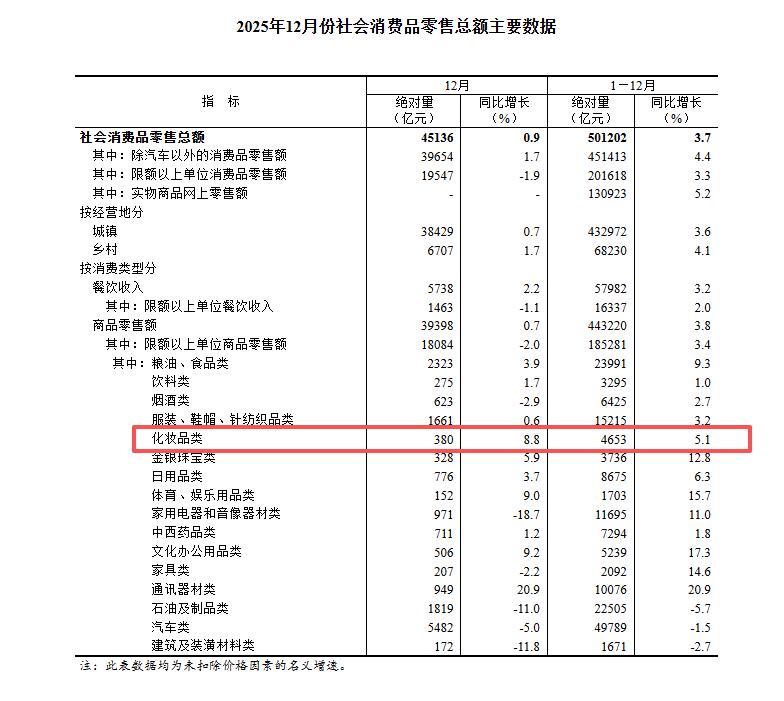
Group 1 - The core viewpoint of the articles indicates that the cosmetics retail sector in China has shown signs of recovery, with retail sales increasing after a decline in previous years [1][4][10] - In December 2025, cosmetics retail sales reached 38 billion yuan, marking an 8.8% year-on-year growth, while the total retail sales for the year amounted to 465.3 billion yuan, reflecting a 5.1% increase [1][4][6] - The overall retail sales of consumer goods in China for 2025 were reported at 501.2 billion yuan, with a growth rate of 3.7%, indicating that the cosmetics sector outperformed the broader market [2][4][6] Group 2 - The cosmetics retail sector has demonstrated resilience, with a consistent upward trend in sales since July 2025, achieving six consecutive months of year-on-year growth [7][10] - The growth in cosmetics retail sales is attributed to a combination of factors, including a relatively low base from the previous year and the impact of promotional events like Double Eleven [2][4][6] - The market share of domestic brands in the cosmetics sector has increased to 57.03%, while foreign brands have seen a decline to 42.97% [11][12] Group 3 - The online sales channel for cosmetics has grown by 9.36%, accounting for 56.06% of total sales, while offline sales increased by 2.38% [11] - The skincare and makeup categories are leading in market size, with sales of 472.48 billion yuan and 169.25 billion yuan respectively, both showing growth [12] - The import of beauty and personal care products has shown a decline in total value, indicating a shift in consumer preference towards domestic products [13] Group 4 - The cosmetics industry is facing challenges, with a significant number of companies going bankrupt or ceasing operations, highlighting a competitive market environment [16][17] - Despite the challenges, there is optimism for 2026, with industry experts emphasizing the importance of innovation and product quality for growth [16][18] - Companies are increasingly looking to expand into overseas markets, particularly in Southeast Asia, to mitigate domestic competition [16][18]

《化妆品安全风险监测新规》8月起施行!行业洗牌加速,头部企业迎发展机遇
Sou Hu Cai Jing· 2025-07-31 16:55
Core Viewpoint - The implementation of the "Cosmetic Safety Risk Monitoring and Evaluation Management Measures" since August 1 aims to establish a comprehensive risk monitoring system for the cosmetics industry, leading to increased industry concentration and a reshaping of market dynamics [1][3]. Group 1: Regulatory Changes - The new regulation consists of six chapters and 33 articles, focusing on a monitoring system that is "nationally coordinated, locally implemented, and technically supported" [3]. - The National Medical Products Administration (NMPA) will oversee the national monitoring plan, concentrating on five categories of risk substances that may harm human health [3]. - A "mystery shopping" approach will be used for sampling, ensuring objectivity in monitoring results [3]. Group 2: Industry Impact - The non-compliance rate for cosmetics is projected to decrease from 3.2% in 2024 due to the new regulations, which will increase compliance costs and accelerate the industry's transition to standardization [3][4]. - Leading companies are expected to leverage their technological capabilities and compliance advantages to gain a competitive edge in the evolving market landscape [1][4]. Group 3: R&D Investment - Among 14 listed beauty and personal care companies, the top five in R&D investment collectively spent over 900 million yuan, accounting for 73% of the total R&D expenditure [4]. - Companies like Betaini and Water Sheep are focusing on developing new raw materials, with Betaini introducing nine self-developed plant-based raw materials for cosmetic registration in 2024 [4]. Group 4: Long-term Industry Trends - The new regulations are seen as a pivotal point for the industry, pushing it from extensive growth to a high-quality development model [4]. - In the long run, leading companies will further solidify their positions due to their comprehensive advantages in technology, funding, and branding, ultimately benefiting consumers with safer and more effective cosmetic products [4].