北约集体防御

Search documents
白宫说“打”,国务卿说“买”,美国国内存分歧
Xin Lang Cai Jing· 2026-01-07 15:07
Core Viewpoint - The U.S. government, led by President Trump, is exploring various options to acquire Greenland, including the potential use of military force, which has raised significant concerns among European nations and NATO allies [1][3][4]. Group 1: U.S. Government Actions and Statements - President Trump has indicated the necessity of Greenland for U.S. national security, citing the presence of Russian and Chinese vessels in the region [2]. - White House officials have suggested that military intervention is a possible option to secure Greenland, emphasizing its strategic importance [3]. - The U.S. has conducted analyses on Greenland's untapped resources, including rare earth minerals and fossil fuels, which are crucial for the U.S. electronic and renewable energy sectors [3]. Group 2: International Reactions - European leaders, including those from seven countries, have issued a joint statement warning that any U.S. attack on Greenland would signify the end of NATO and the post-World War II security framework [4][5]. - The Danish Prime Minister has directly warned that an attack on Greenland would lead to severe consequences for NATO [4]. - Greenland's government has requested urgent meetings with U.S. officials to address the escalating tensions and has called for calm among its citizens [4]. Group 3: NATO and Defense Implications - NATO's Article 5, which ensures collective defense, does not clarify the response to conflicts between member states, raising concerns about the alliance's integrity if the U.S. were to attack a NATO ally [4][5]. - Analysts suggest that any military action against Greenland could fundamentally undermine NATO's collective defense capabilities and credibility [5]. - The disparity in military capabilities between the U.S. and Denmark is stark, with the U.S. having a significantly larger military presence [6]. Group 4: Domestic U.S. Political Landscape - There is a division within the U.S. political landscape regarding military action in Greenland, with some lawmakers opposing the idea and emphasizing the importance of diplomatic relations with Denmark [7][8]. - A recent poll indicates that only 7% of Americans support military action to occupy Greenland, reflecting a lack of public backing for such measures [6].
特朗普:“将”帮助保卫波兰和波罗的海国家
Zhong Guo Xin Wen Wang· 2025-09-22 08:07
Core Viewpoint - The article highlights President Trump's commitment to assist Poland and the Baltic states if Russia escalates its actions, emphasizing NATO's collective defense principle [1] Group 1: U.S. Response to Russia - President Trump affirmed that the U.S. would provide assistance to NATO allies near the Russian border if necessary [1] - Multiple countries, including Lithuania, Estonia, and the Czech Republic, are urging NATO to respond more forcefully to Russia's actions [1] Group 2: NATO's Collective Defense - Article 4 of the North Atlantic Treaty states that member countries should consult together when one believes it is under threat [1] - Estonia has formally requested NATO's assistance based on this article [1] Group 3: Recent Incidents - Poland reported that two Russian aircraft flew low over a drilling platform in the Baltic Sea, violating the platform's safety zone but not crossing the national border [1]
国际观察丨冲突外溢?无人机事件牵动俄乌局势敏感神经
Xin Hua Wang· 2025-09-12 00:56
Core Viewpoint - The recent drone incident involving Poland has raised concerns about the potential spillover of the Russia-Ukraine conflict, with accusations from Poland and NATO that the drones originated from Russia, while Russia denies these claims and suggests that Poland is attempting to escalate tensions [1][4][10]. Summary by Sections Incident Overview - On the night of September 9, a significant number of drones entered Polish airspace, prompting the Polish military to take emergency action and shoot down some of the drones. Poland's Prime Minister Tusk stated that the drones were Russian [2][5]. - This incident marks the first direct engagement between NATO countries and Russian equipment in their airspace since the onset of the Russia-Ukraine conflict in 2022 [2]. NATO Response - Following the drone incident, Poland invoked Article 4 of the North Atlantic Treaty, leading to urgent consultations among NATO member states. This marks the eighth time NATO has activated this clause, which allows for discussions when a member state feels its security is threatened [6][8]. - NATO Secretary General Stoltenberg confirmed that military responses involved aircraft from Poland, the Netherlands, Italy, and Germany, with additional support from the Czech Republic [2][6]. Accusations and Denials - The EU's High Representative for Foreign Affairs accused Russia of launching the most severe violation of European airspace since the conflict began, while Russia denied these allegations and called for evidence from Poland [4][10]. - Russia's Defense Ministry stated that it had conducted large-scale strikes on military targets within Ukraine but had no plans to target Poland [4][10]. Motivations and Implications - Analysts suggest that Russia may be testing NATO's defensive capabilities and attempting to highlight divisions within the alliance, particularly in light of past uncertainties regarding U.S. commitments to NATO [9][10]. - The incident has sparked discussions about the potential for escalation and whether it could trigger NATO's Article 5, which pertains to collective defense, although experts believe there is insufficient evidence to classify the drone incident as an attack on NATO [8][10].

法国宣布出动3架阵风保护波兰领空
Xin Lang Cai Jing· 2025-09-11 20:18
Core Viewpoint - France is enhancing its defense capabilities in Eastern Europe by deploying three "Rafale" fighter jets to strengthen air defense alongside NATO allies, particularly in response to recent threats from Russia [1] Group 1: Military Actions - French President Macron announced the deployment of three "Rafale" fighter jets to bolster air defense in Poland and Eastern Europe [1] - The Polish military reported multiple drone incursions into its airspace during Russian strikes on Ukraine, prompting urgent defensive actions [1] Group 2: NATO Involvement - Polish Prime Minister Tusk officially invoked Article 4 of the North Atlantic Treaty, seeking stronger support from allies for Poland's air defense [1] - Macron has communicated with NATO Secretary General Stoltenberg and UK Prime Minister Starmer regarding the defense collaboration [1]
国际观察|冲突外溢?无人机事件牵动俄乌局势敏感神经
Xin Hua She· 2025-09-11 13:18
Core Points - The incident involving drones entering Polish airspace has raised concerns about the escalation of the Russia-Ukraine conflict and the testing of NATO's defense capabilities [1][3][7] - Poland has claimed that the drones are of Russian origin, while Russia denies this assertion and accuses Poland of spreading misinformation [2][3][7] - NATO invoked Article 4 of the North Atlantic Treaty for emergency consultations, marking the eighth time this clause has been activated [5][6] Group 1: Incident Details - On the night of September 9, Poland detected 19 unidentified aerial targets, leading to the downing of several drones [2] - NATO Secretary General stated that military responses involved aircraft from Poland, the Netherlands, Italy, and Germany, with Czech Republic sending helicopters for assistance [3] - The incident is considered the most serious violation of European airspace since the onset of the Russia-Ukraine conflict [3][4] Group 2: Political Implications - The activation of NATO's Article 4 is seen as a collective demonstration of solidarity among member states [5] - Analysts suggest that the incident could escalate tensions between NATO and Russia, potentially leading to a situation that might trigger Article 5, which involves collective defense [5][6] - The U.S. political risk consultancy firm Eurasia Group indicated that the incident could test NATO's defense capabilities and exacerbate internal divisions within the alliance [7] Group 3: Motivations and Reactions - Western analysts believe Russia's actions are intentional, aimed at demonstrating NATO's inability to provide security assurances to its members [7] - Russia claims that Poland is using the drone incident to escalate the Ukraine crisis and manipulate public perception for domestic political gain [8]
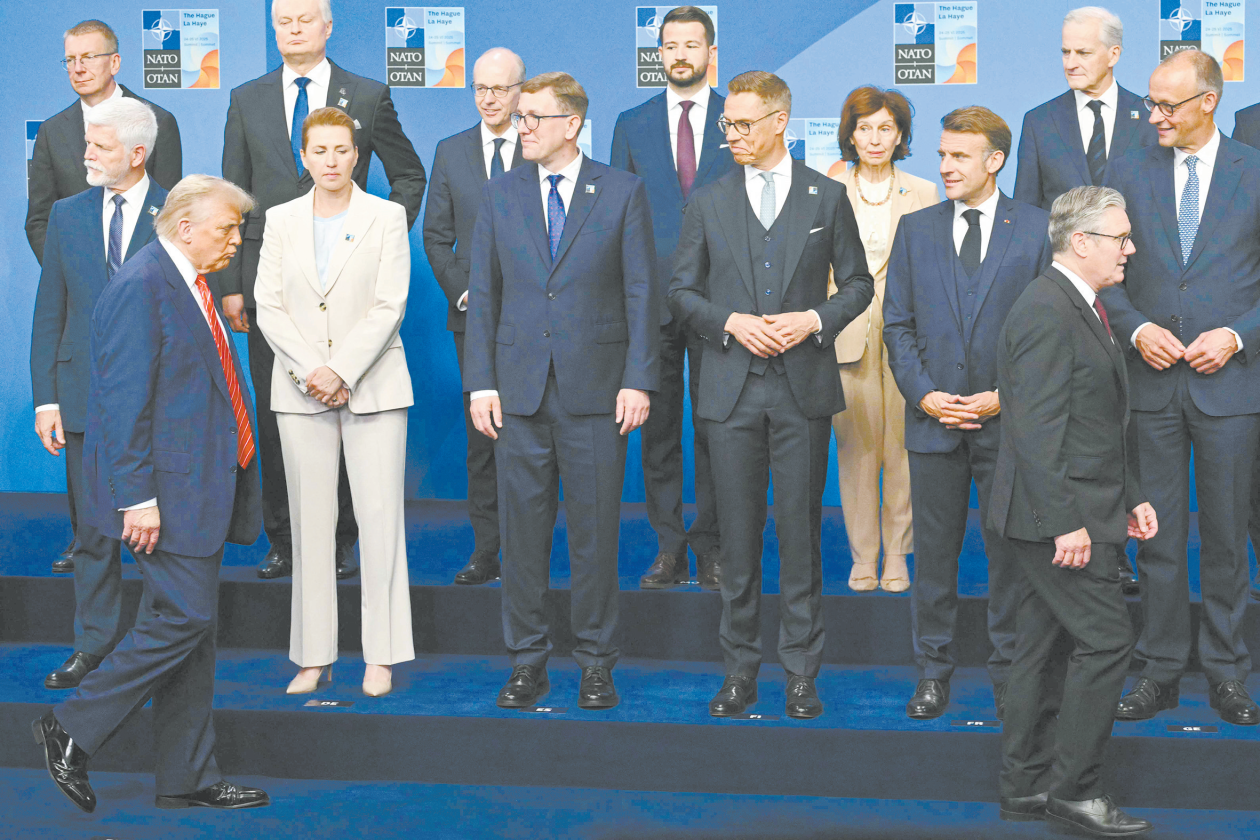
满足特朗普要求,难掩成员国分歧,北约峰会通过“5%军费目标”
Huan Qiu Shi Bao· 2025-06-25 22:21
Group 1 - NATO leaders agreed to increase defense spending to 5% of GDP by 2035, with a review set for 2029 [3][4] - The commitment to collective defense under Article 5 of the North Atlantic Treaty was reaffirmed, stating that an attack on one is an attack on all [3][4] - The increase in defense spending is expected to result in additional expenditures amounting to hundreds of billions annually, significantly higher than the current 2% target [4][7] Group 2 - NATO Secretary General Jens Stoltenberg emphasized strong ongoing support for Ukraine, while member states agreed to label Russia as a long-term threat rather than the greatest threat [4][5] - There are concerns among European allies regarding the unpredictability of U.S. President Trump's commitment to NATO, particularly regarding Article 5 [6][8] - Disagreements among NATO members regarding the increase in defense spending were noted, with countries like Spain expressing opposition and seeking flexibility in their military spending plans [7][8]