医保便捷支付

Search documents
推进医保便捷支付
Xin Lang Cai Jing· 2026-01-13 21:58
Core Viewpoint - The National Healthcare Security Administration (NHSA) aims to establish a comprehensive, secure, and efficient medical insurance payment system within three years, promoting various convenient payment methods such as facial recognition, QR code, mobile, and credit payments [1][2]. Group 1: Payment Methods - The NHSA emphasizes the integration of four payment methods: facial recognition, QR code, mobile, and credit payments, to meet diverse medical payment needs [2]. - Facial recognition payment allows users to complete identity verification and payment without physical cards or smartphones, particularly benefiting elderly individuals [2]. - QR code payment simplifies the process by enabling simultaneous completion of medical insurance reimbursement, personal account payment, and out-of-pocket expenses in one scan [2]. - Mobile payment facilitates the entire process of appointment registration, payment, and reimbursement through apps or mini-programs, reducing the need for in-person queues [2]. - Credit payment allows medical expenses to be covered by banks within a pre-approved credit limit, enabling patients to receive treatment and pay later [2]. Group 2: Implementation Strategy - The NHSA's digital reform of medical insurance payments will adopt a strategy of "initial layout and pilot promotion," with at least two cities in each province as the first batch of implementation [3]. - Cities that have already begun exploring these payment methods will have their existing practices respected, while other regions are encouraged to innovate based on successful experiences [3]. - Each province is required to report replicable and scalable experiences to the NHSA by March and June 2026, ensuring that the first batch of regions and designated medical institutions achieve effective implementation by 2026 [3]. - By 2027, the goal is to achieve coverage across all provincial coordinated areas, with full promotion to all eligible designated medical institutions by 2028 [3].
国家医保局部署大力推进医保便捷支付
Xin Lang Cai Jing· 2026-01-08 21:02
Core Viewpoint - The National Healthcare Security Administration aims to establish a convenient payment system for medical insurance within three years, addressing issues such as long queues and operational difficulties for patients [1]. Group 1: Payment System Innovations - The initiative promotes the integration of four payment methods: facial recognition, QR code payment, mobile payment, and credit payment, to cater to diverse patient needs [2]. - Facial recognition payment allows for identity verification and payment without physical cards or smartphones, particularly benefiting elderly patients [2]. - QR code payment simplifies the process by enabling simultaneous completion of insurance reimbursement and personal payment in one scan [2]. - Mobile payment facilitates online appointment scheduling and payment, reducing the need for in-person queuing [2]. - Credit payment allows patients to defer payment to banks within a pre-approved credit limit, enhancing convenience [2]. Group 2: Benefits and Impacts - The optimization of the payment system enhances patient experience and improves hospital financial management, alleviating queue pressures and improving order in medical visits [3]. - Financial institutions can develop compliant and precise consumer credit products, promoting inclusive financial services [3]. - The initiative contributes to the construction of a social credit system by providing high-quality behavioral data from healthcare transactions [3]. Group 3: Implementation Strategy - The digital reform of medical insurance payments will adopt a phased approach, starting with pilot cities, with at least two cities per province involved [4]. - Traditional payment methods, such as cash and card payments, will remain available to protect the rights of elderly and digitally disadvantaged groups [4]. - By 2026, provinces are required to report replicable and scalable experiences to the National Healthcare Security Administration, aiming for full implementation by 2028 [4].
鼓励药店参与,纳入医保绩效考核!国家医保局:2028年前全面推广便捷支付
Xin Lang Cai Jing· 2026-01-08 11:43
Core Viewpoint - The National Healthcare Security Administration (NHSA) aims to promote convenient payment methods such as facial recognition, QR code scanning, mobile payments, and credit payments nationwide, targeting to make medical payment processes more convenient within approximately three years [1][3]. Group 1: Implementation Strategy - Local healthcare insurance departments will focus on addressing public concerns regarding long queues and multiple waiting times during medical visits [2][5]. - Patients will have the option to use various payment methods, including facial recognition, electronic medical insurance certificates, mobile payments, or credit payments, to achieve "seamless" and "rapid" payment experiences [2][5]. - Provincial healthcare insurance departments will prioritize better-performing cities for pilot programs, with at least two cities in each province to lead the initiative [2][5]. Group 2: Timeline and Coverage - By 2026, the first batch of pilot regions and designated medical institutions will implement convenient payment methods [2][5]. - By 2027, the initiative is expected to cover all coordinated areas within provinces [2][5]. - By 2028, all eligible designated medical institutions within provinces will fully adopt various convenient payment methods [2][5]. Group 3: Monitoring and Public Awareness - The NHSA will incorporate the implementation of convenient payment methods into the performance assessment of designated medical institutions, enhancing daily monitoring to ensure public benefits [2][5]. - The NHSA plans to promote this beneficial policy through various channels to ensure the public is informed and can utilize the new payment methods, thereby improving the medical experience [2][5].

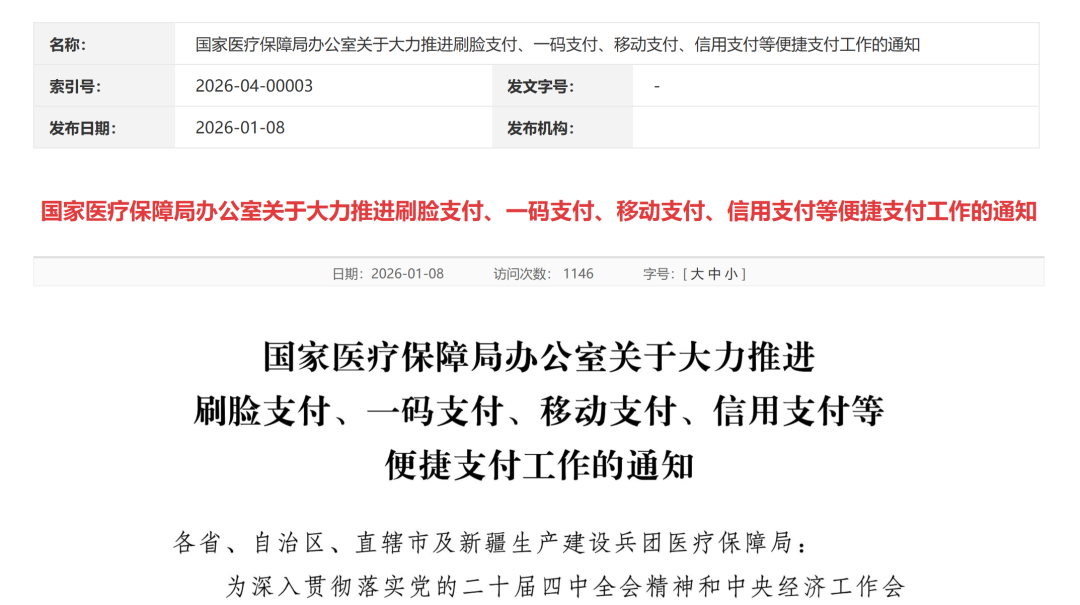
新华社权威快报丨看病缴费不用等!医保便捷支付体系力争3年左右建成
Xin Hua Wang· 2026-01-07 23:39
Core Viewpoint - The National Healthcare Security Administration (NHSA) aims to accelerate the implementation of convenient payment methods in healthcare settings, including facial recognition, QR code payments, mobile payments, and credit payments, with a goal to establish a comprehensive medical insurance payment system within three years [2][4]. Group 1: Implementation Timeline - The NHSA's notification outlines a three-year plan to fully establish a convenient payment system for medical insurance [2][4]. - The first batch of cities for implementation will include at least two cities from each province, with a target for initial effectiveness in designated medical institutions by 2026 [4]. - By 2027, the plan aims for basic coverage across provincial coordinated areas, and by 2028, all eligible designated medical institutions within the province are expected to fully adopt these payment methods [4]. Group 2: Focus on Pain Points - The initiative addresses common issues faced by patients, such as long queues and multiple payment processes when seeking medical care [4]. - The NHSA's focus is on enhancing the payment experience for patients in various medical scenarios, including outpatient and inpatient services [2][4].