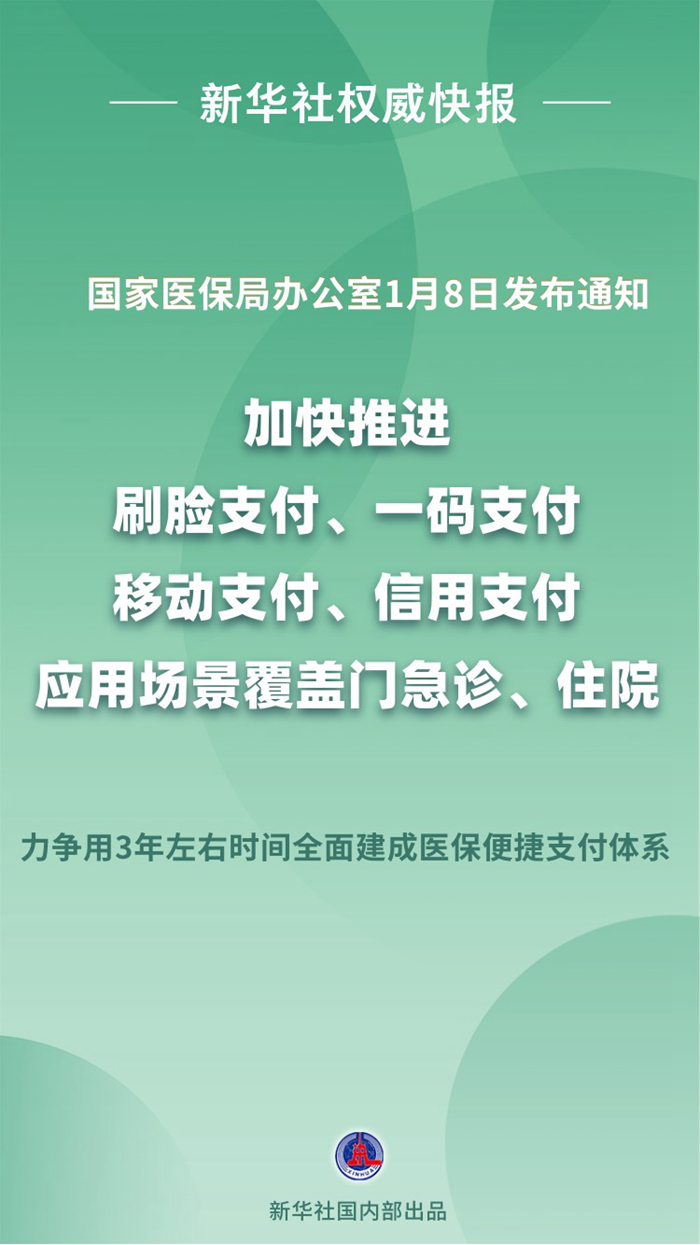
医保便捷支付体系

Search documents
医保便捷支付体系力争3年左右建成 最高法整改上网裁判文书隐去法官姓名做法
Xin Lang Cai Jing· 2026-01-11 05:53
Group 1: Healthcare Payment System - The National Healthcare Security Administration aims to establish a convenient payment system for medical insurance within approximately three years, focusing on reducing long queues and payment difficulties for patients [1] - The initial rollout will include at least two cities from each province, with a target for effective implementation in designated medical institutions by 2026 [1] - By 2027, the plan is to achieve provincial coverage, and by 2028, to fully implement the system in all eligible medical institutions within the province [1] Group 2: Law Enforcement and Crime Reduction - In 2025, the national police reported a 12.8% decrease in criminal cases, reaching a record low for the century, with significant reductions in violent crime and traditional theft cases [4] - The police also reported a 3.5% decrease in public security cases, with no major traffic accidents recorded for the first time since 1990 [4] - A total of 210 police officers and 142 auxiliary police officers sacrificed their lives in the line of duty during the year [4] Group 3: Export Control and Trade - The Ministry of Commerce stated that China's export control measures on dual-use items to Japan will not affect civilian uses, emphasizing the country's commitment to maintaining global supply chain stability [5] - The measures aim to prevent the militarization and nuclear ambitions of Japan, which are deemed legitimate and lawful [5] Group 4: Battery Industry Regulation - The Ministry of Industry and Information Technology is working to regulate the competitive order in the power and energy storage battery industry due to rapid development and irrational competition [6] - The focus will be on enhancing market supervision, enforcing price regulations, and preventing overcapacity risks [6] - The initiative aims to promote fair competition and sustainable development within the industry [6] Group 5: Mineral Resource Exploration - The China Geological Survey announced significant breakthroughs in chromium ore and unconventional oil and gas exploration, with the discovery of 20 new mineral bodies in Xinjiang [6] - The average grade of the newly discovered chromium ore is 30.73%, addressing the strategic mineral shortage in the country [6] - Additionally, a new shale gas resource of 1329.5 billion cubic meters was identified in the western Hubei region, expanding the exploration efforts beyond the Sichuan Basin [6] Group 6: Railway Transportation - In 2025, the national railway system achieved a passenger volume of 4.588 billion, a 6.4% increase year-on-year, and a freight volume of 527.3 million tons, up 2.0% [7] - The railway network expanded to 165,000 kilometers, with high-speed rail exceeding 50,000 kilometers, maintaining a leading position globally in various transport metrics [7] - The modernization of railway infrastructure is seen as a key support for high-quality economic and social development [7] Group 7: Carbon Capture Standards - The National Market Supervision Administration approved 12 national standards for carbon capture, utilization, and storage, set to take effect on July 1, 2026 [8] - These standards will unify key processes and evaluation methods, promoting innovation and application in the carbon capture industry [8] - The implementation of these standards is expected to contribute to deep carbon reduction and high-quality development in the economy [8]


新华时评·民生无小事|把好事办好,让少排队成常态
Xin Hua Wang· 2026-01-09 02:19
Group 1 - The core viewpoint emphasizes the need to improve the medical payment experience by reducing waiting times and implementing convenient payment systems such as facial recognition and mobile payments within three years [1] - The initiative aims to alleviate common issues faced by the public in medical settings, including long queues for payments and services, by optimizing payment processes and enhancing data sharing across different medical services [1] - A combination of efforts from various sectors, including healthcare, finance, and insurance, is necessary to create a seamless payment system and improve overall patient experience [1] Group 2 - Addressing long queues at payment windows is just the first step; there is a need to ensure that other areas, such as medication pick-up, do not become bottlenecks [2] - The focus on solving existing pain points in the healthcare system should also include preventive measures against new challenges that may arise, requiring a coordinated approach tailored to each hospital's circumstances [2] - There is an expectation for further reforms in various sectors to enhance the quality of life for citizens, emphasizing the importance of practical and effective measures [3]
力争3年左右!看病缴费不再“排长队”“多次排队”
2 1 Shi Ji Jing Ji Bao Dao· 2026-01-08 05:18
Core Viewpoint - The National Healthcare Security Administration (NHSA) is set to enhance payment systems in healthcare, aiming to alleviate the long queues and multiple payment processes that have troubled the public for years [1] Group 1: Payment System Improvements - The NHSA plans to promote various payment methods including facial recognition, one-code payment, mobile payment, and credit payment [1] - The goal is to establish a convenient payment system covering outpatient, emergency, and inpatient services within approximately three years [1] Group 2: Implementation Timeline - Each province will have at least two cities as initial implementation sites, with a target for effective rollout in designated medical institutions by 2026 [1] - By 2027, the aim is to achieve provincial coverage in designated areas, and by 2028, to fully implement the system in all eligible medical institutions within the province [1] Group 3: Broader Healthcare Reforms - The initiative is part of ongoing reforms in healthcare services, which include direct settlement for cross-province medical treatment and sharing of medical imaging data [1] - These measures are designed to address public concerns regarding healthcare access and payment processes, emphasizing the need for efficient service delivery [1]
新华社权威快报丨看病缴费不用等!医保便捷支付体系力争3年左右建成
Xin Hua Wang· 2026-01-07 23:39
Core Viewpoint - The National Healthcare Security Administration (NHSA) aims to accelerate the implementation of convenient payment methods in healthcare settings, including facial recognition, QR code payments, mobile payments, and credit payments, with a goal to establish a comprehensive medical insurance payment system within three years [2][4]. Group 1: Implementation Timeline - The NHSA's notification outlines a three-year plan to fully establish a convenient payment system for medical insurance [2][4]. - The first batch of cities for implementation will include at least two cities from each province, with a target for initial effectiveness in designated medical institutions by 2026 [4]. - By 2027, the plan aims for basic coverage across provincial coordinated areas, and by 2028, all eligible designated medical institutions within the province are expected to fully adopt these payment methods [4]. Group 2: Focus on Pain Points - The initiative addresses common issues faced by patients, such as long queues and multiple payment processes when seeking medical care [4]. - The NHSA's focus is on enhancing the payment experience for patients in various medical scenarios, including outpatient and inpatient services [2][4].