
医学人文关怀

Search documents
春启新程|产科医生的除夕夜守望:“这是新年最好的礼物”
Xin Lang Cai Jing· 2026-02-17 05:53
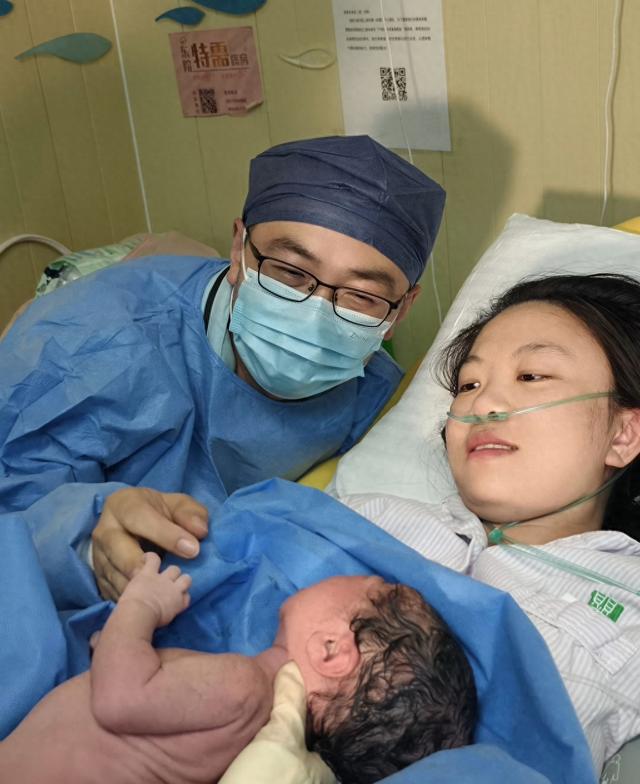
【编者按】 年是时光,是收获,是希望。 又逢辞旧迎新时,智通财经推出新春走基层特别策划之"春启新程",捕捉每一个生动而具体的"中国 年"。 我们的目光从街头到菜场,从景区到小店……记录热气腾腾的生活,打开又一个崭新的春天。 本篇关注除夕夜忙碌的产科医生。 上海市第 周丸丁也是一名二胎妈妈。她25岁结婚,26岁就生老大,29岁又迎来了老二。"我自己是独生子女,老 公家里有三个兄妹,小时候总羡慕别人家有兄弟姐妹。我觉得一个宝宝太孤单了,想给他找个伴,一起 长大,互相扶持。"周丸丁说,养育两个孩子,累并幸福着,生第一胎时只对接生孩子有经验,但对养 孩子这件事是完全手忙脚乱,只能一步步适应、一步步学习。而到了老二,她就多了许多的从容淡定, 延续经验,顺应孩子的个性,反而发现老二更好带。这一次马年春节,考虑到要值班三天,周丸丁的妈 妈特意从四川老家赶来上海,帮她照顾家中的两个孩子。 一妇婴保健院浦东院区产房,门口张贴了福字。智通财经记者 陈斯斯 摄 "太幸运了,这是新年最好的礼物!"2026年2月17日,大年初一,零点钟声刚过,上海市第一妇婴保健 院浦东院区的产房里,伴随着一声清亮的啼哭,一名体重2905克的女宝顺利诞 ...

此“芯”不可代彼“心”(无影灯)
Ren Min Ri Bao· 2026-01-22 23:42
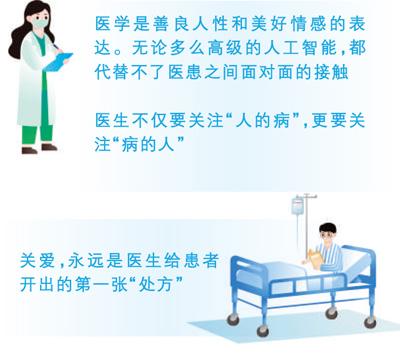
Core Viewpoint - The integration of artificial intelligence (AI) in healthcare is seen as a powerful tool to assist doctors, but it cannot replace the human aspects of medicine, such as doctor-patient communication and emotional support [2][3][4][5]. Group 1: Role of Artificial Intelligence in Healthcare - AI technology is rapidly evolving and provides significant advantages in diagnosing and treating diseases, acting as a "super brain" that surpasses individual doctors in memory, reasoning, and computational abilities [2]. - AI can enhance diagnostic accuracy and efficiency, allowing doctors to focus more on patient interactions, which is essential for fostering a harmonious doctor-patient relationship [2][3]. Group 2: Human Element in Medicine - Despite advancements in AI, the complexity and unpredictability of human life mean that AI cannot fully replace doctors, who must remain the primary decision-makers in patient care [3][4]. - The emotional connection between doctors and patients is irreplaceable, as effective medical care involves understanding both the physiological and psychological dimensions of illness [4][5]. - Historical insights from medical experts emphasize the importance of maintaining personal interactions in healthcare, warning against over-reliance on technology for diagnosis and treatment [3][5]. Group 3: Importance of Humanistic Care - Humanistic care is a critical value in medicine, where emotional exchanges between doctors and patients cannot be substituted by technology [5]. - The essence of medical practice lies in the compassion and warmth that doctors provide, which is vital for building trust and rapport with patients [4][5]. - The future of medicine is envisioned as a collaboration between humans and machines, where the core values of empathy and care remain central to the practice [3][5].
二〇二五,医疗提质惠民生(年终盘点)
Ren Min Ri Bao Hai Wai Ban· 2025-12-29 22:47
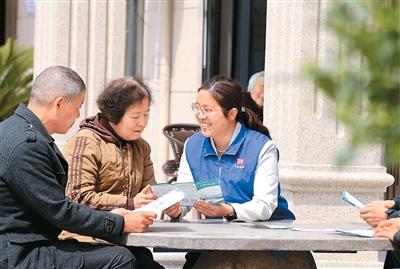
Core Insights - The article discusses the ongoing improvements in China's healthcare system, emphasizing the integration of medical and elderly care services, the expansion of insurance coverage, and the enhancement of accessibility to healthcare services for the population [6][15][20]. Group 1: Healthcare Accessibility - Over 90% of residents can access medical services within 15 minutes, with the number of grassroots medical institutions increasing from 970,000 to 1,040,000 [8]. - The establishment of a unified national medical insurance information platform has enabled instant settlement of medical expenses, covering 1.33 billion insured individuals and 1.14 million designated hospitals and pharmacies [12]. - More than 200 types of medical examination results are now mutually recognized across the country, facilitating easier access to healthcare for patients [9]. Group 2: Insurance and Financial Support - The inclusion of assisted reproductive services in medical insurance aims to alleviate financial burdens for families, with coverage expanding to all provinces and regions by 2025 [6]. - The dynamic adjustment of the medical insurance drug list has added 114 new drugs, increasing the total to 3,253, focusing on urgently needed innovative medications [6]. - Approximately 80 million low-income individuals receive insurance subsidies annually, with a 90% reimbursement rate for hospitalization costs in rural areas [6]. Group 3: Elderly Care Integration - The "Medical and Elderly Care Integration Promotion Action Plan (2025-2027)" aims to address challenges faced by the elderly, such as access to healthcare and quality of life [15]. - The establishment of "15-minute elderly service circles" in cities ensures that elderly individuals receive timely and convenient care [15]. - Long-term care insurance trials are expanding, covering 250 million people, providing home care and rehabilitation services for the elderly [15]. Group 4: Pediatric Healthcare Improvements - Nationwide, 4,845 secondary and tertiary public hospitals now offer pediatric services, addressing the shortage of pediatric care [10]. - Efforts to optimize pediatric healthcare services include appointment systems and extended hours during peak seasons for childhood illnesses [10]. - The average waiting time for pediatric patients has decreased significantly, improving the overall experience for families [11]. Group 5: Traditional Chinese Medicine (TCM) - The number of TCM healthcare institutions has reached 104,000, with 99.6% of community health service centers providing TCM services [20]. - The cultural promotion and international collaboration in TCM have increased public awareness of TCM health culture from 20.69% to 26.85% [20]. - The establishment of expert studios and national laboratories for TCM is enhancing the preservation and innovation of traditional practices [20].
这场手术,托起生命的尊严(民生观)
Ren Min Ri Bao· 2025-06-04 21:56
Core Viewpoint - The article emphasizes the importance of preserving the dignity and quality of life for patients, especially in terminal situations where medical interventions may not extend life but can fulfill emotional and psychological needs [1][2]. Group 1: Medical Humanism - The case of a 74-year-old cancer patient illustrates the value of medical humanism, where the focus shifts from merely treating diseases to addressing the emotional and psychological needs of patients [1]. - The patient's desire for a dignified departure, free from the physical manifestations of illness, highlights the significance of understanding and respecting patient wishes in medical practice [1][2]. Group 2: Patient-Centered Care - The implementation of a detailed surgical plan by a team of over ten specialists showcases the commitment to patient-centered care, integrating resources to address complex medical challenges while ensuring the patient's dignity [1]. - The "Medical Humanistic Care Enhancement Action Plan (2024-2027)" aims to strengthen medical humanistic education and improve doctor-patient communication, reflecting a broader commitment to fostering harmonious doctor-patient relationships [2].