医疗器械本土化

Search documents
波士顿科学临港基地获首证,打破高值医械耗材“临期焦虑”
第一财经· 2026-03-14 07:53
Core Viewpoint - Boston Scientific has received approval for its OptiCross HD intravascular ultrasound diagnostic catheter, marking a significant achievement for its local production base in China, which aims to enhance the accessibility of high-end medical devices in the Chinese market [3][4]. Group 1: Company Developments - The OptiCross HD catheter is produced at Boston Scientific's new manufacturing facility in Lingang, Shanghai, which has established the first automated production line for intravascular ultrasound catheters in China, with an expected annual output of over 10,000 units [3][4]. - Boston Scientific holds a dominant position in the intravascular ultrasound diagnostic catheter market, accounting for approximately 75% of the total procurement demand in a recent centralized procurement initiative, with a total demand of about 292,400 units [4]. Group 2: Industry Context - The Chinese government has emphasized the high-quality development of medical devices in its recent work report, aligning with Boston Scientific's strategy to localize production and enhance collaboration with advanced Chinese manufacturing [3][5]. - The establishment of local manufacturing capabilities by multinational medical device companies, such as Boston Scientific, reflects the growing scale of the Chinese market and the increasing competitiveness of its manufacturing ecosystem [5][6].



缘起进博,波士顿科学本土化“三级跳”
Jing Ji Guan Cha Bao· 2025-11-10 08:27
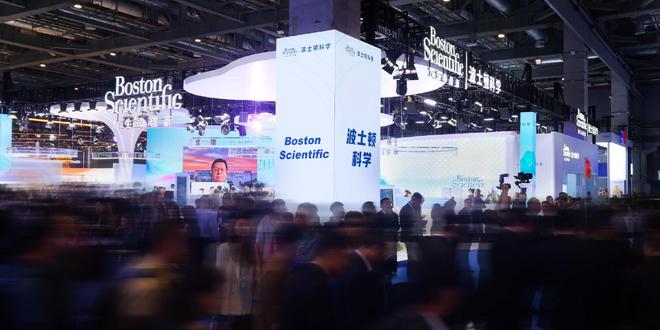
Core Insights - The eighth China International Import Expo (CIIE) has commenced in Shanghai, showcasing multinational medical device companies accelerating their localization efforts in China [2][3] - Boston Scientific has exhibited four unreleased products at the expo, all set to be produced at its Shanghai Lingang factory, marking a significant step in its localization journey [3][5] Localization Strategy - Boston Scientific's localization journey has progressed through three stages: from being an importer, to outsourcing production to local firms, and now establishing its own manufacturing facility in China [5][7] - The company has leveraged the Medical Device Registration Holder (MAH) system to facilitate local production, with the Polaris intravascular ultrasound system being a key milestone in this process [5][6] Recent Developments - In 2023, Boston Scientific made a strategic investment in Chinese medical device company Xianruida, enhancing its integration into the local supply chain and expanding its market reach [6][10] - The new factory in Lingang is designed to meet high standards and aims to become a leading smart factory for Boston Scientific globally, with plans for future expansion [6][7] Product Launches - By October 2024, the Lingang factory is expected to be operational, with four innovative products already in the pipeline for production, including the OptiCross/OptiCross HD catheter [9][12] - The AVVIGO+ intravascular ultrasound system, a complex machine developed with significant input from the Chinese team, is set to be one of the first products to be produced locally [12][14] Market Potential - The Chinese market is viewed as highly attractive due to its vast patient demand and the advantages of a local supply chain, which enhances efficiency and innovation [10][15] - Boston Scientific aims to better serve local markets and meet patient needs through its ongoing localization efforts, which are seen as a driving force for the company's growth in China [15]
缘起进博,波士顿科学本土化“三级跳”
经济观察报· 2025-11-10 08:11
Core Viewpoint - Boston Scientific is significantly expanding its localization strategy in China, leveraging the China International Import Expo (CIIE) to showcase innovative products and establish a strong foothold in the local market [2][3]. Group 1: Localization Strategy - Boston Scientific has achieved a "triple jump" in localization over six years, transitioning from an importer to a local manufacturer with its own factory in Shanghai [3][5]. - The company has successfully utilized the Medical Device Registration Holder (MAH) system to facilitate local production, exemplified by the Polaris intravascular ultrasound system, which received its first domestic registration certificate in July 2022 [6][7]. - In 2023, Boston Scientific made a strategic investment in the Chinese medical device company Xianruida, enhancing its integration into the local supply chain and expanding its product offerings [7][8]. Group 2: Product Development and Innovation - At the 2023 CIIE, Boston Scientific showcased four unreleased products, all set to be manufactured at its Shanghai factory, marking a significant step in its localization efforts [3][10]. - The AVVIGO+ intravascular ultrasound diagnostic system, a complex product developed with significant input from the Chinese team, demonstrates the company's commitment to local innovation [14][16]. - The Shanghai Lingang factory is designed to meet both Chinese and international standards, aiming to become a leading smart factory for Boston Scientific globally [7][8]. Group 3: Market Potential and Collaboration - The Chinese market is viewed as one of the most attractive and promising markets for Boston Scientific, driven by local supply chain advantages and increasing R&D capabilities [12][16]. - The company is actively engaging with local partners and government bodies to explore collaborative opportunities and enhance the local medical industry [15][17]. - Boston Scientific aims to better serve local patients by continuously introducing products and accelerating its localization process [17].

聚焦进博会|“全球首发”由中国研发团队主导,跨国医疗器械在华本土化提速
Di Yi Cai Jing· 2025-11-09 09:37
Core Insights - Multinational medical device companies are shifting from merely importing advanced global technologies to localizing their R&D efforts in China, aiming for a dual-driven model of global innovation and local manufacturing [1][4] Group 1: Localization Trends - The localization process of multinational medical device companies in China has accelerated significantly over the past eight years, with many companies reporting high levels of local R&D involvement [2][4] - GE Healthcare showcased that 60% of its newly launched innovative products at the expo were developed by Chinese teams, marking a record high for local R&D contributions [1][2] - Boston Scientific's Polaris intravascular ultrasound system was the first product approved under China's Medical Device Registration Holder (MAH) system, highlighting the company's commitment to local production [2] Group 2: Strategic Importance of China - China is recognized as a crucial strategic market for multinational companies, with a complete industrial system that supports the entire chain from R&D to mass production [3][4] - The Chinese government is actively optimizing the business environment and encouraging innovation, which serves as an accelerator for medical advancements [4] - Companies like Intuitive Surgical and Boston Scientific are investing in local production facilities and supply chains to enhance their responsiveness to domestic market demands [3][5] Group 3: Supply Chain Innovations - Boston Scientific is focusing on not just product line establishment but also on the localization of raw materials and key components, collaborating with local partners for joint R&D [5] - The company has received significant support from local regulatory bodies, which has facilitated the establishment of its manufacturing base in China [4][5] - The innovation capabilities of China's medical device supply chain are injecting new vitality into the global supply chain [5]
深度|集采叠加关税影响,医疗器械行业发展路在何方?
Di Yi Cai Jing· 2025-04-27 12:42
Core Viewpoint - The medical device industry is facing complex challenges due to escalating trade tariffs, but local companies are increasingly filling the gaps left by imported products, particularly in high-end medical devices [1][3][10]. Group 1: Impact of Tariffs on Medical Device Companies - Major US medical device companies, including Boston Scientific and Edwards Lifesciences, have reported significant financial impacts from tariffs, estimating losses in the hundreds of millions of dollars [3][4]. - Boston Scientific anticipates a $200 million loss due to tariffs but expects strong demand for cardiovascular devices to mitigate this impact [3]. - Johnson & Johnson predicts a $400 million impact on its medical technology profits due to tariffs, while Abbott also expects a multi-million dollar effect [3][4]. Group 2: Localization Efforts by Multinational Companies - Multinational medical device companies are increasing local investments in China to adapt to tariff impacts and meet domestic market demands [7][8]. - Boston Scientific has partnered with local manufacturer Xianruida Medical to enhance product localization and reduce production costs [8]. - Medtronic has invested approximately 300 million yuan in Shanghai for the development of cardiac disease-related products, aiming for production within five years [8]. Group 3: Rise of Domestic Medical Device Manufacturers - Domestic medical device companies are rapidly advancing, with many now offering localized alternatives to previously imported products, such as antibacterial sutures [10][11]. - The average price of domestic high-value medical devices is approximately 30% lower than that of imported products, while quality has reached competitive levels [11][12]. - The approval of innovative domestic medical technologies, such as transcatheter tricuspid valve ring systems, indicates significant progress in filling market gaps [11][12]. Group 4: Future Directions and Challenges - The dual pressures of tariff impacts and centralized procurement policies are pushing domestic companies to innovate and explore high-end medical device markets [12][13]. - Companies are encouraged to localize their supply chains and reduce reliance on imported materials to maintain cost advantages [13]. - The industry is witnessing a shift towards high-end products, with significant opportunities in areas like cardiac electrophysiology and advanced imaging equipment [12][13].