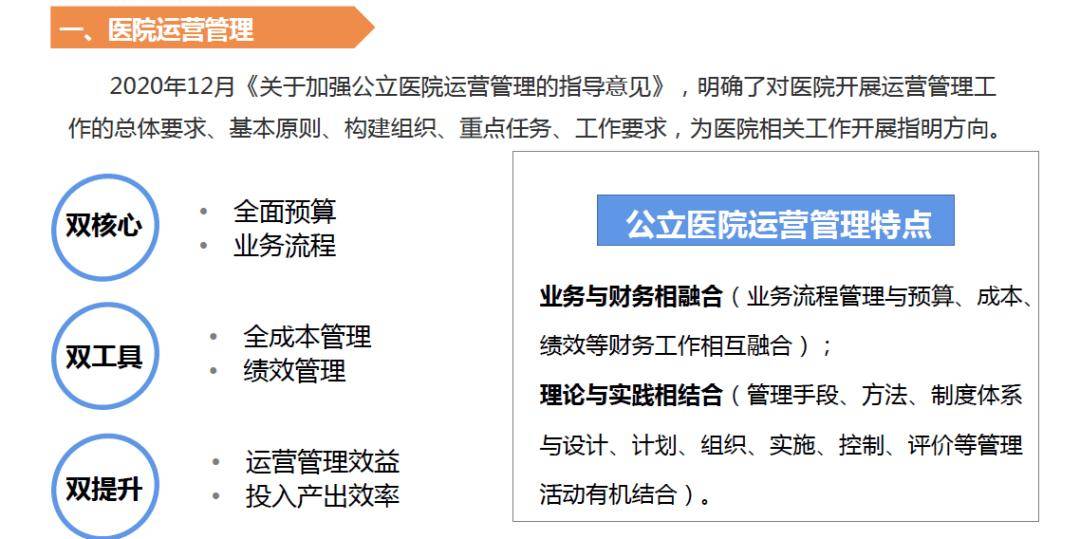
医院运营管理

Search documents
滨医附院成功举办全国医院运营管理与4D识人专题培训班
Sou Hu Cai Jing· 2025-12-23 14:18
Group 1 - The event aims to enhance operational management and internal development of medical institutions in line with the Healthy China strategy, featuring a national training program from December 18 to 21, co-hosted by Binzhou Medical University Affiliated Hospital and the Shandong Provincial Hospital Association [4] - The training program attracted over a hundred management elites from various medical and health institutions across the country to discuss management innovation and hospital development [4] - The opening speech by Wang Dong emphasized the shift in hospital management from "experience-driven" to "science-enabled," highlighting the importance of improving operational management skills and mastering scientific personnel selection methods as essential for high-quality hospital development [7] Group 2 - The training curriculum is designed to address core pain points and practical needs in hospital management, combining theoretical depth with practical application [17] - Experts delivered lectures on topics such as nuclear leadership, personnel selection, and hospital operational management, utilizing diverse formats like case studies and practical exercises to provide cutting-edge management theories and practical tools [17] - Participants from over ten cities, including key hospital leaders and management teams, found the training content directly relevant to addressing management challenges, enhancing personal leadership, and innovating hospital operational mechanisms [17] Group 3 - Binzhou Medical University Affiliated Hospital aims to continue building high-level, professional learning and exchange platforms, collaborating with national healthcare peers to deepen high-quality development paths [17]


明基医院(02581.HK) 12月12日—12月17日招股
Zheng Quan Shi Bao Wang· 2025-12-12 02:19
Core Viewpoint - BenQ Hospital (02581.HK) plans to globally offer 67 million shares, with a maximum offer price of HKD 11.68 per share, aiming to raise approximately HKD 704 million for various expansion and operational purposes [1] Group 1: Share Offering Details - The global offering consists of 6.7 million shares for Hong Kong and 60.3 million shares for international investors [1] - The subscription period is set from December 12 to December 17, with an entry fee of approximately HKD 5,898.90 for a board lot of 500 shares [1] - The expected net proceeds from the offering are HKD 626 million, which will be used for hospital expansion, potential investments and acquisitions, upgrading to a "smart hospital," and general working capital [1] Group 2: Financial Performance - The company's net profit for the fiscal years ending June 30, 2023, 2024, and the first half of 2025 is projected to be CNY 167 million, CNY 109 million, and CNY 48.704 million, reflecting year-on-year changes of 86.99%, -34.95%, and -23.18% respectively [2] Group 3: Strategic Partnerships and Market Position - The company has secured cornerstone investors including He Rong Technology Co., Ltd., He Fu (China) Medical Technology Co., Ltd., and Suzhou Zhanxing Investment Fund Partnership [1] - BenQ Hospital draws on advanced hospital management practices from Taiwan and operates as a private for-profit general hospital group in mainland China [1] Group 4: Listing Information - The company is expected to be listed on the main board by December 22, 2025, with China International Capital Corporation Hong Kong Securities Limited and Citigroup Global Markets Asia Limited acting as joint sponsors [1]
明基医院 12月12日—12月17日招股
Zheng Quan Shi Bao Wang· 2025-12-12 01:58
Group 1 - The company, BenQ Hospital, plans to globally offer 67 million shares, with 6.7 million shares available in Hong Kong and 60.3 million shares for international sale [1] - The subscription period is set from December 12 to December 17, with a maximum offer price of HKD 11.68 per share and an entry fee of approximately HKD 5,898.90 for a trading unit of 500 shares [1] - The total expected fundraising amount is HKD 704 million, with a net amount of HKD 626 million, which will be used for hospital expansion and upgrades, potential investments and acquisitions, smart hospital upgrades, and general working capital [1] Group 2 - The company has introduced cornerstone investors including He Rong Technology Co., Ltd., He Fu (China) Medical Technology Co., Ltd., and Suzhou Zhanxing Investment Fund Partnership [1] - BenQ Hospital is expected to be listed on the main board by December 22, 2025, with China International Capital Corporation Hong Kong Securities Limited and Citigroup Global Markets Asia Limited acting as joint sponsors [1] - The company draws on advanced hospital management experience from Taiwan and operates as a private for-profit general hospital group in mainland China [1] Group 3 - For the fiscal years 2023, 2024, and the first half of 2025 ending June 30, the company's net profits are projected to be CNY 167 million, CNY 109 million, and CNY 48.704 million, reflecting year-on-year changes of 86.99%, -34.95%, and -23.18% respectively [2]
明基医院12月12日至12月17日招股 拟全球发售6700万股 引入禾荣科技等基石投资者
Zhi Tong Cai Jing· 2025-12-12 00:14
Core Viewpoint - BenQ Hospital (02581) plans to conduct a global offering of 67 million shares from December 12 to December 17, 2025, with a share price range of HKD 9.34 to HKD 11.68, aiming to list on the Hong Kong Stock Exchange on December 22, 2025 [1] Group 1: Company Overview - The company is a private for-profit general hospital group in mainland China, leveraging advanced hospital management experience from Taiwan [1] - It currently operates two general hospitals and is the largest private for-profit general hospital group in East China, holding a market share of 1.0% in the region [1] - Nationally, it ranks seventh among private for-profit general hospital groups in China, with a market share of 0.4% [1] - The company ranks first in bed revenue among all private for-profit general hospital groups in mainland China for 2024 [1] Group 2: Investment Agreements - The company has entered into cornerstone investment agreements with He Rong Technology, He Fu (China), and Suzhou Zhanxing, totaling USD 39.9 million for share subscriptions [2] - Assuming a share price of HKD 10.51, cornerstone investors will subscribe to approximately 29.55 million shares [2] Group 3: Financial Performance - Revenue increased from RMB 2.336 billion in 2022 to RMB 2.688 billion in 2023, with a slight decrease to RMB 2.659 billion in 2024 [3] - Revenue for the six months ending June 30, 2024, was RMB 1.33 billion, slightly decreasing to RMB 1.313 billion in the corresponding period of 2025 [3] - Gross margin improved from 16.4% in 2022 to 18.9% in 2023, then decreased to 18.1% in 2024 [3] - Net profit for 2022, 2023, and 2024 was RMB 89.6 million, RMB 168 million, and RMB 109 million, respectively, with net profit margins of 3.8%, 6.2%, and 4.1% [3] Group 4: Use of Proceeds - The estimated net proceeds from the global offering, assuming a share price of HKD 10.51, will be approximately HKD 626 million [2] - The intended use of proceeds includes 74.3% for expanding and upgrading existing hospitals, 16.0% for potential investments and acquisitions, 8.0% for upgrading the "Smart Hospital" initiative, and 1.8% for working capital and general corporate purposes [2]
《医院运营管理:方法、实践、案例》,教你轻松“拿捏”运营管理
Sou Hu Cai Jing· 2025-12-08 06:46
Core Viewpoint - The establishment of a hospital operations management department is essential for integrating core business and operational management, enhancing service quality, and achieving cost control under the new medical reform policies [3][4][5]. Group 1: Importance of Hospital Operations Management - The pressure for internal control in hospitals has increased due to the DRG/DIP cost control requirements and the government's push for high-quality development in public hospitals [3]. - Hospital operations management is crucial for transforming operational management into value creation and improving both service capacity and quality [3][4]. - There is a common misunderstanding regarding the role of the operations department, which is distinct from other departments like medical quality and financial management [3][4]. Group 2: Functions and Benefits of the Operations Department - The operations department serves as a service organization for both internal staff and external patients, aiming to resolve workflow issues and enhance service delivery [6]. - It is not meant to replace existing functional departments but to integrate medical service processes, improve service quality, and increase hospital efficiency [7]. - The operations department can effectively coordinate between various departments, addressing issues that arise from departmental silos and enhancing collaboration [8][9]. Group 3: Operational Efficiency and Support - The operations department can drive the standardization and process optimization of medical services, ensuring comprehensive support for clinical departments [10]. - It provides timely and comprehensive management and decision-making support to hospital administrators, facilitating better problem identification and resolution [11][13]. - By improving internal service support for frontline medical staff, the operations department allows them to focus on patient care rather than administrative issues [14]. Group 4: Data Analysis and Strategic Implementation - The operations department plays a critical role in analyzing operational data and proposing solutions to achieve strategic goals [16]. - It assists departments in enhancing service quality and internal development, thereby freeing department heads to concentrate on strategic and significant issues [17]. - The establishment of the operations management department is seen as a necessary evolution in hospital management, particularly as hospitals grow and require more refined management practices [17]. Group 5: Publication and Knowledge Sharing - The experiences and innovative practices of the operations management department at Zhongnan Hospital of Wuhan University have been compiled into a book, providing a reference for hospital operational management [18]. - The book addresses key decision-making issues in hospital management, including system construction, resource allocation, process optimization, and performance evaluation [18]. Group 6: Structure and Content Overview - The book outlines the development and evolution of hospital operations management, including domestic and international research, operational model construction, and practical explorations [19][20]. - It covers resource allocation methods, medical service process management, and the construction of performance evaluation systems [19][20].

手把手教你写医院运营管理报告!这样写报告,让主任、院长对你刮目相看!附模版分享!
Sou Hu Cai Jing· 2025-05-26 08:07
Core Insights - The article provides a comprehensive guide for writing hospital operation management analysis reports, focusing on data-driven analysis and practical recommendations for improving operational efficiency and performance [1][2]. Group 1: Report Framework and Structure - The report should follow a structured framework that includes key elements such as human resources, asset allocation, revenue, cost, and performance metrics to ensure logical coherence and clarity [5][12]. - It emphasizes the importance of adhering to policy guidelines, particularly the "Guiding Opinions on Strengthening the Operation Management of Public Hospitals," to enhance operational efficiency and effectiveness [2][5]. Group 2: Key Performance Indicators - Human resources analysis should include metrics like the number of medical staff, educational qualifications, and talent reserve structure, aiming for specific ratios such as a target of 1:2 for medical staff to nurses [5][8]. - Revenue analysis focuses on total income, income structure, and departmental contributions, with a particular emphasis on the growth of medical service income compared to drug and consumable income [12][18]. - Cost analysis should cover the structure of costs, including labor, consumables, and operational expenses, to identify areas for improvement [12][22]. Group 3: Efficiency and Quality Metrics - Work efficiency indicators include outpatient visits, discharge numbers, and surgical volumes, with a focus on comparing departmental workloads and tracking trends over time [15][18]. - Quality metrics involve analyzing DRG (Diagnosis-Related Group) indicators, such as the number of DRG groups and CMI (Case Mix Index) values, to assess the complexity and quality of care provided [20][22]. Group 4: Data-Driven Analysis - The report advocates for a multi-system approach to data sourcing, utilizing HRP, HIS, and DRG/DIP systems to ensure data accuracy and reliability [25][26]. - Analytical methods include comparative analysis to identify trends and gaps, quadrant analysis to evaluate departmental efficiency, and causal analysis to understand discrepancies between revenue and performance [25][26]. Group 5: Conclusions and Recommendations - The report concludes by summarizing core issues identified through data analysis, such as declining CMI or inefficiencies indicated by high time consumption indices [26][27]. - It provides actionable recommendations for improving efficiency, controlling costs, and adjusting performance metrics to align with service-oriented income [27][28]. Group 6: Presentation and Communication - The report should be presented in a clear and structured manner, using visual aids like charts and graphs to enhance understanding and facilitate decision-making [29][30]. - The language used should be objective and concise, relying on data to support conclusions rather than subjective descriptions [29][30].