去团购化

Search documents
头部品牌带头离场,团购失宠?
3 6 Ke· 2025-11-04 02:23
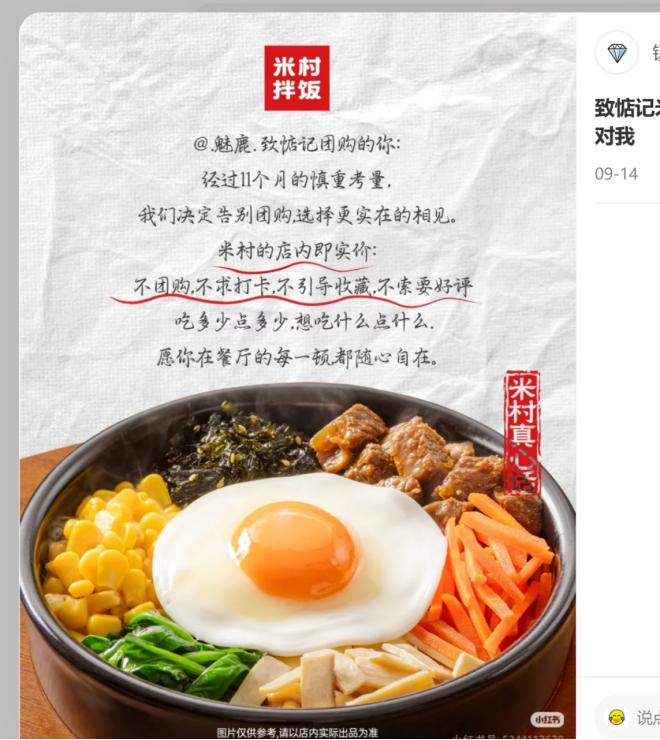
Core Viewpoint - The restaurant industry is undergoing a "de-group-buying" movement, with over 30% of dining establishments actively removing group-buying options, indicating a significant shift away from discount-driven customer acquisition strategies [1][10]. Group 1: Industry Trends - A report from Meituan shows that 23% of restaurants in China have stopped participating in group-buying as of 2023, an increase of 8 percentage points from the previous two years, with a further acceleration expected in 2024 [1]. - Leading brands like Mi Village and Wei Family Liangpi are leading the exit from group-buying, with Mi Village publicly announcing its decision to abandon group-buying after careful consideration [2][10]. Group 2: Brand Strategies - Mi Village has slowed its expansion and implemented a "no assessment" policy, no longer using customer ratings and service speed as key performance indicators [4]. - Wei Family Liangpi has completely ceased its participation in group-buying and external delivery services, focusing solely on dine-in and takeout options [4][6]. Group 3: Small Business Resistance - Independent restaurants and specialty shops are more resolute in rejecting group-buying, emphasizing quality over discounts [8]. - Owners express that discounts and price comparisons detract from the focus on quality, with a common sentiment that they do not want to rely on false discounts for survival [9]. Group 4: Economic Realities - The high cost of raw materials (45.2%), labor (22%), and rising rent are pressuring restaurants, making group-buying discounts unsustainable [10]. - For example, a meal originally priced at 50 yuan sold at a 50% discount results in a loss for the restaurant after platform commissions are deducted [11]. Group 5: Changing Consumer Preferences - Consumer attitudes are shifting from seeking discounts to valuing transparency and quality, with younger generations showing a preference for straightforward pricing [12]. - Reports indicate that consumers are increasingly dissatisfied with the quality of discounted meals, leading them to favor restaurants that offer stable pricing and quality [12]. Group 6: Business Philosophy Shift - Brands are transitioning from a focus on traffic generation to creating long-term value, with Mi Village and Wei Family Liangpi investing in product and service quality rather than relying on group-buying [13][15]. - The experience of "Very Old Sheep Skewers" illustrates that while initial customer traffic may decline after abandoning group-buying, a focus on quality leads to a return of loyal customers [18]. Group 7: Long-term Growth - The initial pain of removing group-buying is often followed by healthier growth patterns, as evidenced by the resurgence of customer interest in dine-in experiences [18]. - The collective move away from group-buying signifies a return to product-driven strategies, emphasizing quality over short-term marketing tactics [20][21].