去瓶颈

Search documents
明年AI主线在哪?大摩:“去瓶颈”主题将取代芯片,看好能源基础设施
Hua Er Jie Jian Wen· 2025-12-02 08:10
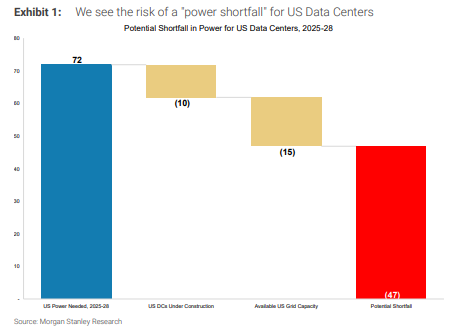
Core Insights - The report from Morgan Stanley indicates a significant shift in market focus from "chips" to "de-bottlenecking" as AI computing demand grows non-linearly, with a projected power shortfall for U.S. data centers reaching 47 GW by 2028, up from a previous estimate of 44 GW [1][2] Group 1: Power Demand and Shortfall - Morgan Stanley has revised its power demand forecast for data centers, indicating a cumulative power shortfall of 47 GW in the U.S. from 2025 to 2028, equivalent to the total electricity consumption of nine Miami areas or fifteen Philadelphia areas [1][2] - The report highlights that even after accounting for various "fast power" solutions, U.S. data centers will still face a power shortfall of 10-20%, approximately 6-16 GW, with the most severe shortfall expected in 2027 [1][4] Group 2: Solutions and Challenges - The report outlines four potential solutions to bypass grid congestion: natural gas turbines, Bloom Energy's fuel cells, site-specific nuclear power, and repurposing Bitcoin mining facilities [4] - Despite these alternatives, analysts remain cautious, believing that the power shortfall cannot be fully mitigated, particularly as chip demand surges and most turbine solutions are not yet operational [4] Group 3: Bitcoin Mining and AI Infrastructure - Bitcoin miners are positioned as a "fast track" to AI infrastructure due to their existing power access permits, which could provide quicker power availability for AI applications [4][5] - Morgan Stanley emphasizes two business models: "New Neocloud" providers like IREN that directly lease GPUs, and "REIT endgame" models like APLD that build and lease facilities to large enterprises, indicating a reevaluation of mining companies' value [5] Group 4: AI Growth and Economic Impact - The exponential growth in AI capabilities is driving increased power demand, with Morgan Stanley defining this trend as "intelligent diffusion" [5] - By 2030, the projected GMV for agentic commerce is expected to reach between $190 billion and $385 billion, representing 10-20% of U.S. e-commerce, with significant user engagement in AI applications like ChatGPT [5][6] - In enterprise AI adoption, 24% of companies reported quantifiable benefits in Q3 2025, up from 15% in Q3 2024, with expectations of AI-driven efficiency gains contributing 30 and 50 basis points to the net profit margins of S&P 500 companies in 2026 and 2027, respectively [6]