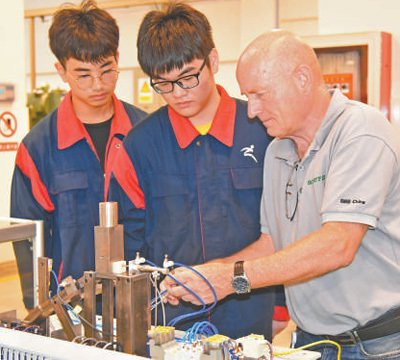
双元制职业教育模式

Search documents
从产教融合看职业教育新前景(大数据观察·点读“十四五”)
Ren Min Wang· 2025-12-22 22:23
Core Viewpoint - The article discusses the innovative educational model in Suzhou, focusing on the integration of vocational education and industry, highlighting the establishment of industry-education integration alliances to cultivate high-level talents in robotics and intelligent manufacturing. Group 1: Industry-Education Integration - The "dual identity" model allows educators to work simultaneously in schools and companies, enhancing their teaching and research capabilities through real-world applications [10][11] - The Wu Zhong Economic and Technological Development Zone has over 1,000 companies in the "robotics + artificial intelligence" sector, accounting for more than 60% of the national service robot output [12] - The establishment of industry-education integration alliances aims to address innovation capacity and talent system issues within the rapidly growing robotics industry [12] Group 2: Talent Development and Curriculum - The curriculum is tailored to meet industry needs, with a "dual mentor system + real projects" approach that includes practical training in actual production environments [13][14] - Students are engaged in hands-on projects, such as designing and manufacturing high-temperature vacuum heating furnaces, which enhances their practical skills and problem-solving abilities [15][16] - The integration of educational resources with industry practices has led to a significant increase in the number of high-quality skilled talents, with 31.51% of graduates becoming technical engineers within three years [16] Group 3: Economic Impact - The collaboration between educational institutions and industries has resulted in improved economic performance, with Taicang City achieving a 4.3% year-on-year growth in industrial output value in 2024 [17] - High-end equipment manufacturing, advanced materials, aerospace, and biomedicine sectors accounted for 77.4% of the industrial output value in Taicang City [17] - The effectiveness of the industry-education integration model is expected to further enhance the prospects of vocational education and industrial development in the region [17]