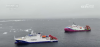
双载人潜水器协同作业模式

Search documents
98天、15000多海里 我国载人潜水器“双子星”成功“打卡”北极
Yang Shi Wang· 2025-10-28 02:06
Core Viewpoint - The successful return of China's first ice-capable manned deep-sea research mother ship "Exploration No. 3" and the manned submersible "Fighter" after completing a deep-sea mission in the Arctic highlights China's advancements in deep-sea exploration technology and its capability to conduct scientific research in extreme environments [1][4]. Group 1 - The Arctic manned deep-sea research team departed from Sanya on July 22 and conducted operations in the Arctic Ocean for 56 days, collecting valuable water, sediment, rock, and biological samples, which will support research on rapid climate changes in the Arctic [4][10]. - The "Fighter" submersible completed 43 dives in the Arctic, collaborating with the "Dragon" submersible for underwater joint operations, marking a new model for dual manned submersible operations in China [5][8]. - The mission included the first manned deep-sea scientific exploration of the Gakkel Ridge in the Arctic, with the "Fighter" spending an average of over 9 hours underwater per dive and over 6 hours on the seabed [6][10]. Group 2 - The mission faced unique challenges in the Arctic, such as navigating through drifting icebergs and adapting to rapid temperature changes during the polar day and night cycles, which significantly affected the sensitivity of the equipment [10]. - The successful completion of this mission positions China as the only country capable of conducting continuous manned deep-sea dives in densely ice-covered areas of the Arctic [8].