反向交易

Search documents
“做多底特律”!美银Hartnett:以史为鉴,接棒黄金的最佳策略
Hua Er Jie Jian Wen· 2026-01-26 08:51
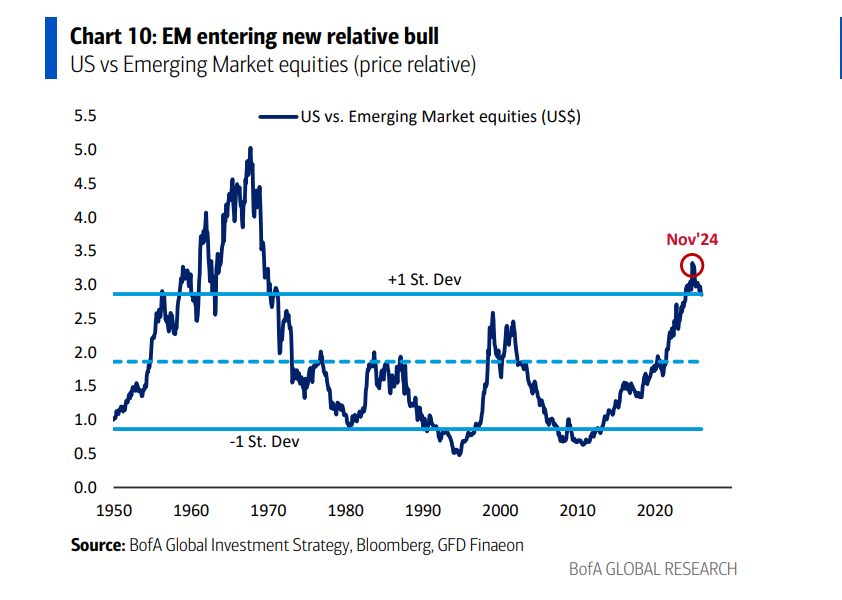
Core Viewpoint - Bank of America signals a tactical sell signal despite the "bull-bear indicator" being in an extremely bullish zone (9.2), suggesting investors should rotate rather than retreat, focusing on small-cap stocks and real economy sectors over large-cap and tech stocks [1][14]. Group 1: Market Trends - The current market sentiment indicates that while the selection of the new Federal Reserve Chair typically leads to yield fluctuations, it is believed that the new chair in 2026 will not allow the 30-year Treasury yield to exceed the 5% "safe haven" level due to interventions like quantitative easing (QE) and yield curve control (YCC) [2]. - The bond market is experiencing a severe bear market, with the price of 30-year U.S. Treasuries dropping by 50% and Japanese government bonds (JGB) falling by 45% since the beginning of the 2020s [3]. Group 2: Fund Flows - Despite rising yields, the bond market recorded an inflow of $15.4 billion, while gold saw inflows of $4.9 billion. Conversely, U.S. equities experienced an outflow of $16.8 billion, marking the first outflow in two weeks [4]. - The bear market in bonds has led to a bull market for U.S. tech stocks, European/Japanese bank stocks, and gold in the first half of the decade, while emerging markets (EM) and small-cap stocks are expected to benefit in the latter half [4]. Group 3: Investment Strategy - The core strategy of "buying Detroit and shorting Davos" emphasizes a bullish outlook on U.S. small-cap stocks until 2027, supported by four pillars: global macro trends, extreme capital outflows from Japan, undervaluation of small-cap stocks, and government interventions to control costs [10][11]. - Historical comparisons suggest that the current situation resembles the 1970s, where initially gold thrived, followed by small-cap stocks becoming the best-performing assets [7]. Group 4: Emerging Markets and Capital Flows - Capital is flowing from weak Asian currencies to U.S. and European assets, with South Korean retail investors having invested nearly $100 billion in U.S. stocks since 2019 [16]. - The long-term bull market for international stocks is entering its second year, driven by strong commodity prices and a strengthening of emerging market currencies, which is expected to lower emerging market bond yields and propel emerging market stocks into a new relative bull market [16].