反美情绪

Search documents
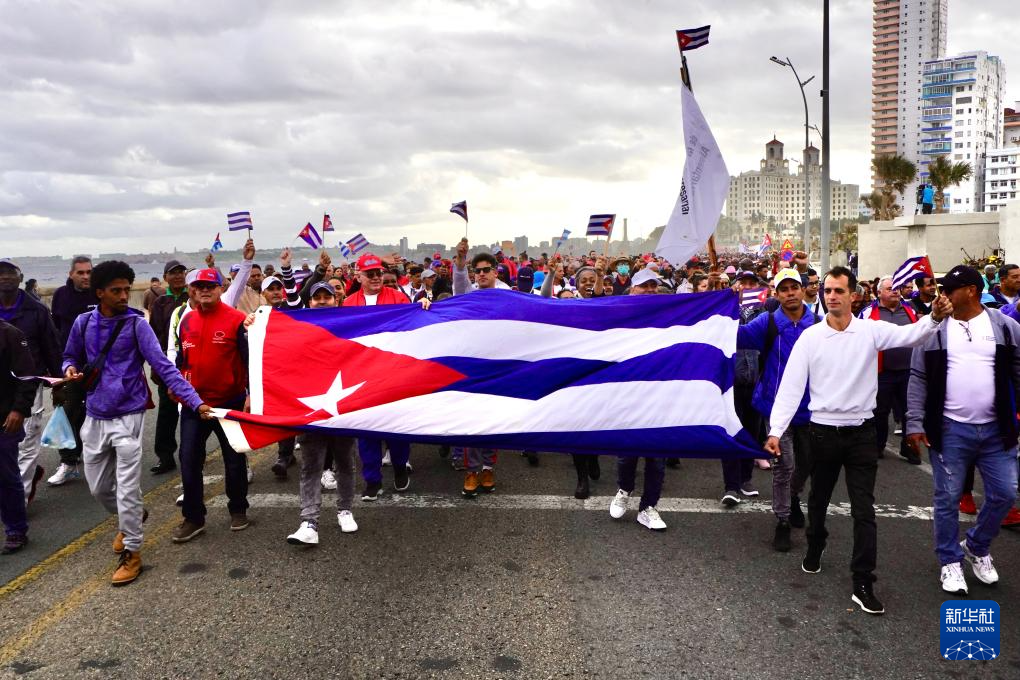
特写|“记住‘猪湾事件’!”——数十万古巴民众游行表达捍卫祖国决心
Xin Lang Cai Jing· 2026-01-17 11:30
Core Viewpoint - The article highlights a large-scale demonstration in Havana, Cuba, where hundreds of thousands of citizens gathered to express their determination to defend their country against perceived U.S. aggression, particularly in relation to the recent attack on Venezuela [1][4]. Group 1: Demonstration Details - On January 16, a significant gathering took place in Havana, with approximately 500,000 participants marching to condemn U.S. actions and honor the Cuban personnel who lost their lives in the recent conflict [4]. - Cuban President Miguel Díaz-Canel addressed the crowd, emphasizing the sacrifices made by 32 Cuban individuals during the U.S. military attack on Venezuela [1][4]. - The demonstration featured a mix of older and younger generations, showcasing a united front against U.S. imperialism, with slogans such as "Down with imperialism" and "Long live free Cuba" being chanted [4][5]. Group 2: Political Statements - Díaz-Canel criticized the U.S. government for disregarding international law and opening the door to violence and destruction, asserting that Cuba remains open to dialogue based on equality and mutual respect, but will resist any form of aggression [2][3]. - The President declared that the Cuban people are prepared to fight back if attacked, reinforcing a message of resilience and unity among the population [4][5]. - The event served as a reminder of historical events, specifically the Bay of Pigs invasion, with participants calling for remembrance of past struggles against U.S. intervention [5].

委内瑞拉内政部长:委内瑞拉决不投降,争取马杜罗回归
Xin Lang Cai Jing· 2026-01-08 02:28
Core Viewpoint - The Venezuelan Interior Minister Caraballo condemned the U.S. military actions against Venezuela, which resulted in 100 deaths and injuries to President Maduro and First Lady Flores [1] Group 1: U.S. Military Actions - The U.S. military actions have led to the destruction of medical and research centers in Venezuela [1] - The actions are characterized as an invasion based on false pretenses, with the U.S. retracting previous accusations against the "Sun Group" [1] Group 2: Venezuelan Response - Venezuela's government vows not to surrender and stands united with its people to promote national development [1] - The strong anti-American sentiment is noted to be rising globally as a result of these actions [1]
美国彭博社刊文:世界开始讨厌美国品牌了吗?
Huan Qiu Shi Bao· 2025-09-18 22:34
Core Insights - The article discusses the declining global interest in American brands due to rising anti-American sentiment and changing consumer preferences [1][2][3] Group 1: Consumer Sentiment - A significant portion of consumers outside the U.S. are distancing themselves from American products, with 37% of respondents in a survey indicating they will stop purchasing U.S. goods due to tariff issues, rising to 57% in Canada [2] - The anti-American sentiment is not just a temporary boycott but may indicate a long-term structural shift in consumer behavior, with European consumers increasingly preferring non-American products for emotional reasons rather than price [2] Group 2: Brand Perception - American brands are losing their appeal globally, as evidenced by the stagnation of the U.S. in the Global Soft Power Index, while China has risen to second place, surpassing the UK for the first time [2] - Companies like Levi's have noted a rise in anti-American sentiment in markets like the UK, which could impact sales [1] Group 3: Corporate Strategy - To navigate the changing landscape, American companies may need to adopt a more localized approach, presenting themselves as multinational rather than distinctly American [3] - Walmart has successfully implemented this strategy by focusing on local market needs and avoiding direct association with U.S. government policies, leading to growth in markets like Canada and Mexico [3][4] Group 4: Lessons Learned - Walmart's past failure in Germany due to cultural misalignment has led to a more cautious and collaborative approach in international expansion, emphasizing the importance of understanding local norms [4] - As American brands face credibility challenges, companies will increasingly need to build their reputation independently of U.S. branding [4]

特朗普“神助攻” 加拿大自由党“逆袭”
Xin Hua She· 2025-04-29 11:52
Core Viewpoint - The victory of the Liberal Party in Canada, led by Prime Minister Mark Carney, is attributed to a dramatic turnaround influenced by external factors, particularly the trade war initiated by U.S. President Trump, which shifted public focus from domestic issues to national sovereignty concerns [3][4][6]. Group 1: Election Results and Factors - The Liberal Party's win is described as a "dramatic turnaround," with significant support coming from voters who preferred any party over the Conservative Party [4]. - Key factors for the Liberal Party's success include the perception that "anyone but the Conservatives" was a viable option, the impact of Trump's tariffs, and the political climate surrounding former Prime Minister Trudeau's leadership [4][6]. - In early polls, the Liberal Party was trailing the Conservative Party by 20 percentage points, indicating a significant shift in voter sentiment leading up to the election [6]. Group 2: Public Sentiment and Trump's Influence - The Canadian public's attention shifted from the Liberal Party's governance to the need to respond to perceived threats from the Trump administration, with many believing that the Liberal Party was better positioned to handle these challenges [6]. - Trump's comments about Canada potentially becoming the "51st state" resonated with voters, making foreign policy a central issue in the election for the first time since 1988 [8][10]. - A notable rise in anti-American sentiment was observed, with Canadians actively resisting Trump's provocations, as evidenced by public demonstrations and the adoption of slogans like "We resist 51st" [10].