发挥政策集成效应

Search documents
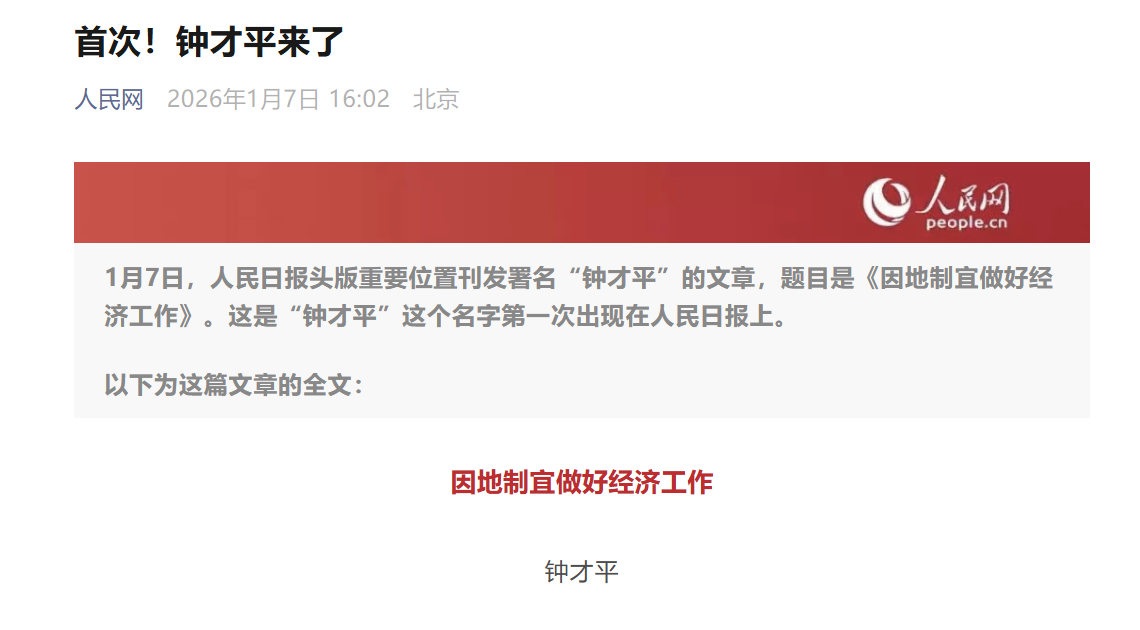
“钟才平”首次亮相人民日报,连发重磅文章有何深意
2 1 Shi Ji Jing Ji Bao Dao· 2026-01-12 14:01
Core Viewpoint - The series of articles by "Zhong Caiping" published in the People's Daily starting January 7 serves as a significant indicator of the government's economic strategy for 2026, emphasizing practical guidance for economic work and addressing key areas of focus [1][4]. Group 1: Articles Overview - The "Zhong Caiping" series consists of six articles covering themes such as tailored economic work, development towards new and superior standards, enhancing macroeconomic governance, promoting consumption and investment, improving livelihoods, and expanding openness [5]. - The articles aim to clarify the central government's strategic framework for the upcoming period, particularly in light of the recent Central Economic Work Conference's focus on 2026's key tasks [5][6]. Group 2: Economic Policy Insights - The article titled "Enhancing Policy Integration Effects" highlights a new emphasis on stabilizing economic growth and reasonable price recovery as key considerations for monetary policy, reflecting a shift in approach [8]. - The 2026 monetary policy is expected to maintain a moderately loose stance, focusing on high-quality economic development and reasonable price recovery, with a combination of total and structural policy tools to support demand and stabilize market expectations [9]. Group 3: Investment and Consumption Dynamics - The article "Coordinating Consumption and Investment" argues that investment and consumption are not mutually exclusive but rather mutually reinforcing, essential for achieving a growth target of around 5% in 2026 [10]. - Recent measures include the early release of a project list and central budget investment plan totaling 295 billion yuan, aimed at stabilizing investment and ensuring continuity in project execution [11]. Group 4: Real Estate Sector Outlook - The article "Promoting High-Quality Development in Real Estate" indicates that there remains significant potential in the real estate sector, with unmet housing demand among urban residents, suggesting a continued role as a pillar industry [12]. - The focus on improving livelihoods through real estate development is expected to stimulate substantial investment, with initiatives like affordable housing and urban infrastructure projects projected to generate nearly 2 trillion yuan in annual investment [12].

连续五日,人民日报刊发钟才平文章
财联社· 2026-01-11 01:38
Core Viewpoint - The article emphasizes the importance of prioritizing people's livelihoods to drive economic development, advocating for a strategy that combines consumer demand with investment in both goods and services to create new growth opportunities [9][10]. Group 1: Economic Development and Livelihood Improvement - The article highlights that improving people's livelihoods is a crucial driver for economic development, with a strong domestic market being essential for a new development pattern [9][10]. - It points out that as economic and social development progresses, the demand for better living conditions, including housing, education, healthcare, and leisure, is increasing, which in turn drives consumption and supply [10][11]. - The need for a new model of real estate development is emphasized, focusing on high-quality urban renewal and increasing the supply of better housing to meet the public's expectations [11][12]. Group 2: Consumer Demand and Investment - The article discusses the shift in consumer preferences towards service-oriented and quality-driven consumption, with significant growth in service consumption per capita from 5,000 yuan to 13,000 yuan between 2013 and 2024, increasing its share from 39.7% to 46.1% [11][12]. - It stresses the importance of aligning new supply with new demand, utilizing creativity and technology to enhance product and service offerings, thereby meeting diverse consumer needs [12][13]. - The article advocates for a virtuous cycle of employment, income, consumption, and investment, emphasizing the need for policies that support job stability and income growth to enhance consumer spending [13][14]. Group 3: Policy Support and Economic Governance - The article outlines the necessity of a coordinated approach to macroeconomic policies, integrating fiscal and monetary measures to enhance economic governance and stability [19][20]. - It calls for a more proactive fiscal policy, with increased government spending and support for local governments to address financial challenges while ensuring sustainable fiscal practices [20][21]. - The article emphasizes the importance of flexible monetary policy to maintain liquidity and support economic recovery, highlighting the need for targeted structural monetary tools to address specific economic challenges [22][23]. Group 4: Innovation and Structural Adjustment - The article notes that China's economic resilience is demonstrated through ongoing structural adjustments and innovation, with significant growth in high-tech manufacturing and equipment sectors [29][30]. - It highlights the importance of fostering an environment conducive to innovation, particularly in response to external pressures, with a focus on self-sufficiency in key technologies [29][30]. - The article discusses the ongoing reforms aimed at enhancing the business environment and promoting high-quality development, including the implementation of laws to support the private economy and streamline market access [30][31].