
古丝绸之路

Search documents
“汉代织锦”在加拿大舞台讲述千年丝路故事
Xin Lang Cai Jing· 2026-01-11 08:59
Core Viewpoint - The Chinese dance drama "Oriental Legend" has been performed in Canada, showcasing the story of a Han Dynasty brocade armguard and the ancient Silk Road, enhancing cultural understanding between China and Canada [1] Group 1 - The performance features a narrative that connects a historical artifact from Xinjiang with the broader context of the Silk Road [1] - The dance drama serves as a medium for cultural exchange, allowing Canadian audiences to engage with Chinese history and aesthetics [1] - The choreography brings history to life, emphasizing the significance of the Han Dynasty and its cultural heritage [1]
乌兹别克斯坦蓝
Ren Min Ri Bao· 2025-11-06 22:11
Group 1 - The article highlights the cultural significance of the color blue in Uzbekistan, particularly in its architecture and historical context, symbolizing the glory of the Timurid era [1][4] - Samarkand, known as the "Blue Porcelain City," features stunning medieval architecture, including the Registan Square, which showcases a blend of Islamic, Greek, and Persian styles [1][2] - The Shah-i-Zinda necropolis in Samarkand, built in the 14th and 15th centuries, is noted for its intricate blue tile work, reflecting a variety of shades and colors that change with the light [1][2] Group 2 - Uzbekistan is one of the world's two double landlocked countries, with a historical connection to the sea through the ancient Silk Road, which facilitated trade and cultural exchange [2] - Samarkand has a rich history of over 2500 years, serving as a crucial point on the Silk Road, where various cultures and goods converged [2] - The Silk Road Samarkand Tourism Center, established in 2022, is the largest tourism and commercial center in Central Asia, covering over 260 hectares and blending traditional culture with modernity [2]
航拍宁夏海原没烟峡:千年古道映朝霞
Zhong Guo Xin Wen Wang· 2025-10-31 05:36
Core Viewpoint - The article highlights the stunning natural beauty of the Meiyan Gorge in Ningxia, showcasing its historical significance as part of the ancient Silk Road [1]. Group 1: Natural Landscape - Meiyan Gorge is located in Zhengqi Township, Haiyuan County, Ningxia, and features breathtaking scenery during autumn mornings [1]. - The gorge stretches approximately 15 kilometers in length and varies in width from 1 to 3 kilometers [1]. Group 2: Historical Significance - Meiyan Gorge serves as an important passage on the ancient Silk Road, carrying a rich historical legacy [1].
纪录片|寻印上合
Xin Hua She· 2025-08-25 12:02
Core Viewpoint - The article emphasizes the historical significance of the Silk Road and its modern counterpart, highlighting the collaborative development among Shanghai Cooperation Organization (SCO) countries in building a prosperous future together [2] Group 1: Historical Context - The Gansu Bamboo Slip Museum showcases historical artifacts that narrate the development and prosperity brought by the ancient Silk Road [2] - The transition from traditional means of communication, such as wooden slips, to modern logistics and electronic records illustrates the evolution of trade and cooperation [2] Group 2: Current Developments - SCO member states are set to gather in Tianjin, China, to discuss the vision of a "common home," aiming for mutual prosperity and happiness for their peoples [2] - The article reflects on the shared destiny and collaborative efforts of SCO countries in the "New Era Silk Road" [2]


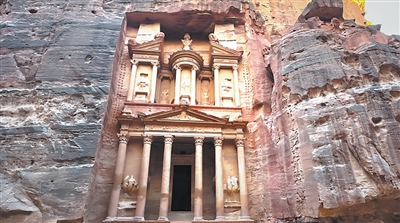
“玫瑰城”佩特拉(旅人心语)
Ren Min Ri Bao· 2025-07-17 22:02
Core Insights - The article highlights the historical significance and architectural marvel of Petra, particularly the Al-Khazneh temple, which showcases the ingenuity of the Nabataeans in overcoming environmental challenges to create a thriving city in the desert [1][2]. Group 1: Historical Context - The Nabataeans settled in Petra around the 3rd century BC, transforming it into a prosperous city known as the "Rose City" [1]. - At its peak, Petra had a population of 20,000 to 30,000, with significant cultural and commercial interactions among ancient civilizations including Egyptians, Assyrians, Jews, Greeks, and Romans [1]. - The city thrived due to its strategic location along the ancient Silk Road, facilitating trade in luxury goods like frankincense and myrrh [1]. Group 2: Architectural Achievements - Petra features over 500 sandstone-carved structures, blending Greek, Roman, and Egyptian architectural styles with Nabataean creativity [2]. - The Nabataeans developed advanced water management systems, including a network of ceramic pipes to transport water from 8 kilometers away, allowing them to build five dams to protect the city from floods [2][3]. - The construction techniques employed by the Nabataeans included innovative methods for carving high cliffs, utilizing natural platforms created from debris to facilitate the sculpting of the temple facades [3]. Group 3: Rediscovery and Modern Significance - After a devastating earthquake in 363 AD, Petra was largely forgotten until its rediscovery by Swiss explorer Johann Burckhardt in 1812 [5]. - Petra was designated a UNESCO World Heritage Site in 1985, attracting hundreds of thousands of tourists annually who come to experience its historical and cultural richness [5].
综述|地方人文交流促进中国-中亚民心相通
Xin Hua Wang· 2025-06-24 01:12
Group 1 - The core viewpoint of the articles emphasizes the importance of local cultural exchanges in promoting mutual understanding between China and Central Asian countries [1][2][3] - The forum held in Astana highlighted the active participation of government officials, think tank scholars, and media representatives in enhancing cultural cooperation [1] - Academic research is deemed foundational for the relationship between Central Asian countries and China, with key areas of focus including politics, energy, security, and social issues [1] Group 2 - Various initiatives have been launched by media, think tanks, and universities to foster cultural exchanges, such as workshops and field research involving foreign experts and youth [2] - The historical significance of cities along the ancient Silk Road, like Xi'an and Almaty, presents vast opportunities for collaboration in archaeology, exhibitions, and cultural heritage interpretation [2] - Recent cultural exchange activities in Astana, such as the "Long Night of Chang'an" and "Bronze and Gold: Dialogue of Civilizations," showcased the rich cultural heritage and the power of civilization integration [2]