古建筑文化

Search documents
京西禅影映“马鞍”
Bei Jing Wan Bao· 2026-02-10 06:55
Core Viewpoint - The article highlights the historical and cultural significance of Mount Mǎ'ān and its central feature, the Jiètái Temple, which is renowned for its Buddhist戒坛, making it a significant site in Chinese Buddhism [9][10]. Group 1: Historical Significance - Mount Mǎ'ān, located at the intersection of several districts, is primarily composed of limestone and dolomite formed over 400 million years ago during the Ordovician period [1]. - Jiètái Temple, also known as the "Temple of the First Altar," has a history dating back over 1,400 years, with its戒坛 being the largest in the country [9][10]. - The temple has been a center for Buddhist teachings and has received imperial patronage throughout history, with emperors frequently visiting and contributing to its maintenance [10]. Group 2: Economic Contributions - The area around Mount Mǎ'ān has historically been a source of high-quality limestone and coal, contributing to the construction industry in Beijing since the Yuan Dynasty [7][8]. - The village of Dàhuīchǎng, located at the mountain's southeastern foot, was known for its limestone production, which was essential for building materials in the region [7]. Group 3: Environmental Concerns - Long-term mining activities have caused damage to the mountain and posed risks to Jiètái Temple, leading to multiple historical prohibitions against mining in the area [8]. - Several protective monuments have been erected to safeguard the temple from mining activities, indicating ongoing concerns about environmental preservation [8]. Group 4: Architectural Features - Jiètái Temple features a unique architectural layout, facing east, which is uncommon among most temples that typically face south [10]. - The temple complex includes significant structures such as the 千佛阁, which houses 1,680 Buddha statues, and other notable features like the "顺风旗" and "晴雨表" [11]. Group 5: Cultural Heritage - The temple is home to a collection of ancient burial towers for high monks, reflecting its importance as a spiritual center [13]. - The surrounding area includes a network of natural caves that have been transformed into stone grottoes, further enhancing the cultural and historical landscape of the region [12].


了不起的古建筑丨郏县文庙:小城有大成
He Nan Ri Bao· 2025-08-12 23:58
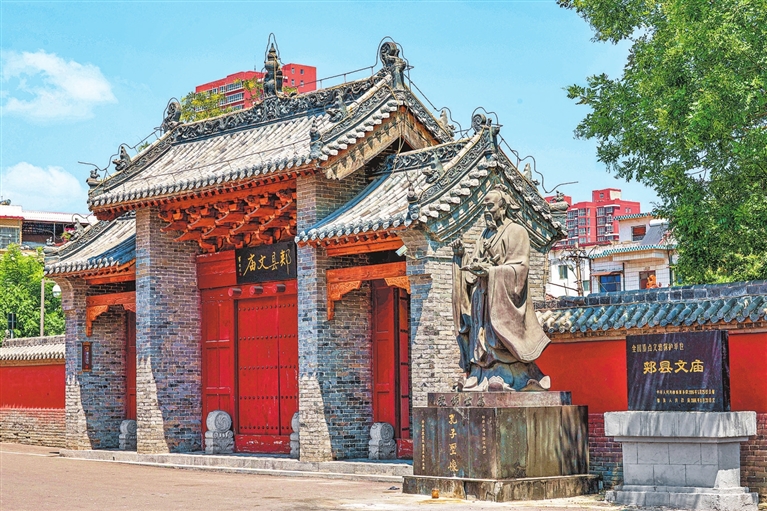
Core Viewpoint - The article highlights the significance of the Jiajian Confucian Temple in Jiajian County as a cultural and educational landmark, showcasing its historical importance and architectural uniqueness, particularly during the summer vacation period when students visit for inspiration and learning [2][22]. Group 1: Historical and Cultural Significance - The Jiajian Confucian Temple, also known as the Confucius Temple, is a vital part of China's ancient cultural heritage, embodying Confucian ideals and serving as a place for education and worship [6][23]. - The temple is one of nearly a thousand Confucian temples remaining across the country, with several in Henan Province designated as key cultural heritage sites [2][6]. - The temple's history includes its establishment in 1206 and multiple renovations throughout the Ming and Qing dynasties, with the current structures primarily dating back to the Qing period [21][24]. Group 2: Architectural Features - The layout of the Jiajian Confucian Temple follows a traditional design with a central axis and symmetrical wings, featuring significant structures such as the main hall (Dacheng Hall) and various memorials [8][9]. - Dacheng Hall, the temple's main building, is notable for its exquisite wood and stone carvings, including a rare "Two Dragons Playing with a Spider" stone sculpture [12][13][15]. - The temple's architectural style reflects local characteristics while adhering to national standards for Confucian temples, making it a unique example of cultural and architectural synthesis [14][18]. Group 3: Educational and Cultural Activities - The temple serves as a center for traditional cultural education, hosting activities such as public classes on Confucian classics and annual ceremonies that attract large crowds [22]. - The integration of local music and dance into traditional rituals has created a distinctive cultural experience, enhancing the temple's role as a tourist attraction [22]. - The surrounding area maintains historical street patterns, contributing to the temple's status as a key cultural landmark in Jiajian County [22].